Confessions Of A Cannibal
pp. 19-22 · Read in the full issue

Fiji's Oldest Inhabitant Is Wistfully Reminiscent
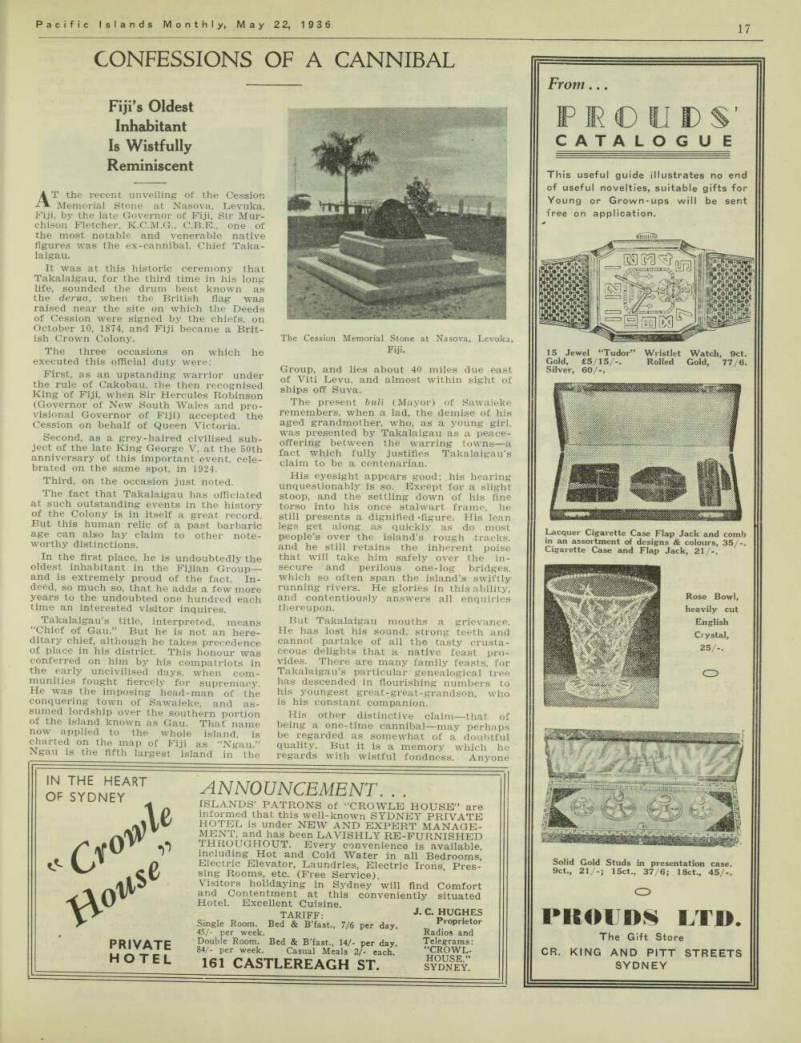
AT the recent unveiling of the Cession Memorial Stone at Nasova, Levuka, Fiji, by the late Governor of Fiji, Sir Mur chison Fletcher, K.C.M.G., C.8.E., one of the most notable and venerable native figures was the ex-cannibal, Chief Taka laigau.
It was at this historic ceremony that Takalaigau, for the third time in his long life, sounded the drum beat known as the derua, when the British flag was raised near the site on which the Deeds of Cession were signed by the chiefs, on October 10, 1874, and Fiji became a Brit ish Crown Colony.
The three occasions on which he executed this official duty were: First, as an upstanding warrior under the rule of Cakobau, the then recognised King of Fiji, when Sir Hercules Robinson (Governor of New South Wales and pro visional Governor of Fiji) accepted the Cession on behalf of Queen Victoria.
Second, as a grey-haired civilised sub ject of the late King George V, at the 50th anniversary of this important event, cele brated on the same spot, in 1924.
Third, on the occasion just noted.
The fact that Takalaigau has officiated at such outstanding events in the history of the Colony is in itself a great record.
But this human relic of a past barbaric age can also lay claim to other note worthy distinctions.
In the first place, he is undoubtedly the oldest inhabitant in the Fijian Group— and is extremely proud of the fact. In deed, so much so, that he adds a few more years to the undoubted one hundred each time an interested visitor inquires.
Takalaigau’s title, interpreted, means “Chief of Gau.” But he is not an here ditary chief, although he takes precedence of place in his district. This honour was conferred on him by his compatriots in the early uncivilised days, when com munities fought fiercely for supremacy.
He was the imposing head-man of the conquering town of Sawaieke, and as sumed lordship over the southern portion of the island known as Gau. That' name now applied to the whole island, is charted on the map of Fiji as “Ngau.”
Ngau is the fifth largest island in the
Group, and lies about 40 miles due east of Viti Leva, and almost within sight of ships off Suva.
The present buli (Mayor) of Sawaieke remembers, when a lad, the demise of his aged grandmother, who, as a young girl, was presented by Takalaigau as a peace offering between the warring towns —a fact which fully justifies Takalaigau’s claim to be a centenarian.
His eyesight appears good; his hearing unquestionably is so. Except for a slight stoop, and the settling down of his fine torso into his once stalwart frame, he still presents a dignified -figure. His lean legs get along as quickly as do most people’s over the island’s rough .tracks, and he still retains the inherent poise that will take him safely over the in secure and perilous one-log bridges, which so often span the island’s swiftly running rivers. He glories in this ability, and contentiously answers all enquiries thereupon.
But Takalaigau mouths a grievance.
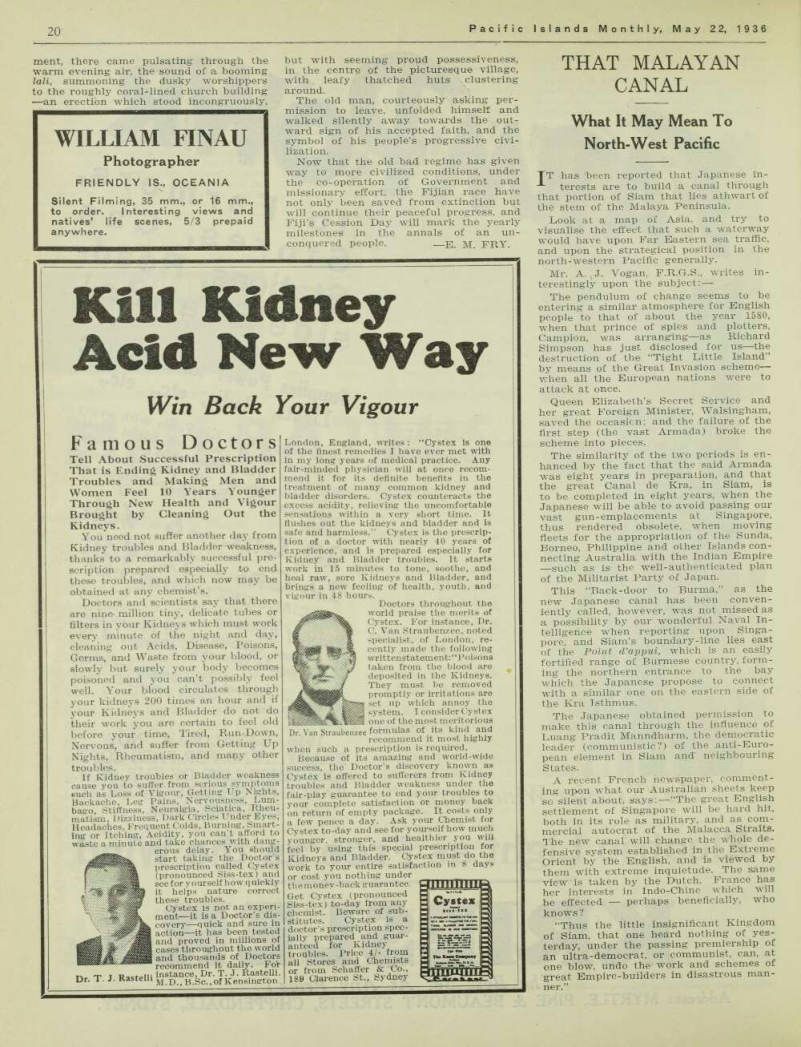
He has lost his sound, strong teeth and cannot partake of all the tasty crusta ceous delights that a native feast pro vides. There are many family feasts, for Takalaigau’s particular genealogical tree has descended in flourishing numbers to his youngest great-great-grandson, who is his constant companion.
His other distinctive claim—that of being a one-time cannibal—may perhaps be regarded as somewhat of a doubtful quality. But it is a memory which he regards with wistful fondness. Anyone
The Cession Memorial Stone at Nasova, Levuka, Fiji.
who understands the Fijian language can spend many hours listening to his tales of olden times; and, as a talk has an irresistible attraction for a Fijian, he readily complied with a request for the story of his youth.
“I was born in the native town of Sawaieke where I now live,” he began, tucking his legs crosswise underneath him. “When a child about so high,” in dicating the height of a child about seven years of age, “I was taken by my parents to Bau Island. Here I grew up, and re mained for forty years, fighting under Cakobau in the many tribal wars. Those were good times,” he sighed. “We took many prisoners.”
When asked what was done with the prisoners, his answer came startingly: “We killed and ate them. Much good
food we had then for our feasts.” And. warming to this gruesome subject, he said, leaning eagerly forward and peering up weirdly out of his excited, faded eyes.
“I will tell you about it.
“Prisoners of war,” he emphasised, “were food for the big chiefs only. This food was tahu to commoners, on pain of death. But Cakobau would sometimes delight to honour the lesser chiefs and the bravest of warriors. I have eaten from the hands and feet.” he whisper ingly confided.
“When food was needed for a great celebration, one or more prisoners, bound hand and foot, were lifted bodily and killed by striking their heads forcibly on large stones, previously placed in posi tion for that purpose. These stones were then added to the long line of the town’s boundary fence. One stone, one life.” added the old cannibal, sententiously.
“The bodies, when cooked and taken from the lovu (pit oven), were decorated with evergreens and presented with much ceremonial procedure to Cakobau.
“Man’s flesh is good, very good.” he continued, appreciatively. “It is drega dregata (glutinous) and good eating.”
Asked whether, if there were no Govern ment or mission to stop them, they would
eat human flesh again, the ancient gentle man made answer: “I do not know, but I think so. Even now there are Teal-colas (bushmen) of whom we hear strange things. Civilisa tion is good for the younger generation.
They have been taught that it is wrong to kill men for food.
“When first I went to Bau Island we wore no such clothes as these,” he said, pulling at his white shirt a,nd sulu (loin cloth). Our only covering was a girdle of shredded banana leaves.
“We were very happy then. Fighting was our play. Our gods were the dead and once mighty chiefs, whom we dread ed in death as in life.
“Then the missionaries came. It was a long time after their coming that Cakobau came to believe in the white man’s God. To know the love of God in Heaven is a good thing for the Fijians to-day,” added the old man.
As if in response to that last state
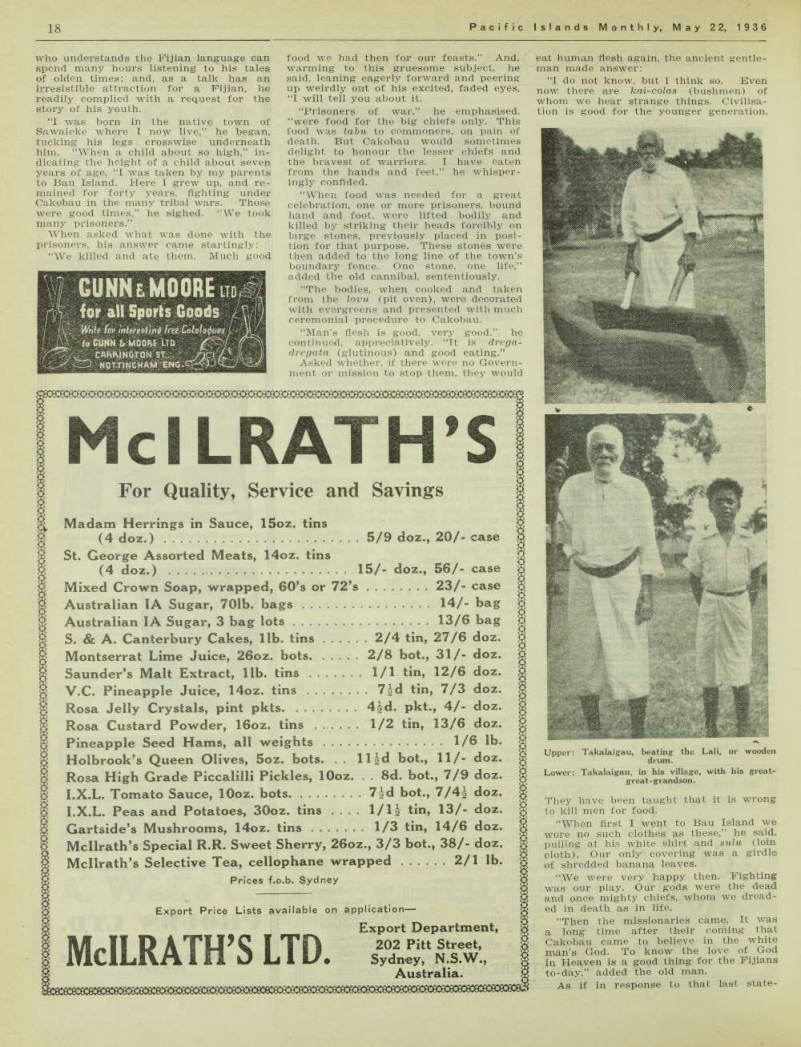
Upper: Takalaigau, beating the Lali, or wooden drum.
Lower: Takalaigau, in his village, with his great great-grandson.
ment, there came pulsating through the warm evening air, the sound of a booming lali, summoning the dusky worshippers to the roughly coral-lined church building —an erection which stood incongruously.
but with seeming proud possessiveness, in the centre of the picturesque village, with leafy thatched huts clustering around.
The old man, courteously asking per mission to leave, unfolded himself and walked silently away towards the out ward sign of his accepted faith, and the symbol of his people’s progressive civi lization.
Now that the old bad regime has given way to more civilized conditions, under the co-operation of Government and missionary effort, the Fijian race have not only been saved from extinction but will continue their peaceful progress, and Fiji’s Cession Day will mark the yearly milestones in the annals of an un
conquered people.