Housekeeping in the Tropics
p. 65 · Read in the full issue
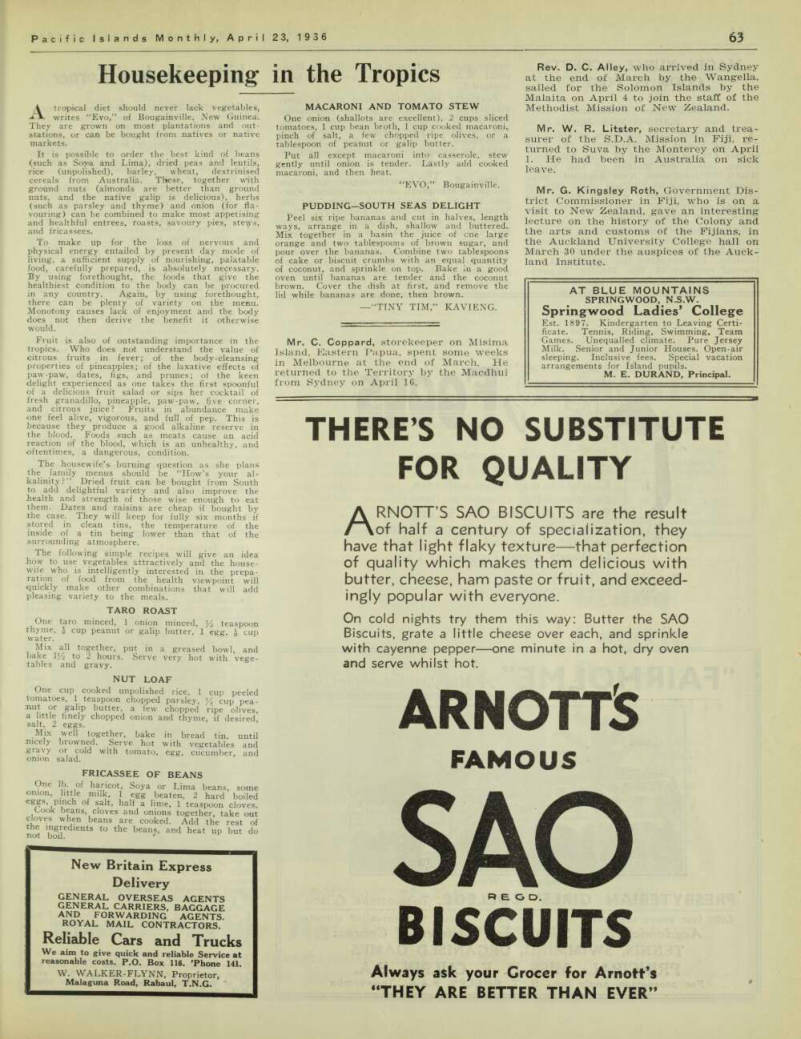
\ tropical diet should never lack vegetables, -kJk writes “Evo,” of Bougainville, New Guinea.
They are grown on most plantations and out stations, or can be bought from natives or native markets.
It is possible to order the best kind of beans (such as Soya and Lima), dried peas and lentils, rice (unpolished), barley, wheat, dextrinised cereals from Australia. These, together with ground nuts (almonds are better than ground nuts, and the native galip is delicious), herbs (such as parsley and thyme) and onion (for fla vouring) can be combined to make most appetising and healthful entrees, roasts, savoury pies, ste\vs, and fricassees.
To make up for the loss of nervous and physical energy entailed by present day mode of living, a sufficient supply of nourishing, palatable food, carefully prepared, is absolutely necessary.
By using forethought, the foods that give the healthiest condition to the body can be procured in any country. Again, by using forethought, there can be plenty of variety on the menu.
Monotony causes lack of enjoyment and the body does not then derive the benefit it otherwise would.
Fruit is also of outstanding importance in the tropics. Who does not understand the value of citrous fruits in fever; of the body-cleansing properties of pineapples; of the laxative effects of paw-paw, dates, figs, and prunes; of the keen delight experienced as one takes the first spoonful of a delicious fruit salad or sips her cocktail of fresh granadillo, pineapple, paw-paw, five corner, and citrous juice? Fruits in abundance make one feel alive, vigorous, and full of pep. This is because they produce a good alkaline reserve in the blood. Foods such as meats cause an acid reaction of the blood, which is an unhealthy, and oftentimes, a dangerous, condition.
The housewife’s burning question as she plans the family menus should be “How’s your al kalinity?” Dried fruit can be bought from South to add delightful variety and also improve the health and strength of those wise enough to eat them. Dates and raisins are cheap if bought by the case. They will keep for fully six months if stored in clean tins, the temperature of the inside of a tin being lower than that of the surrounding atmosphere.
The following simple recipes will give an idea how to use vegetables attractively and the house wife who is intelligently interested in the prepa ration of food from the health viewpoint will quickly make other combinations that will add pleasing variety to the meals.
Taro Roast
One taro minced, 1 onion minced, y 2 teaspoon thyme, \ cup peanut or galip butter, 1 egg, J cup water.
Mix all together, put in a greased bowl, and bake 11/2l l / 2 to 2 hours. Serve very hot with vege tables and gravy.
Nut Loaf
One cup cooked unpolished rice, 1 cup peeled tomatoes, 1 teaspoon chopped parsley, y 2 cup pea 31u* ® r J? a l'P butter, a few chopped ripe olives, a little finely chopped onion and thyme, if desired salt, 2 eggs.
Mix well together, bake in bread tin, until uicely browned. Serve hot with vegetables and gravy or cold with tomato, egg, cucumber, and onion salad.
Fricassee Of Beans
One lb, of haricot, Soya or Lima beans, some onion, little milk, 1 egg beaten, 2 hard boiled •eggs, pinch of salt, half a lime, 1 teaspoon cloves.
Look beans, cloves and onions together, take out cloves when beans are cooked. Add the rest of the ingredients to the beans, and heat up but do not boil. * v
Macaroni And Tomato Stew
One onion (shallots are excellent), 2 cups sliced tomatoes, 1 cup bean broth, 1 cup cooked macaroni, pinch of salt, a few chopped ripe olives, or a tablespoon of peanut or galip butter.
Put all except macaroni into casserole, stew gently until onion is tender. Lastly add cooked macaroni, and then heat.
“EVO,” Bougainville,
Pudding—South Seas Delight
Peel six ripe bananas and cut in halves, length ways, arrange in a dish, shallow and buttered.
Mix together in a basin the juice of cne large orange and two tablespoons of brown sugar, and pour over the bananas. Combine two tablespoons of cake or biscuit crumbs with an equal quantity of coconut, and sprinkle on top. Bake in a good oven until bananas are tender and the coconut brown. Cover the dish at first, and remove the lid while bananas are done, then brown.
"Tiny Tim.” Kavieng.
Mr. C. Coppard, storekeeper on Misima Island, Eastern Papua, spent some weeks in Melbourne at the end of March. He returned to the Territory by the Macdhui from Sydney on April 16.
Rev. D. C. Alley, who arrived in Sydney at the end of March by the Wangella, sailed for the Solomon Islands by the Malaita on April 4 to join the staff of the Methodist Mission of New Zealand.
Mr. W. R. Litster, secretary and trea surer of the S.D.A. Mission in Fiji, re turned to Suva by the Monterey on April 1. He had been in Australia on sick leave.
Mr. G. Kingsley Roth, Government Dis trict Commissioner in Fiji, who is on a visit to New Zealand, gave an interesting lecture on the history of the Colony and the arts and customs of the Fijians, in the Auckland University College hall on March 30 under the auspices of the Auck land Institute.