Brown and Joske
pp. 20-21 · Read in the full issue
How Old Firm is Linked with Early History of Fiji
THE purchase by Messrs. W. R. Carpen ter and Co. Ltd., of a controlling interest in Messrs. Brown and Joske Limited, of Suva, is an important event, because the history of Messrs. Brown and Joske Ltd. is closely bound up with the early history of the Crown Colony of Fiji.
It is, in fact, connected with that famous incident wherein the United States Gov ernment demanded from King Thakam bau of Fiji a payment of £9,000 as com pensation for damage to the property of nationals.
The King was so hard pressed in con nection with this debt that when two re presentatives of a Melbourne syndicate, Messrs. W. H. Brewer and J. L. Evans, arrived in Fiji in 1868 to purchase land whereon to grow cotton, he thought he saw a way out of his difficulties. He sold outright for £9,000 some 200,000 acres of land on Viti Levu, to the two gentlemen named. The deal was completed on May
23, 1868, aboard the steamship Albion.
This sale was bitterly contested by the British official authorities; but it formed the basis on which was formed the famous Polynesian Co. Limited, of Mel bourne. This company raised a large sum of money and made an attempt to grow cotton; but it got into trouble and created so many difficulties, financial and otherwise, that eventually Great Britain
was compelled to act, and annexed the Kingdom of Fiji.
Thakambau failed to give the company a good title to 200,000 acres; but he made certain land available, including 27,000 acres in Suva district, comprising the harbour, the islets in the bay, and the surrounding lands where the town now stands.
Mr. Paul Joske arrived in Fiji from England, via Australia, in 1869, and he soon afterwards purchased from the Poly nesian Company an area of land near where Suva is now situated. He had con siderable capital, and, as the Polynesian Co. was not making good progress, he was joined by Mr. Brewer. Messrs. Joske and Brewer decided to produce cane sugar on their land near Suva, and in 1871 they erected the first sugar mill, actually on the site of part of the present town of Suva. They, therefore, were the real pioneers of the Fiji sugar industry. Mr.
Joske was a man of great vision and ac tivity, and, in addition to his sugar busi ness, he acquired interests in timber, cotton, cattle, and general merchandise.
It is still remembered of him that in those early days, when there was virtually no government, he issued his own currency notes in pounds and dollars.
For a few years he prospered exceed
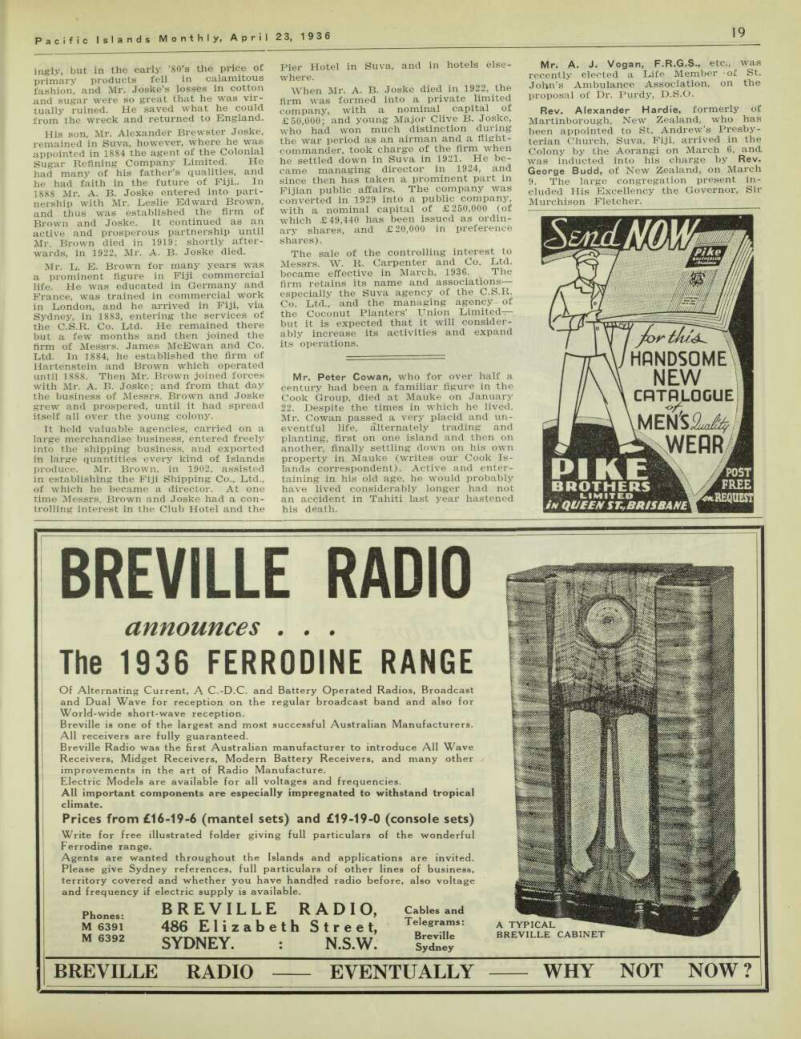
Mr. L. E. Brown.
ingly, but in the early ’Bo’s the price of primary products fell in calamitous fashion, and Mr. Joske’s losses in cotton and sugar were so great that he was vir tually ruined. He saved what he could from the wreck and returned to England.
His son, Mr. Alexander Brewster Joske, remained in Suva, however, where he was appointed in 1884 the agent of the Colonial Sugar Refining Company Limited. He had many of his father’s qualities, and he had faith in the future of Fiji.. In 1888 Mr. A. B. Joske entered into part nership with Mr. Leslie Edward Brown, and thus was established the firm of Brown and Joske. It continued as an active and prosperous partnership until Mr. Brown died in 1919; shortly after wards, in 1922, Mr. A. B. Joske died.
Mr. L. E. Brown for many years was a prominent figure in Fiji commercial life. He was educated in Germany and France, was trained in commercial work in London, and he arrived in Fiji, via Sydney, in 1883, entering the services of the C.S.R. Co. Ltd. He remained there but a few months and then joined the firm of Messrs. James McEwan and Co.
Ltd. In 1884, he established the firm of Hartenstein and Brown which operated until 1888. Then Mr. Brown joined forces with Mr. A. B. Joske; and from that day the business of Messrs. Brown and Joske grew and prospered, until it had spread itself all over the young colony.
It held valuable agencies, carried on a large merchandise business, entered freely into the shipping business, and exported in large quantities every kind of Islands produce. Mr. Brown, in 1902, assisted in establishing the Fiji Shipping Co., Ltd., of which he became a director. At one time Messrs. Brown and Joske had a con trolling interest in the Club Hotel and the
Pier Hotel in Suva, and in hotels else where.
When Mr. A. B. Joske died in 1922, the firm was formed into a private limited company, with a nominal capital of £50,000; and young Major Clive B. Joske, who had won much distinction during the war period as an airman and a flight commander, took charge of the firm when he settled down in Suva in 1921. He be came managing director in 1924, and since then has taken a prominent part in Fijian public affairs. The company was converted in 1929 into a public company, with a nominal capital of £250,000 (of which £49,440 has been issued as ordin ary shares, and £20,000 in preference shares).
The sale of the controlling interest to Messrs. W. R. Carpenter and Co. Ltd. became effective in March, 1936. The firm retains its name and associations — especially the Suva agency of the C.S.R.
Co. Ltd., and the managing agency of the Coconut Planters’ Union Limited— but it is expected that it will consider ably increase its activities and expand its operations.
Mr. Peter Cowan, who for over half a century had been a familiar figure in the Cook Group, died at Mauke on January 22. Despite the times in which he lived, Mr. Cowan passed a very placid and un eventful life, alternately trading and planting, first on one island and then on another, finally settling down on his own property in Mauke (writes our Cook Is lands correspondent). Active and enter taining in his old age, he would probably have lived considerably longer had not an accident in Tahiti last year hastened his death.
Mr. A. J. Vogan, F.R.G.S., etc., was recently elected a Life Member of St.
John’s Ambulance Association, on the proposal of Dr. Purdy, D.S.O.
Rev. Alexander Handle, formerly of Martinborough, New Zealand, who has been appointed to St. Andrew’s Presby terian Church, Suva, Fiji, arrived in the Colony by the Aorangi on March 6, and was inducted into his charge by Rev.
George Budd, of New Zealand, on March 9. The large congregation present in cluded His Excellency the Governor, Sir Murchison Fletcher.