Gauguin as Newspaper
pp. 37-39 · Read in the full issue
Editor Relics of Famous Frenchman In Sydney Library
By Eric Ramsden
OF all the strange people who ever en tered Papeete, none has aroused more criticism, provoked more conjecture, than Paul Gauguin. The French painter was already a much discussed man before ever he set foot in Tahiti. After his death in the Marquesas, in the early part of this century, collectors, or their agents, scoured the islands of French Polynesia for any thing that pertained, to Gauguin.
Well do I recall the expression on the face of Oscar Nordmann, a well-known identity of Papeete, when he told me not long ago how he had once assisted in the destruction of a number of Gauguin’s carv ings. If the Nordmann family had retained them those links with the great Frenchman would have brought them a small fortune!
So much has been written concerning the sojourns of Gauguin in Tahiti, of his sympathy for the natives, his tirades against the administration of his day, of his loves, his hates —in fact, there is little that has not been placed on record.
But concerning Gauguin’s activities as a newspaper editor comparatively little has been pub'ished. It was, therefore, with the keenest interest that I scanned the faded pages cf Les Guepes and Le Sourire, sev eral copies of which were recently pur chased by the Mitchell Library, in Sydney.
The pages were tattered and torn: some had not withstood the ravages of the tropics. Yet within those sheets was hidden much that was historically im portant, much that revealed the soul of that cantankerous genius whose name will ever be identified with the most beautiful of islands —Tahiti.
The outpourings in these journals has been described as among “the poorest stuff Gauguin ever wrote.” That may be.
Nevertheless, it must be remembered that
the painter at that time was entering the last phase of his colourful existence. Dis ease and drugs had both played their pajt.
Carelessness has been detected in his work of that period. Gauguin’s eyesight was failing. There was a more hectic and feverish lack of control. J. G. Fletcher, cne of his biographers, has described the Gauguin of that last phase as “an extinct volcano, a burned out crater.”
On his return rrom Prance, towards the close of last century, the Frenchman took a young native girl for wife, companion, and model. She served him devotedly, pro cure 1 food for him, and nursed him in his illness. I believe that woman still lives with her son at Punauuia. It would seem so, at any rate, as she was certainly his last mistress in Tahiti.
For some reason or other, the painter took it into his head that she should leave his house, and he drove her out. Though
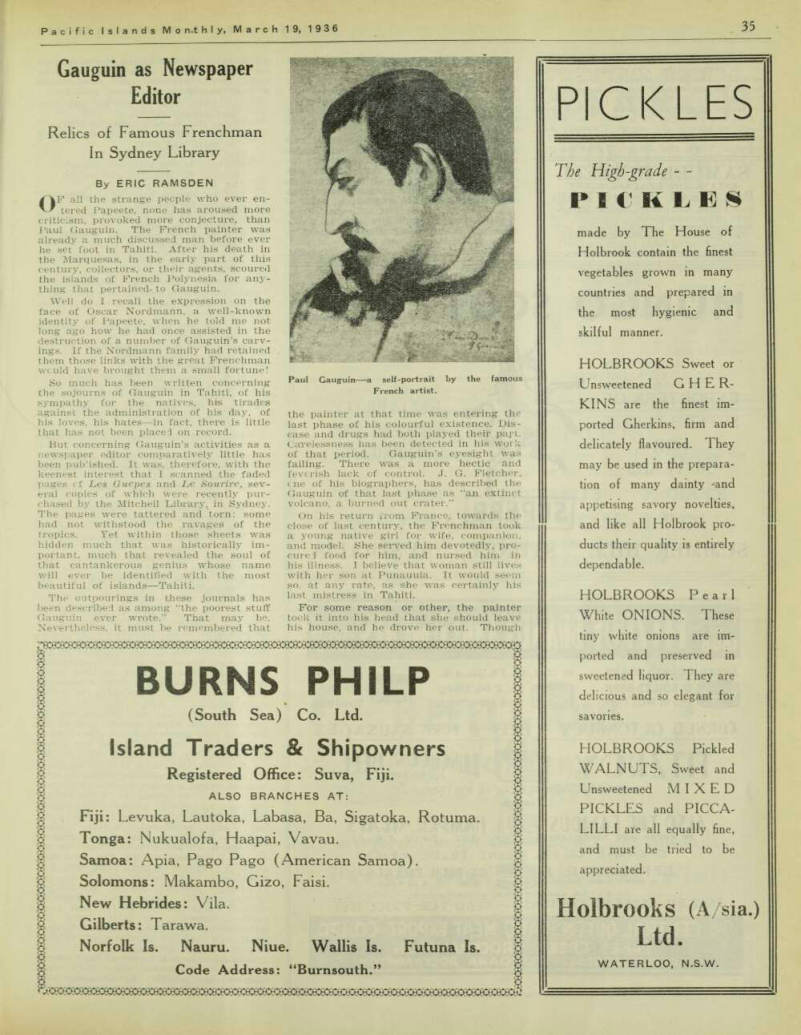
Paul Gauguin—a self-portrait by the famous French artist.
a helpless invalid, he even appealed to the law to prevent the girl from returning.
Naturally, the Administration took no no tice of his ravings. This further enraged Gauguin. Since his return from Europe his fellow-countrymen had treated him as either a madman or a fool. He deter mined to attack the entire Colonial Ad ministration. Now he would obtain his revenge. With the aid of a copying ap
paratus he set up and printed several issues of a paper called first, Les Guepes (The Wasps), and, later, Le Sourire (The Smile). The copies in the Mitchell Library extend from April 12, 1899, to December 12, 1900. Robert Rey, an authority on Gau guin, says the first copy of Le Sourire was issued in August, 1899.
The crude gibes at the Governor and prominent officials, attacks on native policy (especially in the Tuamotus), to gether with the equally crude caricatures that Gaugin drew of prominent people in Tahiti, seem to have creating something of a stir. Much that was purely political has, however, quite lost all significance.
“People began to fear him at last,” wrote Fletcher, “and it was, for a moment, a triumph.”
Still, here and there are little gems,
glimpses of his life among the people he loved. For instance these lines, which he titled Terre Delicieuse (and from which a free translation has been made): • • Daily life in all its gay and picturesque attitudes Varies this scene of unquiet charm.
Life awakens at dawn in the beauty of earth and sun.
Life herself awakening ...
Pleasure is the principle thought, Showing its strength and agility And helping friends.
Virtues should also be a game— A game for the old.
Close to the hut of purau wood com mences the forest.
Freshness of man and woman, of tane and vahine, is there.
They are in separate groups—some reposing— Drinking, chattering, laughing .. .”
Only those who have known the ‘charm of Tahiti can appreciate the truth of these lines: “As twilight falls, all around, sounds as if from Some immense pigeon-house fill the moon-carved darkness.
They dance and sing.
Men squat at the foot of trees, And the women dance in the open places While the last light of day plays around them.
They sing—the men—and the women dance: They mime as the words are sung.
They move arms and legs, inviting, showing How they will come under cover of night.
With night—heavy night—comes a flight of demons ...
The tupapau Who later will stretch themselves out by the beds Where nightmares trouble the sleepers, And invade the couches of the maidens Soon to be women.”
Then, again, the painter plays on the vivo, the Tahitian flute, intermingling his dreams with its plaintive notes. Referring to himself, Gauguin says: “What is he dreaming of —this savage musician on the river bank towards which modulations of his vivo float? What is this heart, savage, too, dreaming of? This wounded heart so alone in the solitude —for whom is it beating? ... And I went far to the sea with memories and hopes, to the wonderful sea whose sounds, around the isle, are like impenetrable walls shutting in my exile. And I hold out my hands into space—my hands filled with youth.”
I like, too, Gauguin’s rabelaisian story of his handsome young cockerel with “purple wings, a golden neck, and a black tail.” “God!” he cried, “he is beautiful!”
But because the bird provided amusement for the native children he refused to eat him, and concluded. sadly; “What penury! Nothing to eat! I am hungry.”
There is an amusing reference to one of the Governors of the day marching down a Papeete street “with his fine corpulence and foolish face,” to the Protestant temple, and of an alleged dream wherein that same dignitary entered Paris “on one of the four local Service horses,” and later heard the Minister for the Colonies cry: “Hence forth, you will be Emperor of Tahiti,” only to awaken, terrified!
Gauguin was well aware of the Chinese menace. “We know that they (the Chinese) are prolific,” he declared, “and they will go on mingling their blood with
that of the Maori race to its extinction, and those of a later generation will be Frenchmen! We blush for it!”
Reverting to the subject under the heading of Encore les Chinois, he said: “We observe that Canada, a country ten times bigger than France, foresees the necessity of taking precautions against the Chinese —this terrestrial pest which overruns big countries such as the United States, Australia, New Zealand, etc. And what does France, our natural protector, do for us? She peacefully per mits the Chinese to invade our little Colony! Tw r enty years ago we made note of the coming danger, and demanded by hook or by crook that measures be taken to stem this sinister invasion. A deaf ear w r as turned to our pleas. The danger which faces us, and which threatens the future of our children, has no terrors for those who govern us ... France has beautiful colonies, but what does she do wdth them? It is certain that our Pearl of the Pacific will be throwm to the Chinese, to be exploited by them, and pilaged! ”
Those words were penned in 1900.
Had Gauguin lived he would have seen the inroads made by the Chinese in Tahit, and surrounding islands, since then.
The painter’s thoughts must often have returned to his native France. In one little anecdote he writes about a typical cafe scene in Paris: “.. . I draw. Everything is beautiful, everything is ugly. Now, there is a head that I know. The mirrors make the crowd look bigger. Where in the devil have I seen that head? The profile is angular, and I am trying to recall where I have seen it. Ah! now I know. It is myself. ...”
The Madame, “bedecked, perfumed, coarse,” asks Gauguin: “What are you having—champagne ?”
“No,” he modestly replies, “Give me some pipperment! ”
As the mirror reflects the blowsy figure, Gauguin reflects to himself: “So they say love makes you beautiful! I try to con vince myself. My pitiless pencil will not believe it. It refuses.” The little story was headed La Yerite!