Surplus
p. 30 · Read in the full issue
Fiji Has Half-Million Trade
Currency of Empire’s Richest Colony is Mysteriously Peg ged at 12½ % Discount.
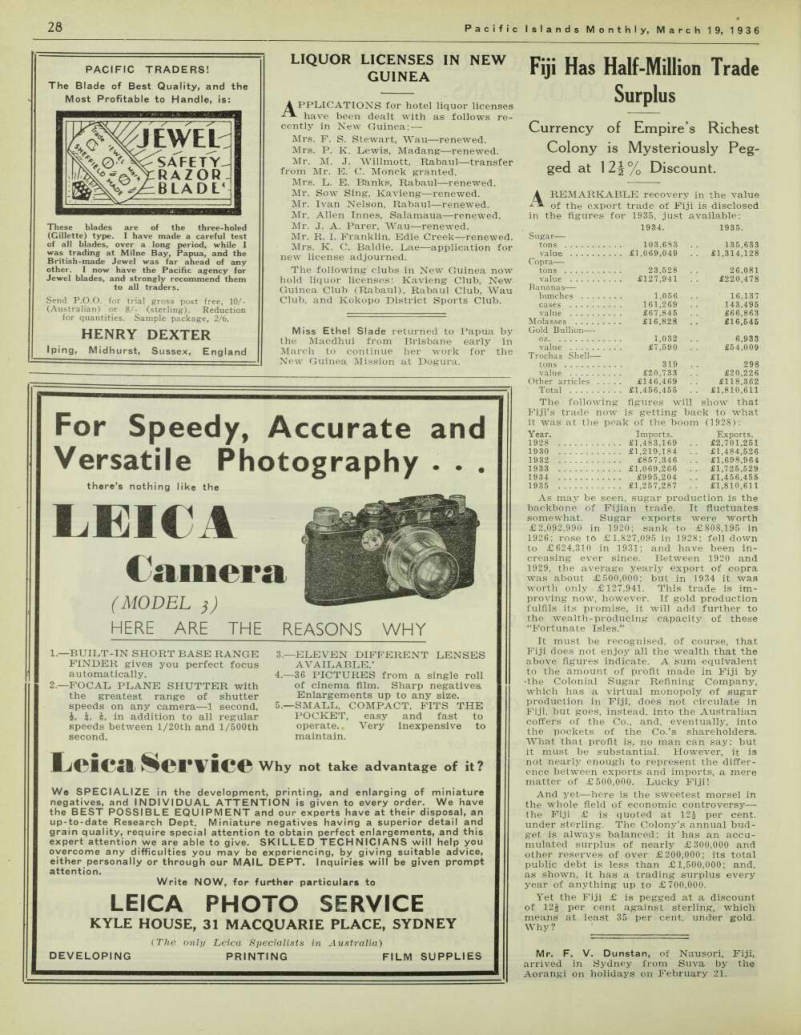
4 REMARKABLE recovery in the value of the export trade of Fiji is disclosed in the figures for 1935, just available:
The following figures will show that Fiji’s trade now is getting back to what it was at the peak of the boom (1928);
As may be seen, sugar production is the backbone of Fijian trade. It fluctuates somewhat. Sugar exports were worth £2,092,990 in 1920; sank to £808,195 in 1926; rose to £1,827,095 in 1928; fell down to £624,310 in 1931; and have been in creasing ever since. Between 1920 and 1929, the average yearly export of copra was about £500,000; but in 1934 it was worth only - £127,941. This trade is im proving now, however. If gold production fulfils its promise, it will add further to the wealth-producing capacity of these “Fortunate Isles.”
It must be recognised, of course, that Fiji does not enjoy all the wealth that the above figures indicate. A sum equivalent to the amount of profit made in Fiji by •the Colonial Sugar Refining Company, which has a virtual monopoly of sugar production in Fiji, does not circulate in Fiji, but goes, instead, into the Australian coffers of the Co., and, eventually, into the pockets of the Co.’s shareholders.
What that profit is, no man can say: but it must be substantial. However, it is not nearly enough to represent the differ ence between exports and imports, a mere matter of £500,000. Lucky Fiji!
And yet—here is the sweetest morsel in the whole field of economic controversy— the Fiji £ is quoted at 12| per cent, under sterling. The Colony’s annual bud get is always balanced; it has an accu mulated surplus of nearly £300,000 and other reserves of over £200,000; its total public debt is less than £1,500,000; and, as shown, it has a trading surplus every year of anything up to £700,000.
Yet the Fiji £ is pegged at a discount of 12| per cent against sterling, which means at least 35 per cent, under gold.
Why?
Mr. F. V. Dunstan, of Nausori, Fiji, arrived in Sydney from Suva by the Aorangi on holidays on February 21.
1934. 1935.
Sugar— tons 103,683 .. 135,633 value . . £1,069,049 .. £1,314,128 Copra— tons 23,528 .. 26,081 value £127,941 . . £220,478 Bananas— bunches 1,056 . . 16,137 cases 161,269 . . 143,495 value . . £67,845 . . £66,863 Molasses £16,828 .. £16,545 Gold Bullion— oz 1,032 .. 6,933 value £7,590 . . £54,009 Trochas Shell— tons 319 . . 298 value £20,733 . . £20,226 Other articles . . . £146,469 . . £118,362 Total . . £1,456,455 £1,810,611
Year. Imports. Exports. 1928 £1,483,169 . . £2.701,251 1930 £1,219,184 . . £1,484,526 1932 £857,346 . . £1,698,964 1933 £1,069,266 . . £1,725,529 1934 £995,204 . . £1,456,455 1935 £1,257,287 .. £1,810,611