Fiji’S Copra
p. 75 · Read in the full issue
Outlook
Gold Industry and Labour Shortage
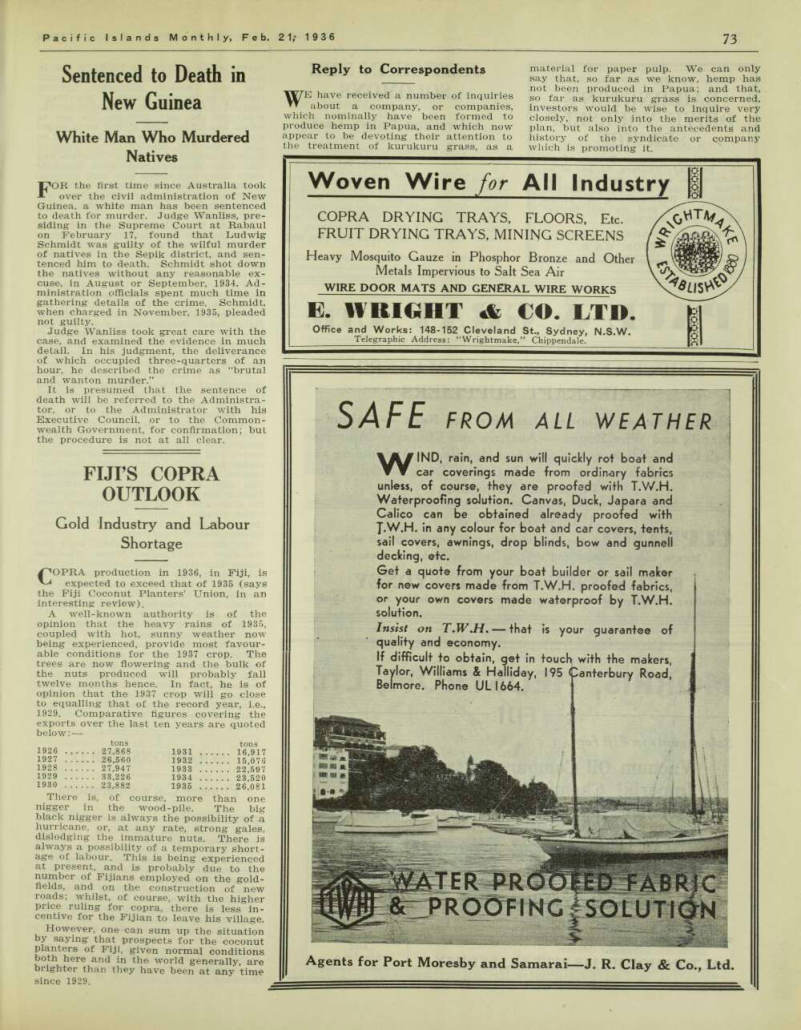
COPRA production in 1936, in Fiji, is expected to exceed that of 1935 (says the Fiji Coconut Planters’ Union, in an interesting review).
A well-known authority is of the opinion that the heavy rains of 1935, coupled with hot, sunny weather now being experienced, provide most favour able conditions for the 1937 crop. The trees are now flowering and the bulk of the nuts produced will probably fall twelve months hence. In fact, he is of opinion that the 1937 crop will go close to equalling that of the record year, i.e., 1929. Comparative figures covering the exports over the last ten years are quoted below:
There is, of course, more than one nigger in the wood-pile. The big black nigger is always the possibility of a hurricane, or, at any rate, strong gales, dislodging the immature nuts. There is always a possibility of a temporary short age of labour. This is being experienced at present, and is probably due to the number of Fijians employed on the gold fields, and on the construction of new roads; whilst, of course, with the higher price ruling for copra, there is less in centive for the Fijian to leave his village.
However, one can sum up the situation by saying that prospects for the coconut planters of Fiji, given normal conditions both here and in the world generally, are brighter than they have been at any time since 1929.
tons tons 1926 . ,. . . . 27,868 1931 ... 1927 . . . . . . 26,560 1932 ... ... 15,076 1928 . . . . . . 27,947 1933 ... . . . 22,597 1929 ... . . . 33,226 1934 ... . . . 23,520 1930 . . . . . . 23,882 1935 ... . . . 26,081