The Soma
p. 36 · Read in the full issue
Deep History of Common Islands Plant
By Arthur J. Vogan, F.R.G.S.
“Full many a gem of purest ray Serene The dark unfathom’d caves of ocean bear; Full many a flower is born to blush unseen, And waste its sweetness on the desert air!” —Gray.
AFTER 20 years’ wandering about the Western Pacific, I can truthfully affirm that the strangest thing I have noticed is that its inhabitants know little, or nothing, about it. I have never visited an island new to me, but I have discovered upon it something new to science. Why Australia has ignored this Sleeping Beauty lying at her doors until the last few years, since gold has been discovered, is another of those puzzles that no man can under stand !
We have, for instance, the romance of the Soma, that first vegetable to be men tioned in Man’s earliest attempt at litera ture: the plant yielding the first intoxicat ing liquor known to him —for then, as to-day, strong drink and literature had a mystical connection, which Byron ex plained in the lines: “Man, being reasonable, must get drunk: The best of Life is but intoxication!”
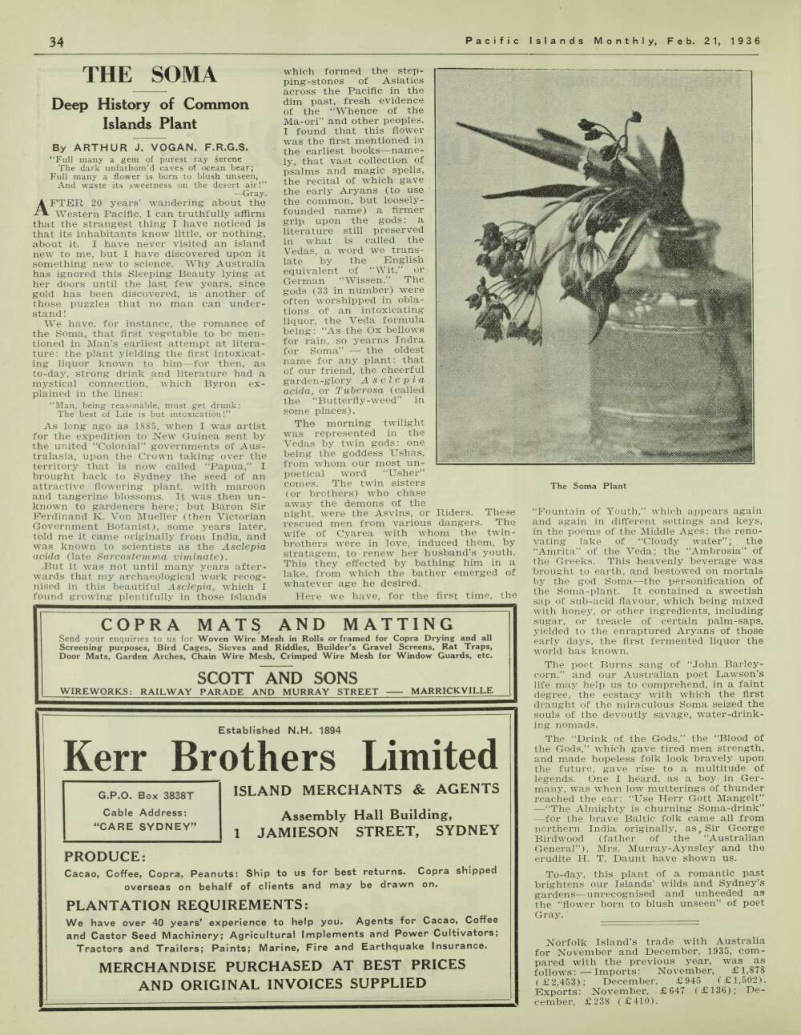
As long ago as 1885, when I was artist for the expedition to New Guinea sent by the united “Colonial” governments of Aus tralasia, upon the Crown taking over the territory that is now called “Papua,” I brought back to Sydney the seed of an attractive flowering plant, with maroon and tangerine blossoms. It was then un known to gardeners here; but Baron Sir Ferdinand K. Von Mueller (then Victorian Government Botanist), some years later, told me it came originally from India, and was known to scientists as the Asclepia acida (late Sarcostemma viminate). .But it was not until many years after wards that my archaeological work recog nised in this beautiful Asclepia, which I found growing plentifully in those islands
which formed the step ping-stones of Asiatics across the Pacific in the dim past, fresh evidence of the “Whence of the Ma-ori” and other peoples.
I found that this flower was the first mentioned in the earliest books —namely, that vast collection of psalms and magic spells, the recital of which gave the early Aryans (to use the common, but loosely founded name) a firmer grip upon the gods; a literature still preserved in what is called the Vedas, a word we trans late by the English equivalent of “Wit,” or German “Wissen.” The gods (33 in number) were often worshipped in obla tions of an intoxicating liquor, the Veda formula being: “As the Ox bellows for rain, so yearns Indra for Soma” the oldest name for any plant: that of our friend, the cheerful garden-glory Asclepia acida, or Tuherosa (called the “Butterfly-weed” in some places).
The morning twilight was represented in the Vedas by twin gods: one being the goddess Ushas, from whom our most un poetical word “Usher” comes. The twin sisters (or brothers) who chase away the demons of the
night, were the Asvins, or Riders. These rescued men from various dangers. The wife of Cyarea with whom the twin brothers were in love, induced them, by stratagem, to renew her husband’s youth.
This they effected by bathing him in a lake, from which the bather emerged of whatever age he desired.
Here we have, for the first time, the
“Fountain of Youth,” which appears again and again in different settings and keys, in the poems of the Middle Ages: the reno vating lake of “Cloudy water”; the “Amrita” of the Veda; the “Ambrosia” of the Greeks. This heavenly beverage was brought to earth, and bestowed on mortals by the god Soma —the personification of the Soma-plant. It contained a sweetish sap of sub-acid flavour, which being mixed with honey, or other ingredients, including sugar, or treacle of certain palm-saps, yielded to the enraptured Aryans of those early days, the first fermented liquor the world has known.
The poet Burns sang of “John Barley corn,” and our Australian poet Lawson’s life may help us to comprehend, in a faint degree, the ecstacy with which the first draught of the miraculous Soma seized the souls of the devoutly savage, water-drink ing nomads.
The “Drink of the Gods,” the “Blood of the Gods,” which gave tired men strength, and made hopeless folk look bravely upon the future, gave rise to a multitude of legends. One I heard, as a boy in Ger many, was when low mutterings of thunder reached the ear; “Use Herr Gott Mangelt” —“The Almighty is churning Soma-drink” —for the brave Baltic folk came all from northern India originally, as. Sir George Birdwood (father of the “Australian General”), Mrs. Murray-Aynsley and the erudite H. T. Daunt have shown us.
To-day, this plant of a romantic past brightens our Islands’ wilds and Sydney's gardens—unrecognised and unheeded as the “flower born to blush unseen” of poet Gray.
Norfolk Island’s trade with Australia for November and December, 1935, com pared with the previous year, was as follows: —Imports: November, £1,878 (£2,453); December, £945 (£1,502).
Exports; November, £647 (£136); De cember, £238 (£410).
The Soma Plant