Atebrin
Further Experiences of Malaria Sufferers
By a Tropical Practitioner THE drug atebrin was brought to trial in the P.I.M. of December 20, and con demned as a delusion and a snare.
Awdi alteram partem. Let us try and arrive at the truth regarding the merits and demerits of the drug in malaria.
Will you, Mr. Editor, allow me space to act as counsel for the defence; and give equal prominence to the fact that atebrin is a very useful drug in malaria when it is rightly used?
Of the two drugs in common use, quinine is the greater and atebrin the lesser, but
the patient who makes use of both will be the one to receive the greatest benefit.
I, too, have been disappointed with atebrin in the past, because I tried to make it take the place of quinine, which it will not do. But atebrin carries on beneficial treatment at a stage when quinine has ceased to be of much use. Quinine cuts short the fever by destroying most of the active parasites; but it fails to clean up the blood completely, and in this necessary cleansing process atebrip becomes invalu able.
As a practising medical man, I could refer to many sound opinions on the value of atebrin, and many reported trials of its successful use on a far larger scale and under more critical observance than the cases quoted in the but it will suffice to say, in general terms, that medi cal men who know their job do use it and save their patients much ill-health by doing so.
The advice that should be given to your readers is not to reserve atebrin for Southern leave, but to use it in their own homes, right amongst the mosquitoes, and to use quinine as well.
The rule I follow is this; When you have an acute attack of malaria, take quinine EARLY, and in full doses. The quinine gets to work at once and usually, in 2 or 3 days’ time, the tem
perature drops to normal. Discontinue the quinine at once, when the fever has gone, and take a bottle of atebrin, 15 tabs, in 5 days, after which no direct anti-malarial drugs are necessary, though a course of iron and arsenic for blood replacement gives further benefit.
The main point that emerges from this method is that, during an acute attack, quinine is the best remedy, and that the continuing action of the atebrin lessens the risk of relapse.
Referring to the statement that atebrin brought on a more severe type of fever, and one similar to an infection sustained years before, I hope I may say without offence that no chemical agent can generate malaria, nor is atebrin at all likely to bring on any kind of fever for which a living organism or germ has been proved to be the causal agent. The onset of a severer type mentioned by your corres pondent is either co-incidental or, more likely, an aggravation of his actual malarial attack, brought on by abandoning quinine in favour of atebrin, an unwise form of treatment in many instances.
I am sure your correspondent wrote in good faith and that he will pardon another view being placed before your readers. I agree that to use atebrin exclusively is to court failure: but to use it in conjunction with quinine is to enjoy comparative im munity, even in highly malarious districts.
Only those who are so situated know what a blessing freedom from attacks means, and they are likely to attain it by the conscientious use of a bottle of atebrin after every bout.
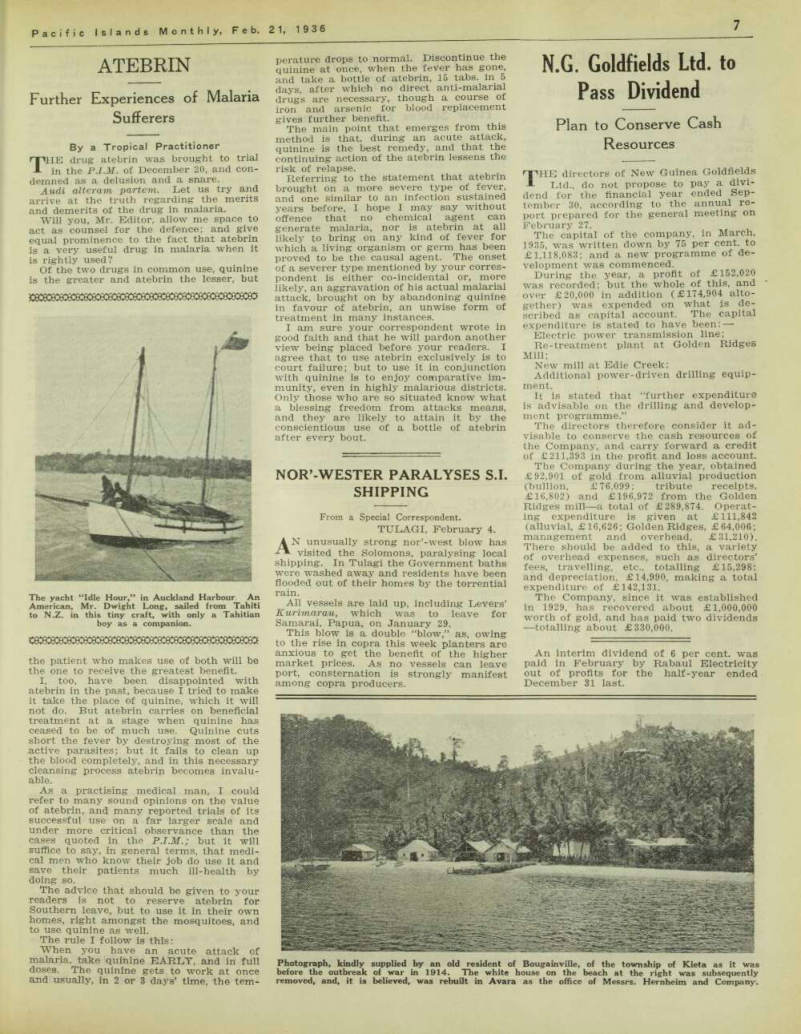
The yacht “Idle Hour,” in Auckland Harbour. An American, Mr. Dwight Long, sailed from Tahiti to N.Z. in this tiny craft, with only a Tahitian boy as a companion.