How Near Is The Japanese “Menace"?
pp. 5-6 · Read in the full issue
“An Anglo-Japanese war is not the dream of a fool, nor even an unreasonable hypothesis,” writes Lieutenant-Commander Tota Ishimaru, of the Japanese Navy, in a book, “Japan Must Fight Britain,” which was published to-day.
Lieut.-Commander Ishimaru considers a con flict in the Pacific inevitable “unless either Japan stops the policy of expansion she is driven to adopt under severest pressure, or unless Eng land, with excessive colonies, abandons the policy of preservation of status quo.” He exam ines in detail the probable course of the war, and concludes that Japan has nothing to fear since she could count on decisive superiority over any British air or naval forces that could be concentrated in the Pacific. He believes that a Japanese victory would be followed by the col lapse of the British Empire. India, he says, would break away, Hong Kong would be lost, and Australia and New Zealand would pass to Japanese hands. He regards the Singapore Base as the most serious threat. “If England is in a position to despatch a powerful fleet to the Far East in a few days, the hands of her diplomatists in China will be greatly strengthen ed. China herself will become ‘uppish’ and begin to treat us with scant respect,” he says.
He offers no constructive suggestions for the maintenance of peace, but merely repeats “Bri tain and America must give way.” —From the London correspondent of Sydney Morning Herald, cabling on February 6.
JS there need for alarm? Or is the pub lic being bombarded, as is so often the case, with rubbish produced by ignor
ant, sensation-mongering journalists? Let
us examine the facts, as we actually
know them.
Japan’s population is now 100,000,000, and is increasing with astonishing rapidity. She needs more territory.
For many years, Japanese foreign policy was moulded in accordance with two pacts —the Anglo-Japanese Treaty, and the Washington Agreement, under which warship construction was limited by a formula. The Anglo-Japanese Treaty has been denounced; the Wash ington Agreement is expiring; and Japan, in January, withdrew from the London Naval Conference, where an at tempt was being made to find a new building formula. Japan, in 1934, with drew from the League of Nations.
Japan, in January, made a pact with Germany under which they agreed that each should assist the other against an aggressor. This, of course, is directed primarily against Russia. If Russia at tacks Japan while Japan is busy else where, Germany will attack Russia.
The pro-Britain, pro-peace party has been in the ascendant in the government of Japan for a long time. There is no
guarantee that it will remain in power.
There are strong political groups which are neither pro-British nor pro-peace.
It was announced, in February, that Japan intends to build the world’s largest warship. Every report, without exception, indicates the intention of Japan to create a bigger and bigger navy.
Japan bitterly resents the fact that the United States and the British Dominions, as part of their policy of keeping out Asiatic migrants, will not permit the entry of Japanese settlers. The Japanese are a proud, clever people and they con sider that they have a natural right to enter any of the Pacific territories.
Now, look at a map of the Pacific.
Southwards of Japan lie rich lands, ter ritories capable of development by and providing a home for the overflowing Japanese—Philippines, New Guinea, New Britain, New Ireland, Solomons, New Caledonia, Australia, and New Zealand. Those great territories mostly are under-populated, and unprotected.
Six million Australians could not defend the whole of their enormous coastline against modern armaments for a day.
The Japanese do not invade those rich,
empty, enticing countries because the two great Anglo-Saxon powers, Britain and the United States, with France and Hol land in support, have constituted them selves the defenders of the status quo in the Pacific. That was recognised in the Washington Agreement. It allowed Japan a fleet that was quite big enough to defend Japan and her contiguous ter ritories, but which was not big enough to protect lines of communication, in the event of Japan making a drive into the south or east for the purpose of acquiring territory. For fifty years, the status quo was accepted. We were all safe in the Pacific.
But, now, the navy limitation agree ment is gone. Japan is building more and bigger warships. She says, quite openly, that she must have more territory for her enormous and growing popula tion. Can there be the slightest doubt that Japan will seize Pacific territory, as she seized Asiatic territory, as soon as she feels that she is strong enough?
One assumes that U.S.A. would not remain indifferent to any move towards Japanese expansion in the Pacific: but America remains a very uncertain quan tity in international affairs. As a mat ter of fact, the only certain obstacle to Japanese ambitions in the Pacific is Bri tain, and the British navy. The safety of Europeans here in the Pacific terri tories depends entirely upon the effi ciency of that world-wide organisation of men and machines who work under the White Ensign. We may as well re cognise the cold logic of clear facts.
For two decades, this writer has said, comfortingly: “Yes, the Japanese will turn southwards—that is inevitable —but not in our day. They have enough to do in China to keep them busy for fifty years.” Very recent events have changed all that. The Japanese have made it clear that they will not necessarily delay, until they have tapped the Chinese reser voir of raw material and man power, their attempt to conquer the Western Pacific. They will make the attempt just as soon as they think they are strong enough to hold their sea-lines against British and American naval power. (Be cause of the uncertainty of American policy in the Pacific, Japan must regard America as a potential opponent of her expansionist designs.) They will build ships, and more ships, and they will strengthen their economic structure; and, as certainly as the sunrise, they will strike—when they think Britain is weak or unready.
Meanwhile, Germany waits. She does not want to fight Britain; but she is at
one with Japan in her determination to acquire, somewhere, new territory for her growing population.
The danger, beyond doubt, is very real; but we should not say that it is yet imminent. If the well-meaning dreamers of the Ramsay MacDonald era were still in charge in London, we might sleep insecurely; but Britain at last re cognises her danger, and she is arming with great rapidity, and on a scale such as the world never before has seen. With in the next three years, Britain will spend over £300,000,000 on armaments —not with any plan of conquest, but simply to protect the Empire, and, if possible, to maintain world peace. And that means the maintenance of the status quo in the Pacific. Japan, attacking to day, doubtless could sweep the British naval forces away and seize great Pacific territories. But, to-morrow, she would have to face powerful attacks upon her sea - communications, probably from America and certainly from Britain.
Japan is restrained, not by the hazards of to-day, but by the possibilities of to-morrow. No people in the world have greater length of vision than the Japanese. Their reply to Britain’s £300,000,000 armaments programme probably will be made at a conference table, at no distant date, when the three
landless powers—Germany, Japan, and Italy—will make a reasonable appeal to the great colonial powers—and especially to Britain. That appeal probably will not fall on deaf ears. Britain—the nation which has given or is giving self rule to the Boers, to India, to Egypt, to Iraq—cannot be indifferent to the cry of the landless peoples. But, having been driven to a £300,000,000 armament pro gramme by an implacable Japan and an aggressive Germany, Britain will not forget that those restless Powers are ap pealing only because they have got to — that, in fact, they would much prefer to march in unannounced, seize British ter ritories, and divide the spoil according to the law of the tooth and the claw.
In a word the cons i der ation which dominates intern ational relationships to d ig “territory”; and, as the territories of the South and Western Pacific are the
least developed;
we people who live in them are dosel and individua i ly affect . ed b what is ; on We no more can defend ourse]ves than wg can , r tection from the chattering old gentlemen at Geneva - We must P ut our falth m Britain, and our hope in the American navy. So long as those forces are com petent to defend the status quo in the Pacific, we are safe—but no longer.
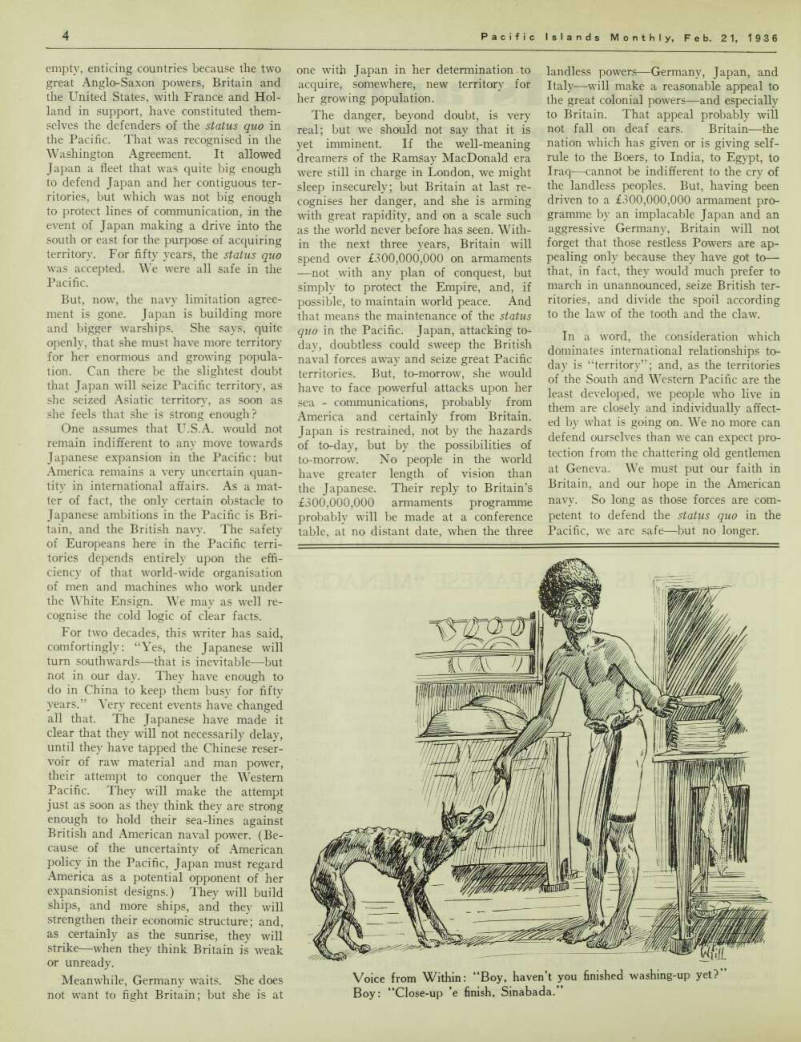
Voice from Within: “Boy, haven’t you finished washing-up yet?’’
Boy: “Close-up ’e finish, Sinabada."