New Year Honours
pp. 75-76 · Read in the full issue
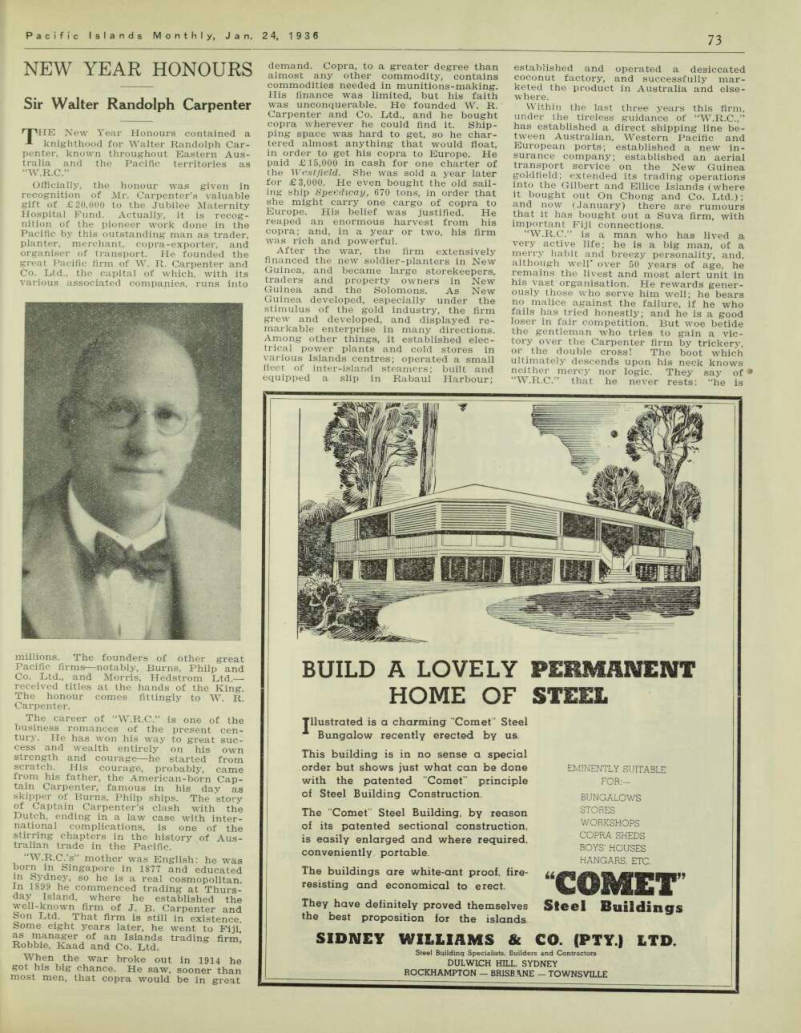
Sir Walter Randolph Carpenter
THE New Year Honours contained a A knighthood for Walter Randolph Car penter, known throughout Eastern Aus tralia and the Pacific territories as
“W.R.C.”
Officially, the honour was given in recognition of Mr. Carpenter’s valuable gift of £20,000 to the Jubilee Maternity Hospital Fund. Actually, it is recog nition of the pioneer work done in the Pacific by this outstanding man as trader, planter, merchant, copra-exporter, and organiser of transport. He founded the great Pacific firm of W. R. Carpenter and Co. Ltd., the capital of which, with its various associated companies, runs into
millions. The founders of other great Pacific firms —notably, Burns, Philp and Co. Ltd., and Morris, Hedstrom Ltd.— received titles at the hands of the King.
The honour comes fittingly to W. R.
Carpenter.
The career of “W.R.C.” is one of the business romances of the present cen tury. He has won his way to great suc cess and wealth entirely on his own strength and courage—he started from scratch. His courage, probably, came from his father, the American-born Cap tain Carpenter, famous in his day as skipper of Burns, Philp ships. The stow of Captain Carpenter’s clash with the Dutch, ending in a law case with inter national complications, is one of the stirring chapters in the history of Aus tralian trade in the Pacific.
“W.R.C.’s” mother was English: he was born in Singapore in 1877 and educated in Sydney, so he is a real cosmopolitan.
In 1899 he commenced trading at Thurs day Island, where he established the well-known firm of J. B. Carpenter and Son Ltd. That firm is still in existence.
Some eight years later, he went to Fiji, as manager of an Islands trading firm' Robbie, Kaad and Co. Ltd.
When the war broke out in 1914 he got his big chance. He saw, sooner than most men, that copra would be in great
demand. Copra, to a greater degree than almost any other commodity, contains commodities needed in munitions-making.
His finance was limited, but his faith was unconquerable. He founded W. R.
Carpenter and Co. Ltd., and he bought copra wherever he could find it. Shippmg space was hard to get, so he chartered almost anything that would float, m order to get his copra to Europe. He Pf ld T £ 1 5 - 00 ,? m cash for pne charter of i he l\ e^ eld ' T She was so i? year later for £3.000. He even bought the old sailmg ship Speedway, 670 tons, in order that she might carry one cargo of copra to Europe. His belief was justified. He reaped an enormous harvest from his copra; and, in a year or two. his firm was rich and powerful. . i Aftei the war, the firm extensively financed the new soldier-planters in New Guinea, and became large storekeepers, traders and Property owners in New Gumea and the Solomons. As New Guinea developed, especially under the stimulus of the gold industry, the firm grew and developed, and displayed remarkable enterprise in many directions.
Among other things, it established electncal power plants and cold stores in various Islands centres; operated a small fleet of mter-island steamers; built and equipped a slip in Rabaul Harbour;
established and operated a desiccated coconut factory, and successfully mar keted the product in Australia and else where.
Within the last three years this firm, under the tireless guidance of “W.R.C.,” has established a direct shipping line be tween Australian, Western Pacific and European ports; established a new in surance company; established an aerial transport service on the New Guinea goldfield; extended its trading operations into the Gilbert and Ellice Islands (where it bought out On Chong and Co. Ltd.); and now (January) there are rumours that it has bought out a Suva firm, with important Fiji connections.
“W.R.C.” is a man who has lived a very active life; he is a big man, of a merry habit and breezy personality, and, although well’ over 50 years of age, he remains the livest and most alert unit in his vast organisation. He rewards gener ously those who serve him well; he bears no malice against the failure, if he who fails has tried honestly; and he is a good loser in fair competition. But woe betide the gentleman who tries to gain a vic tory over the Carpenter firm by trickery, or the double cross! The boot which ultimately descends upon his neck knows neither mercy nor logic. They say of * “W.R.C.” that he never rests; “he is
always cooking up something new.” He does not seek profits, so much as achieve ment —he has a boy’s delight in success.
His is the joy of the true builder.
The only unhappy feature of this knighthood is that the euphonious “W.R.” disappears, and a new and portentous person, ‘‘Sir Walter” takes his place. To several hundred hard-working people, the “W.R.” has represented for many years a very real personality—the active, restless, jolly chief whom they all loyally follow. Knighthood will not change the man himself; but his friends and asso ciates are going to have a hard time, schooling themselves to say “Sir Walter” when they mean “W.R.” For all that, their congratulations have poured in upon him in overwhelming measure.