Pacific Shipping
p. 58 · Read in the full issue
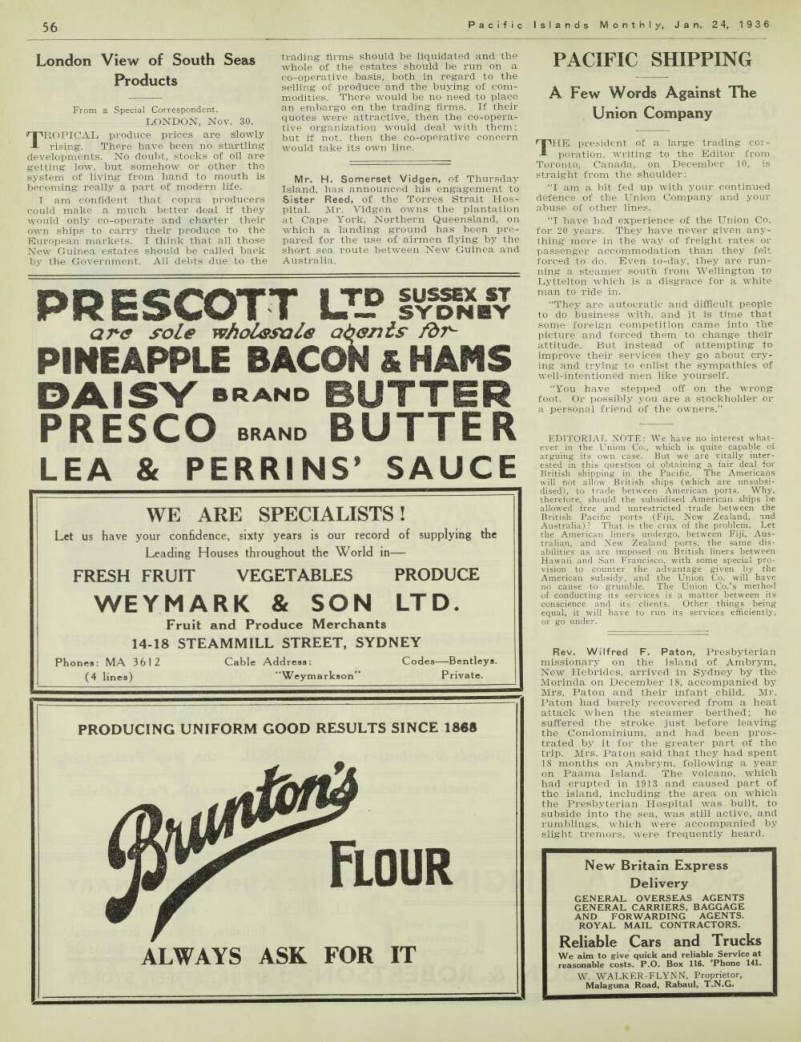
A Few Words Against The Union Company
THE president of a large trading cor poration, writing to the Editor from Toronto, Canada, on December 10, is straight from the shoulder; “I am a bit fed up with your continued defence of the Union Company and your abuse of other lines.
“I have had experience of the Union Co. for 20 years. They have never given any thing more in the way of freight rates or passenger accommodation than they felt forced to do. Even to-day, they are run ning a steamer south from Wellington to Lyttelton which is a disgrace for a white man to ride in.
“They are autocratic and difficult people to do business with, and it is time that some foreign competition came into the picture and forced them to change their attitude. But instead of attempting to improve their services they go about cry ing and trying to enlist the sympathies of well-intentioned men like yourself.
“You have stepped off on the wrong foot. Or possibly you are a stockholder or a personal friend of the owners.”
EDITORIAL NOTE: We have no interest what ever in the Union Co., which is quite capable of arguing its own case. But we are vitally inter ested in this question of obtaining a fair deal for British shipping in the Pacific. The Americans will not allow British ships (which are unsubsi dised), to trade between American ports. Why, therefore, should the subsidised American ships be allowed free and unrestricted trade between the British Pacific ports (Fiji, New Zealand, and Australia) ? That is the crux of the problem. Let the American liners undergo, between Fiji, Aus tralian, and New Zealand ports, the same dis abilities as are imposed on British liners between Hawaii and San Francisco, with some special pro vision to counter the advantage given by the American subsidy, and the Union Co. will have no cause to grumble. The Union Co.’s method of conducting its services is a matter between its conscience and its clients. Other things being equal, it will have to run its services efficiently, or go under.
Rev. Wilfred F. Paton, Presbyterian missionary on the island of Ambrym, New Hebrides, arrived in Sydney by the Morinda on December 18, accompanied by Mrs. Paton and their infant child. Mr.
Paton had barely recovered from a heat attack when the steamer berthed; he suffered the stroke just before leaving the Condominium, and had been pros trated by it for the greater part of the trip. Mrs, Paton said that they had spent 18 months on Ambrym, following a year on Paama Island. The volcano, which had erupted in 1913 and caused part of the island, including the area on which the Presbyterian Hospital was built, to subside into the sea, was still active, and rumblings, which were accompanied by slight tremors, were frequently heard.