Mosquitoes
pp. 48-49 · Read in the full issue
The Deadly Enemy of Mankind In the Tropics
The following is from an interesting article which appeared in a recent issue of the “Public Service Bulletin " of New Guinea.
MAN has been a long time on this Earth, a long time during which he has been leaving scraps of waste water around his dwellings so that, as evolution has pro gressed and specialised, some mosquitoes, like ordinary flies, have come to depend upon human carelessness for their susten ance. In other words, they have come to regard these domestic waste waters as the most acceptable nursery, always depend able, for their eggs and larvae, while, at the same time, the female of the species has come to depend upon human blood as a food supply.
Experience of health work in a tropical town has taught one that possibly the rela tion is the other way round and that the mosquito has discovered that in the en vironment of humans she may generally depend upon finding water suitable for the hatching of her eggs. At any rate, all the
mosquitoes concerned with the distribution of disease And that a blood meal is an essential preliminary to the laying of eggs On nearby water; of course, one is only dealing with the females: the males do not require blood, and, in fact, are rarely seen in houses.
Now, let us take the case of the common brown house mosquito, the one that comes buzzing around at night. Though she is mainly concerned with blood for dietetic purposes, anything that accompanies the blood will be ingested with it. Somewhere down along the track of evolution, a small bxood worm has found that this mosquito offers an excellent means of transferring from man to man. The microscopical worm enters the stomach of the mosquito and undergoes a process of development without, apparently, doing much harm to the mosquito, so that, in a little whil&, when the mosquito comes to your house one night for a drop of blood, the wormlet now wriggles out and enters your body through the mosquito bite. There is no call to dis cuss here the group of associated causes which result in Elephantiasis but it may be taken as certain that if that matured wormlet does not enter a person’s body, he will not get the disease.
The ordinary brown house mosquito that is commonly associated with the trans mission of this disease is somewhat par ticular about the water used for egg laying; she prefers it on the clean side and usually does not fly far afield. One would suggest that the tins under the ice box or the safe; the gutterings; the tanks or the odd tin that has been thrown out by the house-boy would repay inspection.
Then, again, there is a handsome black and white mosquito that turns up especi ally about four o’clock in the afternoon and makes life miserable until sundown.
This one is concerned with the passage of Dengue Fever, and when you feel as if every bone in your body had its own ex quisite ache and you are wretched and depressed beyond belief, it will be some comfort, though a poor one, to reflect that your troubles are due to lack of mosquito cleanliness in yourself or your neighbours.
This mosquito appears to find any water acceptable, however dirty it may be, and her ,presence usually implies a tin of foul water or water held in rotting vegetation, or, ideally, a broken fallen coconut. She is nearly always to be found in numbers near places where copra is being prepared.
Neither of these two mosquitoes are pleasant visitors, but Elephantiasis is cer tainly infrequent in the New Guinea Terri tory and Dengue appears to have left us for some years now. But there is another mosquito-borne disease, Malaria, that is always with us.
The Anopheline mosquito is altogether a different proposition from the two men tioned previously. They usually occupy artificial collections of water and, by con stant watchfulness on such water, their breeding can be prevented. The Anopheline, however, though it has come to depend upon a blood meal, still requires natural ground-w r ater for its larvae. Suitable water may be anything from a huge swamp to a heel impression in water-logged ground.
Obviously, these latter microscopical puddles are difficult to find, so that the only really effective measure is to have the whole ground so drained that no water can remain in any air-exposed surface for more than about 48 hours. Swamps and streams are channelled, so that the water is kept in cleared ways free of grass and back eddie.
To deal effectively with the Anopheline mosquito is the job of a specialist; but there is no doubt that given a trained staff and sufficient funds, the work can be done effectively and Malaria banished.
No more Malaria; no more Blackwater
Fever; no more Quinine; this tropical world would seem a different place. Per haps it will come some day, but, in the meantime, one would point the moral of this little story—the mosquito is an unclean beast and a deadly enemy. A resident of tropical places should feel the same repul sion to mosquitoes that everyone feels to flies and corruption. Destroy the adult; destroy the larvae; make your residence uninhabitable to mosquitoes.
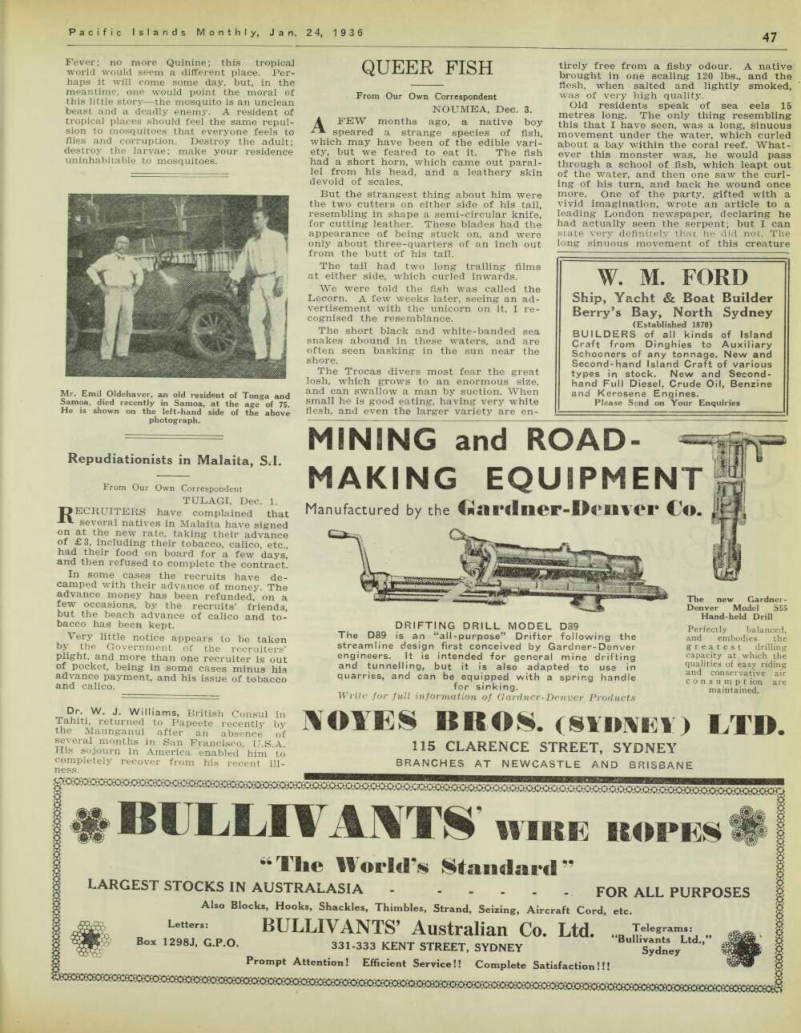
Mr. Emil Oldehaver, an old resident of Tonga and Samoa, died recently in Samoa, at the age of 75.
He is shown on the left-hand side of the above photograph.