Men Who Knew Yesterday
pp. 43-44 · Read in the full issue
By Eric Ramsden
4 “Fox Of Melanesia”
A LITTLE man. his head buried in piles A of a well-known Australian sporting journal not usually observed in clerical circles, sat in a corner of the Melanesian Mission’s motor-yacht “Southern Cross” when she reached Sydney in December.
He gave me a friendly, a shy little smile, and pushed a tin of cigarettes in my direction.
“Yes,” he admitted, “my name is Fox.” , , „ T “You see, he went on to explain lam rather anxious to find out how the All- Blacks get on in England.
It was, indeed, a far cry from the field at Te Aute College in New Zealand, when a slight, eager-faced boy with the deep-set eyes of a student, lay panting in the mud, a ball clasped in his arms. “I think that was the happiest moment of my life,” declared the Rev. Dr. C.
E. Fox, world-renowned authority on the in tricate languages of Melanesia. “I shall never forget that try. It gave us the match!” In those days young Fox played for the Napier Boys’ High School. The annual match with the Maori College at Te Aute is still the event of the football year among Hawke’s Bay juveniles.
Like most men who have really accom plished something in life, Dr. Fox does not like to talk of his own achievements. There is nothing of the assertive parson about him. For his “The Threshold of the Pacific,” an account
of the social organisa tion, magic and religion of the people of San Cristoval, the University of New Zea land honoured C. E. Fox with a doctorate of literature. Professor G. Elliot Smith (who played no small part in its publica tion), said of Fox: ‘‘He has picked his way through the jungle of Melanesian culture with marvellous skill and patient care, and has rescued for science a rich harvest of trustworthy and unsuspected evidence which, it is no exaggeration to claim, sheds a new light on the culture of Oceania and the history of the world’s civilisation.”
Praise, indeed, from one of the world’s au thorities !
C. E. Fox has spent 34 years of his inten sive life in Melanesia. It was at Norfolk Island in 1908, where the Melanesian Mis sion then had a school for native boys, that he first met the late Dr. Rivers. In his subsequent journeying among the Mela nesian islands the little missionary acted as interpreter for the great savant.
As a result of that meeting, and the corre spondence that ensued, Dr. Fox became deeply interested in ethnology. Hitherto he had regarded it as “a vague, picturesque, and highly imaginative subject, and not at all as an exact or scientific study.”
In 1915, he went to England, at the in vitation of Dr. Rivers, and stayed with him in rooms above his own in St. John’s College, Cambridge. ‘There we had many walks and talks,” he says, “and I rowed with Rivers on the Cam which, above Gran chester, is so extraordinarily like a Solomon Islands river ... I was amazed at his in
terest in my work and appreciation of it, and at the courteous way in which so un couli"l a Melanesian savage was received tteaWd, no* only by himself but by his irienas a o.
Three years later Dr. Rivers was in ill health: he knew that he had not long to live. To Professor Elliot Smith he con tided what an impression a manuscript forwarded to him by C. E. Fox had made upon his mind. “Dr. Rivers regarded it, and with ample justification,” said the Pro fessor, “as one of the most important, if not the most imp ortant piece of field work that has ever been done in social anthro pology. . . . His chief anxiety was the risk that the publication of Fox’s book might be imperilled if the responsibility was his alone.” Therefore, he asked Dr. Elliot Smith to be his literary executor, “mainly for the purpose of getting the results of Fox’s work published; and six months be-
fore his death he impressed this upon me as my first duty to him.”
The result of that meeting between Riv ers and Fox on Norfolk Island all those years ago was the publication of a monu mental work that has stood the test of time —a work that made the little missionary famous.
Dr. Raymond Firth Curiously enough. Dr. Pox was himself instrumental, in later years, in directing the steps of a brilliant young student, an other New Zealander, towards the antho pological field. Naturally enough, he has taken pride in the career of Dr. Raymond Firth, until recently acting Professor of Anthropology at Sydney University, and now of the University of London. When Fox and Firth first met, the latter was a student in Auckland. Now, Dr. Fox is awaiting with interest the publication of Raymond Firth’s researches on the island of Tikopia. For Dr. Pox, like his fellow countrymen, is intensely interested in the study of Polynesian communities sur rounded by a Melanesian culture. ‘‘There is still tremendous scope ahead of the in vestigator in the Western Pacific,” he says.
What makes Dr. Pox so interesting to Polynesian scholars, men of the mental calibre of Bishop Herbert Williams, of Wai pau (whom he regards as the greatest living authority on Pacific languages) and Sir Apirana Ngata, is that he approaches Polynesian problems from a Melanesian angle. Hitherto, precisely the opposite has
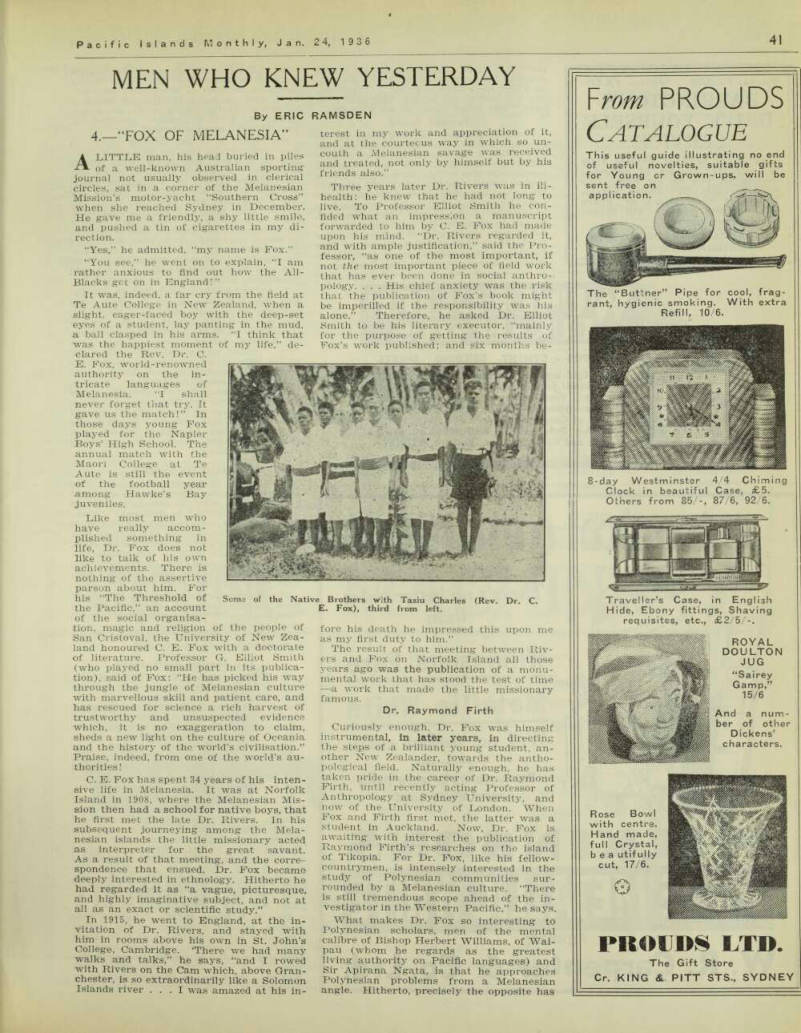
Soma of the Native Brothers with Tasiu Charles (Rev. Dr. C.
E. Fox), third from left.
prevailed. But, unfortunately, in recent years he has been unable to devote the time he would have liked to study. “When one has a school of 200 boys to look after,” he says, “that takes about all one’s energy.”
Rennell Island Nevertheless, it is amazing what he has accomplished in acquiring information. Dr.
Fox still has the manuscript of an unpub lished vocabulary of the San Cristoval people. Of late he has been engaged on a similar work dealing with the Rennell Island natives. “There we have one of the most interesting Polynesian communities in the whole of the Pacific,” he commented.
So far missionaries have not been permit ted to work on Rennell (which is 120 miles to the south-east of San Cristoval). The language, he contends, more closely re sembles Maori than even the Tuamotuan
(east of Tahiti). On his recent visit to New Zealand he took with him Tasiu Henry Maabe, a member of the Native Brother hood, who can speak the Rennell tongue— as well as nearly twenty other languages.
“And when I say languages,” observed Dr.
Fox, “I don’t mean dialects!”
His object in taking Brother Henry to New Zealand was that he might talk Ren nell (and other languages) with Bishop Williams. Incidentally, Dr. Fox has a sin cere admiration for the intellectual quali fications of the Melanesian. “There are few Europeans who could do that,” he added. As a matter of fact, he contended, there was no reason why the Western Pacific should not produce men of the in tellectual standard of Ngata, Buck, and Pomare, Anglo-Maoris who have won dis tinction both in politics and science. “In fact, we have already men of splendid intellectual attainments,” he remarked.
In his thirty-odd years in the Pacific Dr.
Fox has witnessed many changes. He has served under five Bishops of Melanesia, and has seen the Christian flock increase from 2,000 to 22,000. When he first went to Norfolk Island, early in this cen tury, feeling was so intense between the native boys at school there, from the dif ferent islands, that he saw fights where spears were actually thrown! To-day, that feeling has almost disappeared: “The Solomon Islander now feels that he is a dis tinct entity. He no longer regards himself as a native of any particular island in the group. In effect, he regards himself as a Solomon Islander, and he takes a natural pride in that fact.”
Praise for Traders As for the European trader, Dr. Fox believes him to have been a much maligned person. “The early traders in the Group set a high standard,” he declared, “a stan dard that has been maintained by their successors. They taught the natives that the word of an Englishman was his bond.
That belief exists to-day.” The plantations were, generally speaking, exceedingly well run, and the natives were satisfied with their conditions and treatment.
The missionaries of to-day, he submitted, were carefully selected and well-trained men. A course in anthropology was in most cases exceedingly valuable. To men of a scientific turn of mind, Melanesia offered a fascinating field for research.
The Famous Brotherhood In the remarkable Native Brotherhood, entirely self-supporting and in no way dependent upon the Mission’s funds, Dr.
Fox is known as Tasiu (Brother Charles).
He is the only European member. The prin cipal object of The Brothers is to penetrate within the districts still regarded as savage and heathen. After three years of evan gelical work, its members labour on the plantations for a year so that their wages can be devoted to The Brotherhood’s gen eral activities.
After a holiday visit to relatives in New Zealand (which includes a call at Te Aute College where young Maoris anxious to emulate the football prowess of men like Taiaroa and Nepia are still turned out), Tasiu Charles, D.Litt., will be well content to return to Guadalcanal. The only draw back is that he finds it a little difficult there to keep track of the football scores of his triumphant fellow-countrymen!
Hon. V. A. Pratt, M.L.C., of Rabaul, New Guinea, arrived in Sydney at the end of December, after a holiday visit to Western and Central America. He spent some in teresting months in out-of-the-way coun tries, such as Cuba, Guatemala and Mexico. He returned to New Guinea in January.