Mali's Joy
p. 24 · Read in the full issue
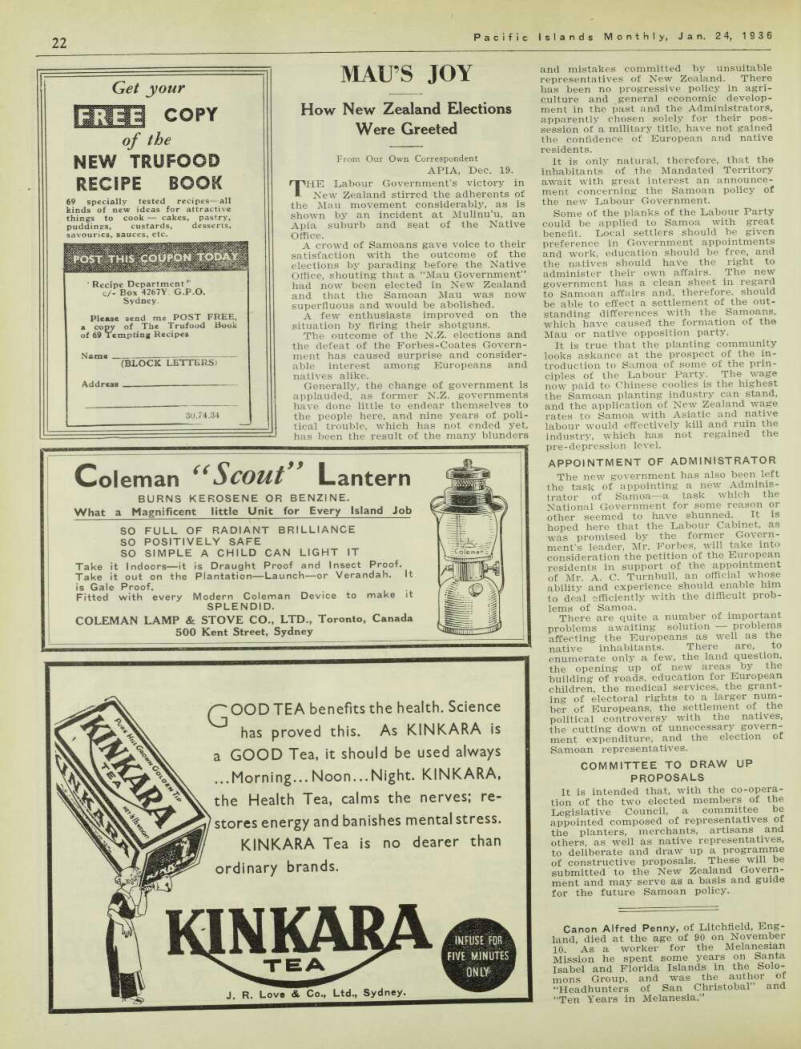
How New Zealand Elections Were Greeted
From Our Own Correspondent
Apia, Dec. 19.
THE Labour Government’s victory in New Zealand stirred the adherents of the Mau movement considerably, as is shown by an incident at Mulinu’u, an Apia suburb and seat of the Native Office.
A crowd of Samoans gave voice to their satisfaction with the outcome of the elections by parading before the Native Office, shouting that a “Mau Government” had now been elected in New Zealand and that the Samoan Mau was now superfluous and would be abolished.
A few enthusiasts improved on the situation by firing their shotguns.
The outcome of the N.Z. elections and the defeat of the Forbes-Coates Govern ment has caused surprise and consider able interest among Europeans and natives alike.
Generally, the change of government is applauded, as former N.Z. governments have done little to endear themselves to the people here, and nine years of poli tical trouble, which has not ended yet, has been the result of the many blunders
and mistakes committed by unsuitable representatives of New Zealand. There has been no progressive policy in agri culture and general economic develop ment in the past and the Administrators, apparently chosen solely for their pos session of a military title, have not gained the confidence of European and native residents.
It is only natural, therefore, that the inhabitants of the Mandated Territory await with great interest an announce ment concerning the Samoan policy of the new Labour Government.
Some of the planks of the Labour Party could be applied to Samoa with great benefit. Local settlers should be given preference in Government appointments and work, education should be free, and the natives should have the right to administer their own affairs. The new government has a clean sheet in regard to Samoan affairs and, therefore, should be able to effect a settlement of the out standing differences with the Samoans, which have caused the formation of the Mau or native opposition party.
It is true that the planting community looks askance at the prospect of the in troduction to Samoa of some of the prin ciples of the Labour Party. The wage now paid to Chinese coolies is the highest the Samoan planting industry can stand, and the application of New Zealand wage rates to Samoa with Asiatic and native labour would effectively kill and ruin the industry, which has not regained the
pre-depression level.
Appointment Of Administrator
The new government has also been left the task of appointing a new Adminis trator of Samoa —a task which the National Government for some reason or other seemed to have shunned. It is hoped here that the Labour Cabinet, as was promised by the former Govern ment’s leader, Mr. Forbes, will take into consideration the petition of the European residents in support of the appointment of Mr. A. C. Turnbull, an official whose ability and experience should enable him to deal efficiently with the difficult prob lems of Samoa.
There are quite a number of important problems awaiting solution problems affecting the Europeans as well as the native inhabitants. There are, to enumerate only a few, the land question, the opening up of new areas by the building of roads, education for European children, the medical services, the grant ing of electoral rights to a larger num ber of Europeans, the settlement of the political controversy with the natives, the cutting down of unnecessary govern ment expenditure, and the election of
Samoan representatives.
Committee To Draw Up
Proposals
It is intended that, with the co-opera tion of the two elected members of the Legislative Council, a committee be appointed composed of representatives of the planters, merchants, artisans and others, as well as native representatives, to deliberate and draw up a programme of constructive proposals. These will be submitted to the New Zealand Govern ment and may serve as a basis and guide for the future Samoan policy.
Canon Alfred Penny, of Litchfield, Eng land, died at the age of 90 on November 10. As a worker for the Melanesian Mission he spent some years on Santa Isabel and Florida Islands in the Solo mons Group, and was the author or “Headhunters of San Christobal” and “Ten Years in Melanesia.”