Fiji Cotton
p. 65 · Read in the full issue
Government Persists With Attempt to Re-establish the Industry
1 1 tHE Government of Fiji has decided to persist, for another year or two, with its efforts to establish the cotton industry in the Colony.
The Empire Cotton Growing Association sent an expert to Fiji some time ago, and attempts have been made to evolve a cross strain. Fiji-grown cotton always has been of high quality, and it is believed that, If it can be produced in sufficient quantity, cotton-growing can be made an important industry. So far, owing to world economic conditions, Fiji cotton production has shown little revival: the export last year was only ten bales.
Critics of the cotton-growing plan are not friendly. At the last meeting of the Legislative Council, Mr. J. P. Bayly said that 10 bales, after 13 years’ encourage ment, was a very poor result. He was of opinion that the Indians would not grow •cotton —it would be better to encourage other industries. Other critics, Mr, H. H.
Ragg, and Major Willoughby Tottenham, said that the world had ample cotton sup plies—America was burning a surplus of thousands of bales—and Fiji, having to pay •comparatively high wages, could not compete.
The Governor, supported by Dr. H. W.
Jack (Director of Agriculture) and Mr. K.
B. Singh (Indian member), argued that, as Fiji Sea Island cotton brought top prices, as the market was improving, and as Fiji cotton could be profitably produced if pro
duced on a large scale, it was advisable to continue, for another year or two, the at tempt to establish the industry that should Interest the small farmers.
During the American civil war, cotton was very profitably grown in the Pacific islands, and especially in Fiji. Then the industry died out. It is now part of British policy, however, to encourage cotton-grow ing within the Empire, so as to secure some measure of independence. When cotton prices were high, in the decade after the war, seed was obtained from Barbados, and Fijian growers, for two or three years, made profits. Then the industry slumped again. The demand for Sea Island cotton, which is of very fine quality, varies with the world demand for lace. That is why the authorities are trying to evolve a satis factory cross strain. Sea Island cotton, moreover, is considerably more expensive to handle than the commoner types.
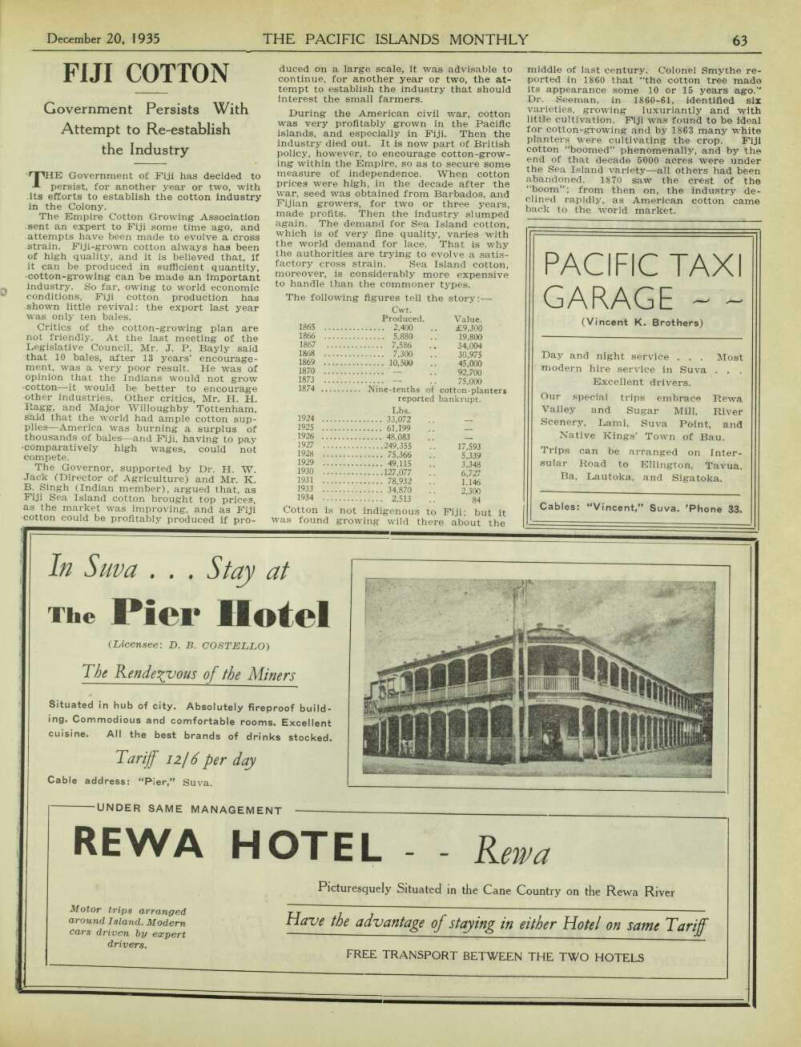
The following figures tell the story:
middle of last century. Colonel Smythe re ported in 1860 that “the cotton tree made its appearance some 10 or 15 years ago.”
Dr. Seeman, in 1860-61, identified six varieties, growing- luxuriantly and with little cultivation. Fiji was found to be ideal for cotton-growing and by 1863 many white planters were cultivating the crop. Fiji cotton “boomed” phenomenally, and by the end of that decade 5000 acres were under the Sea Island variety—all others had been abandoned. 1870 saw the crest of the “boom”; from then on, the industry de clined rapidly, as American cotton came back to the world market.
1865 ..
Cwt.
Produced. 2,400 Value. £9,300 1866 ... 5,880 19,800 1867 .. 7.586 ., 34,004 1868 ... 7,300 30,975 1869 ... 45,000 1870 ... 92,700 1873 .. 75,000 1874 ... of cotton-planters reported bankrupt. 1924 ...
Lbs. 33,072 1925 ... 1926 ... 1927 ... 17,593 1928 ... 5,339 1929 ... 3,348 1930 ... 6,727 1931 ... 1,146 1933 ... 2,300 1934 ... 84 Cotton is not indigenous to Fiji; but it was found growing wild there about the