Punishment of Native
p. 60 · Read in the full issue
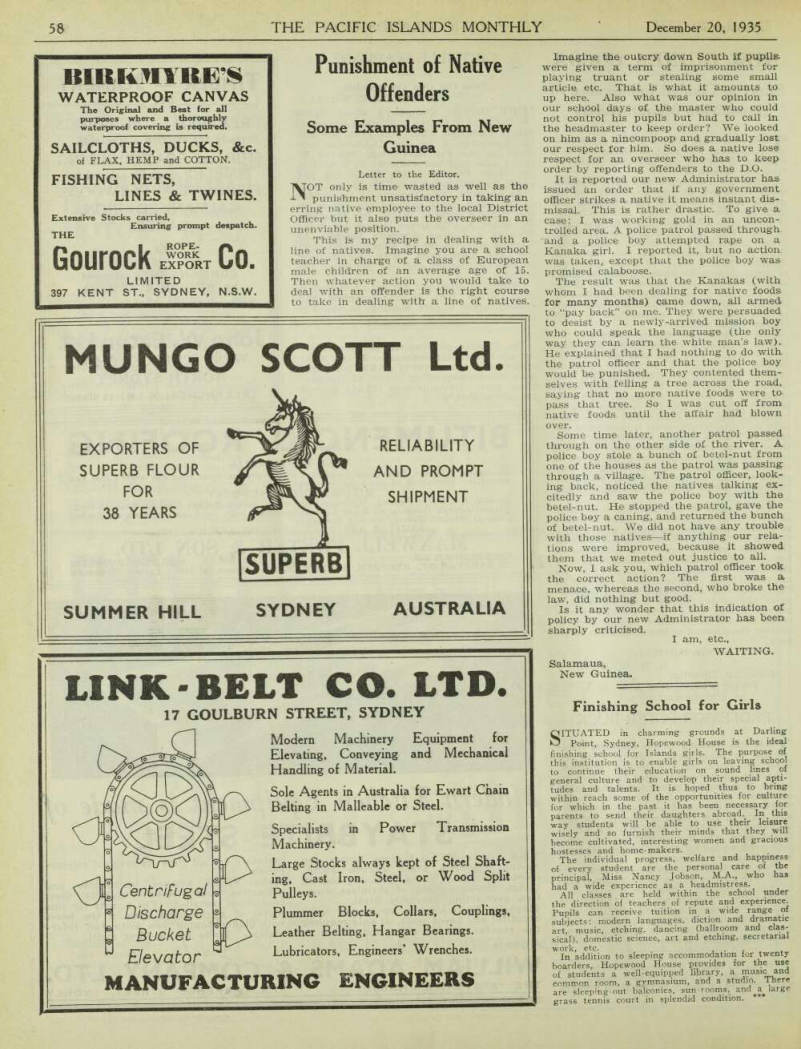
Offenders Some Examples From New Guinea
Letter to the Editor.
NOT only is time wasted as well as the punishment unsatisfactory in taking an erring native employee to the local District Officer but it also puts the overseer in an unenviable position.
This is my recipe in dealing with a line of natives. Imagine you are a school teacher in charge of a class of European male children of an average age of 15.
Then whatever action you would take to deal with an offender is the right course to take in dealing with a line of natives.
Imagine the outcry down South if pupils. were given a term of imprisonment for playing truant or stealing some small article etc. That is what it amounts to up here. Also what was our opinion in our school days of the master who could not control his pupils but had to call in the headmaster to keep order? W© looked on him as a nincompoop and gradually lost our respect for him. So does a native lose respect for an overseer who has to keep order by reporting offenders to the D.O.
It is reported our new Administrator has issued an order that if any government officer strikes a native it means instant dis missal. This is rather drastic. To give a. case: I was working gold in an uncon trolled area. A police patrol passed through and a police boy attempted rape on a Kanaka girl. I reported it, but no action was taken, except that the police boy wa& promised calaboose.
The result was that the Kanakas (with whom I had been dealing for native foods for many months) came down, all armed to “pay back” on me. They were persuaded to desist by a newly-arrived mission boy who could speak the language (the only way they can learn the white man’s law).
He explained that I had nothing to do with the patrol officer and that the police boy would be punished. They contented them selves with felling a tree across the road, saying that no more native foods were to pass that tree. So I was cut off from native foods until the affair had blown over.
Some time later, another patrol passed through on the other side of the river. A police boy stole a bunch of betel-nut from one of the houses as the patrol was passing through a village. The patrol officer, look ing back, noticed the natives talking ex citedly and saw the police boy with the betel-nut. He stopped the patrol, gave the police boy a caning, and returned the bunch of betel-nut. We did not have any trouble with those natives —if anything our rela tions were improved, because it showed them that we meted out justice to all.
Now, I ask you, which patrol officer took the correct action? The first was a menace, whereas the second, who broke the law, did nothing but good.
Is it any wonder that this indication of policy by our new Administrator has been sharply criticised.
I am, etc.,
Waiting.
Salamaua, New Guinea.