An Ancient Tahitian Marae
p. 48 · Read in the full issue
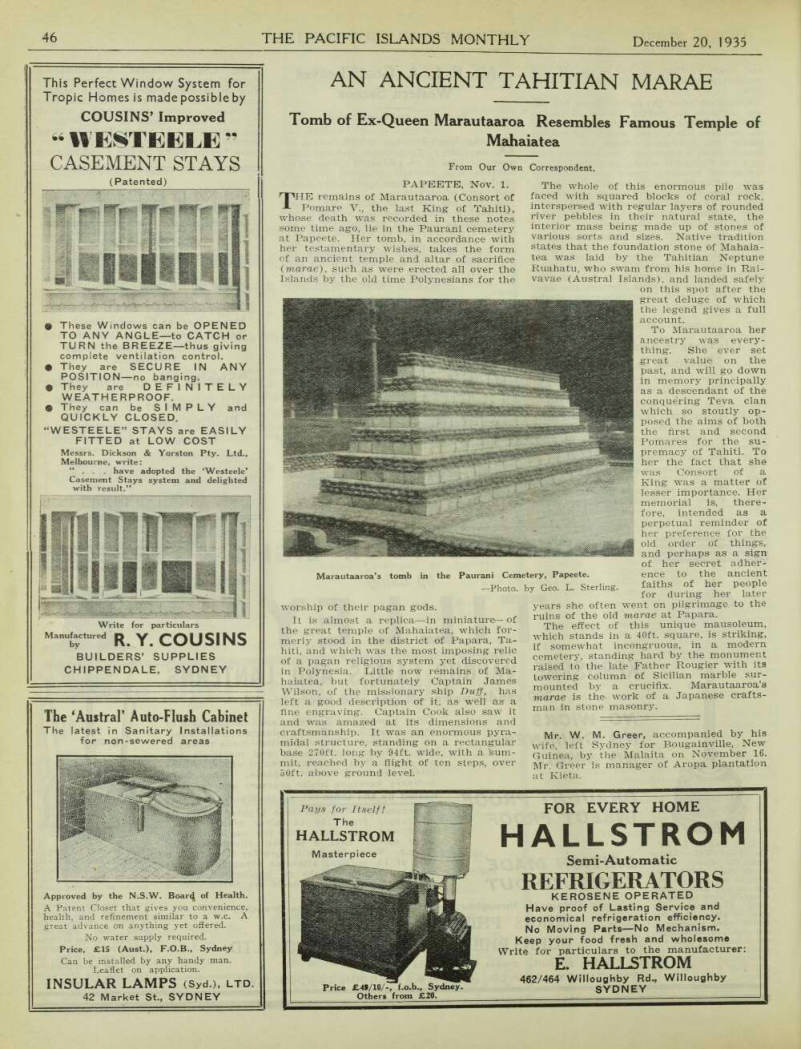
Tomb of Ex-Queen Marautaaroa Resembles Famous Temple of Mahaiatea
From Our Own Correspondent.
Papeete, Nov. 1.
THE remains of Marautaaroa (Consort of Pomare V., the last King of Tahiti), whose death was recorded in these notes some time ago, lie in the Paurani cemetery at Papeete. Her tomb, in accordance with her testamentary wishes, takes the form of an ancient temple and altar of sacrifice (marae), such as were erected all over the Islands by the old time Polynesians for the
worship of their pagan gods.
It is almost a replica—in miniature—of the great temple of Mahaiatea, which for merly stood in the district of Papara, Ta hiti, and which was the most imposing relic of a pagan religious system yet discovered in Polynesia. Little now remains of Ma haiatea, but fortunately Captain James Wilson, of the missionary ship Duff, has left a good description of it, as well as a fine engraving. Captain Cook also saw it and was amazed at its dimensions and draftsmanship. It was an enormous pyra midal structure, standing on a rectangular base 270 ft. long by 94ft. wide, with a Sum mit, reached by a flight of ten steps, over 50ft. above ground level.
The whole of this enormous pile was faced with squared blocks of coral rock, interspersed with regular layers of rounded river pebbles in their natural state, the interior mass being made up of stones of various sorts and sizes. Native tradition states that the foundation stone of Mahaia tea was laid by the Tahitian Neptune Ruahatu, who swam from his home in Rai vavae (Austral Islands), and landed safely
on this spot after the great deluge of which the legend gives a full account.
To Marautaaroa her ancestry was every thing. She ever set great value on the past, and will go down in memory principally as a descendant of the conquering Teva clan which so stoutly op posed the aims of both the first and second Pomares for the su premacy of Tahiti. To her the fact that she was Consort of a King was a matter of lesser importance. Her memorial is, there fore, intended as a perpetual reminder of her preference for the old order of things, and perhaps as a sign of her secret adher ence to the ancient faiths of her people for during her later
years she often went on pilgrimage to the ruins of the old marae at Papara.
The effect of this unique mausoleum, which stands in a 40ft. square, is striking, if somewhat incongruous, in a modern cemetery, standing hard by the monument raised to the late Father Rougier with its towering column of Sicilian marble sur mounted by a crucifix. Marautaaroa’s marae is the work of a Japanese crafts man in stone masonry.
Mr. W. M. Greer, accompanied by his wife, left Sydney for Bougainville, New Guinea, by the Malaita on November 16.
Mr. Greer is manager of Aropa plantation at Kieta.
Marautaaroa’s tomb in the Paurani Cemetery, Papeete. —'Photo, by Geo. L. Sterling.