Big Developments In Dutch New Guinea
pp. 24-26 · Read in the full issue
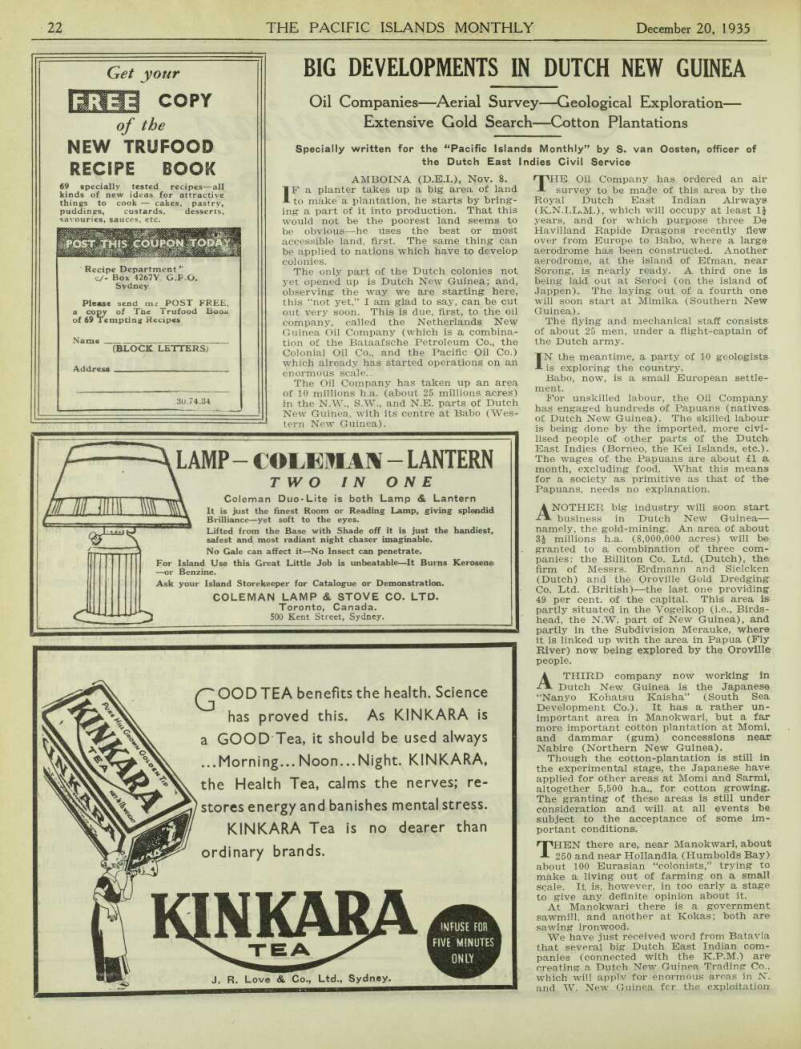
Oil Companies—Aerial Survey—Geological Exploration— Extensive Gold Search—Cotton Plantations
Specially written for the “Pacific Islands Monthly" by S. van Oosten, officer of the Dutch East Indies Civil Service
Amboina (D.E.1.), Nov. 8.
IF a planter takes up a big area of land to make a plantation, he starts by bring ing a part of it into production. That this would not be the poorest land seems to be obvious —he uses the best or most accessible land, first. The same thing can be applied to nations which have to develop colonies.
The only part of the Dutch colonies not yet opened up is Dutch New Guinea; and, observing the way we are starting here, this “not yet,” I am glad to say, can be cut out very soon. This is due, first, to the oil company, called the Netherlands New Guinea Oil Company (which is a combina tion of the Bataafsche Petroleum Cos., the Colonial Oil Cos., and the Pacific Oil Cos.) which already has started operations on an enormous scale..
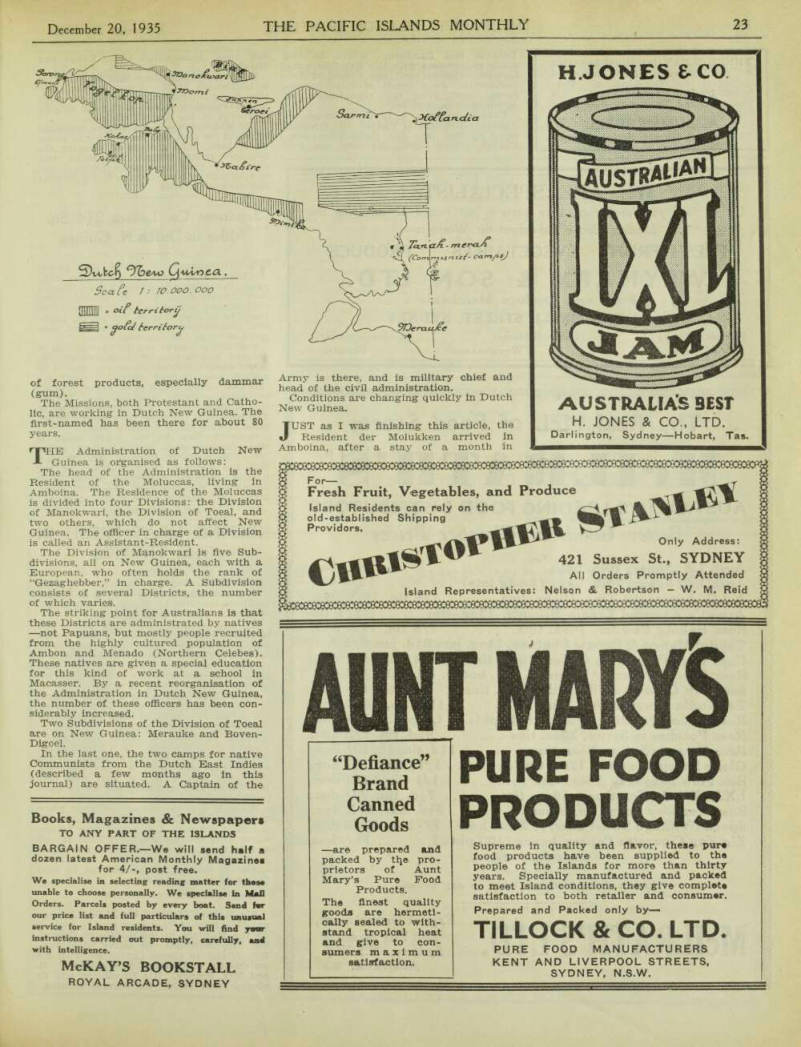
The Oil Company has taken up an area of 10 millions h.a. (about 25 millions acres) in the N.W., S.W., and N.E. parts of Dutch New Guinea, with its centre at Babo (Wes tern New Guinea).
THE Oil Company has ordered an air survey to be made of this area by the Royal Dutch East Indian Airways (K.N.1.L.M.), which will occupy at least years, and for which purpose three De Havilland Rapide Dragons recently flew over from Europe to Babo, where a large aerodrome has been constructed. Another aerodrome, at the island of Efman, near Sorong, is nearly ready. A third one is being laid out at Seroei (on the island of Jappen). The laying out of a fourth one will soon start at Mimika (Southern New Guinea).
The flying and mechanical staff consists of about 25 men, under a flight-captain of the Dutch army.
IN the meantime, a party of 10 geologists is exploring the country.
Babo, now, is a small European settle ment.
For unskilled labour, the Oil Company has engaged hundreds of Papuans (natives of Dutch New Guinea). The skilled labour is being done by the imported, more civi lised people of other parts of the Dutch East Indies (Borneo, the Kei Islands, etc.).
The wages of the Papuans are about £1 a month, excluding food. What this means for a society as primitive as that of the Papuans, needs no explanation.
ANOTHER big industry will soon start business in Dutch New Guinea — namely, the gold-mining. An area of about 3| millions h.a. (8,000,000 acres) will be granted to a combination of three com panies: the Billiton Cos. Ltd. (Dutch), the firm of Messrs. Erdmann and Sielcken (Dutch) and the Oroville Gold Dredgingr Cos. Ltd. (British) —the last one providing 49 per cent, of the capital. This area is partly situated in the Vogelkop (i.e., Birds head, the N.W. part of New Guinea), and partly in the Subdivision Merauke, where it is linked up with the area in Papua (Fly River) now being explored by the Orovillo people.
A THIRD company now working in Dutch New Guinea is the Japanese “Nanyo Kohatsu Kaisha” (South Sea Development Cos.). It has a rather un important area in Manokwari, but a far more important cotton plantation at Momi, and dammar (gum) concessions near Nabire (Northern New Guinea).
Though the cotton-plantation is still in the experimental stage, the Japanese have applied for other areas at Momi and Sarmi, altogether 5,500 h.a., for cotton growing.
The granting of these areas is still under consideration and will at all events be subject to the acceptance of some im portant conditions.
THEN there are, near Manokwari, about 250 and near Hollandia (Humbolds Bay) about 100 Eurasian “colonists,” trying to make a living out of farming on a small scale. It is, however, in too early a stage to give any definite opinion about it.
At Manokwari there is a government sawmill, and another at Kokas; both are sawing ironwood.
We have just received word from Batavia that several big Dutch East Indian com panies (connected with the K.P.M.) are creating a Dutch New Guinea Trading Cos., which will applv for enormous areas in N. and W. New Guinea fcr the exploitation
of forest products, especially dammar (sum).
The Missions, both Protestant and Catho lic, are working in Dutch New Guinea. The first-named has been there for about 80 years. fTTHE Administration of Dutch New A Guinea is organised as follows: The head of the Administration is the Resident of the Moluccas, living in Amboina. The Residence of the Moluccas is divided into four Divisions: the Division of Manokwari, the Division of Toeal, and two others, which do not affect New Guinea. The officer in charge of a Division is called an Assistant-Resident.
The Division of Manokwari is five Sub divisions, all on New Guinea, each with a European, who often holds the rank of “Gezaghebber,” in charge. A Subdivision consists of several Districts, the number of which varies.
The striking point for Australians is that these Districts are administrated by natives —not Papuans, but mostly people recruited from the highly cultured population of Ambon and Menado (Northern Celebes).
These natives are given a special education for this kind of work at a school in Macasser. By a recent reorganisation of the Administration in Dutch New Guinea, the number of these officers has been con siderably increased.
Two Subdivisions of the Division of Toeal are on New Guinea: Merauke and Boven- Digoel, In the last one, the two camps for native Communists from the Dutch East Indies (described a few months ago in this journal) are situated. A Captain of the
Army is there, and is military chief and head of the civil administration.
Conditions are changing quickly in Dutch New Guinea.
JUST as I was finishing this article, the Resident der Molukken arrived in Amboina, after a stay of a month in
Batavia and Bandoeng, where he had many conferences with His Excellency the Governor-General and the Chiefs of De partments. As a result of these confer ences, next year the organisation of Administration will be: Fakfak becomes a Division, under an Assistant-Resident at Fakfak, the Division being divided into five Subdivisions —i.e., Fakfak, Boven-Digoel, Merauke and two
new ones; Inanawatan (near Babo) and Mimika.
East, of Mimika, there will be stationed a Lieutenant of the Army, at the same time doing Administration work; the same in the Vogelkop, where a Captain will be in charge of the new Subdivision.
The number of soldiers will be increased by about 160 men, and the number of police by 60 men. The process of bringing the country under control will make this necessary. Four more medical officers will be stationed on New Guinea; also a forester and an agriculturist.