Housekeeping in the Tropics
pp. 68-69 · Read in the full issue
Conducted by “Dorothea”
For Beauty In Tropical Distress
SHOULD your face cream harden, screw the lid on tightly, and stand the jar in a saucepan of cold water. Heat water slowly, and keep it hot (but not boiling lest the jar cracks) until the cream is soft again. Always keep lids screwed on tightly, as it is the exposure to the air which causes creams to harden.
If liquid nail varnish has hardened, warm slightly, as for hardened cream, and add a few drops of methylated spirits afterwards.
For face powder that has lost its perfume, moisten a circle of blotting paper with scent, insert inside lid and leave box closed for a few days. If the perfume used on the blotting paper matches the previous powder perfume, so much the better.
Lumps in powder may be extracted by sifting the powder through a piece of silk material.
A slight smear of vaseline or olive oil inside the lid of the rouge jar or tin keeps the contents moist.
Lipsticks wrapped in blotting paper rarely wilt in the heat.
Keep all cosmetics in a drawer or box, not left out on the dressing table. This remark applies particularly to bottle perfumes, which should have tightly-fitting rubber stoppers, not cork ones.—
“Judy S.”
Banana Pie
A splendid tropical dessert, within the reach of all, is a banana pie and most cook boys easily manage it. Serve it with canned cream and it is delicious. Make a pie-crust in the usual way and line a pie-plate in the usual way with a layer of the pastry; bake in oven until done. Make a mix ture of three bananas, which have been mashed and then whipped with an egg-beater, add 1 cup sugar, 1 dessertspoonful lemon juice, pinch of salt, and the whites of 2 eggs beaten until frothy; pour this mixture into the pastry-lined dish, and bake
for 20 minutes. When finished, sprinkle withi desiccated coconut or chopped nuts, serve at once.
“Bulwa.”
New Guinea.
Mysterious Wings
When our groceries from down South were un packed recently there was a brand of flour witbi wings on the bag.
My cook-boy rushed out and brought in his one-talks (fellow tribesmen —men of the same dialect).
After much jabbering, I asked him: “What name ’e now?”
Pointing to the flour, said Arnbung: “Him Kai kai (food), belonga Jesus Christ. ’E all same wings same Jesus Christ!”
And they were quite reverent about it.
“Bulwa.”
New Guinea.
En Route To Heaven
’Planes of any description are still a novelty in the Solomons, many natives not having seen one.
During the recent visit of H.M.S. Sussex her sea-plane flew over our place. A new Malaita “boy” watched it with wonderment, and, turning to me, said: “Some feller stop along him?”
“Yes,” I replied; “might be two feller.”
“What way engine he work?” asked Donai.
“Two feller savvy work him,” I answered.
Donai looked at me doubtfully. “You no gam mon me, missus,” he said reproachfully. “Me savvy man he die finish, no savvy workem en- S “But two feller no die,” I told him-. “Two feller savvy walk about, savvy kai-kai, savvy sleep—all the same you and me.”
“My,” said Donai, a smile spreading over his face. “Me tink two feller die finish; now him go along heaven along this something.”
“Bititamboa.”
Tulagi, S.I. (For the benefit of those in non-Pidgin terri tories: The boy, when assured that there was one, and perhaps two men in the seaplane, asked how the engine was operated. He refused to believe that a dead man could operate an engine.
Finally he decided that the seaplane was a heavenly manifestation, and provided the two dead men with a way of getting to heaven.)
Little Islanders’ Corner
Dear Dorothea,—What memories the “P.1.M.” awakens in one’s heart, and what longings as well.
As a small child, and up to a couple of years ago, I spent my life in New Guinea. My father owned a small island 60 miles off the mainland. Jwe used to travel a great deal in our schooner. The fascination of those tropic seas and isles are al ways calling us all back, and some day we 11 pack and be off, unable to withstand the call any longer.
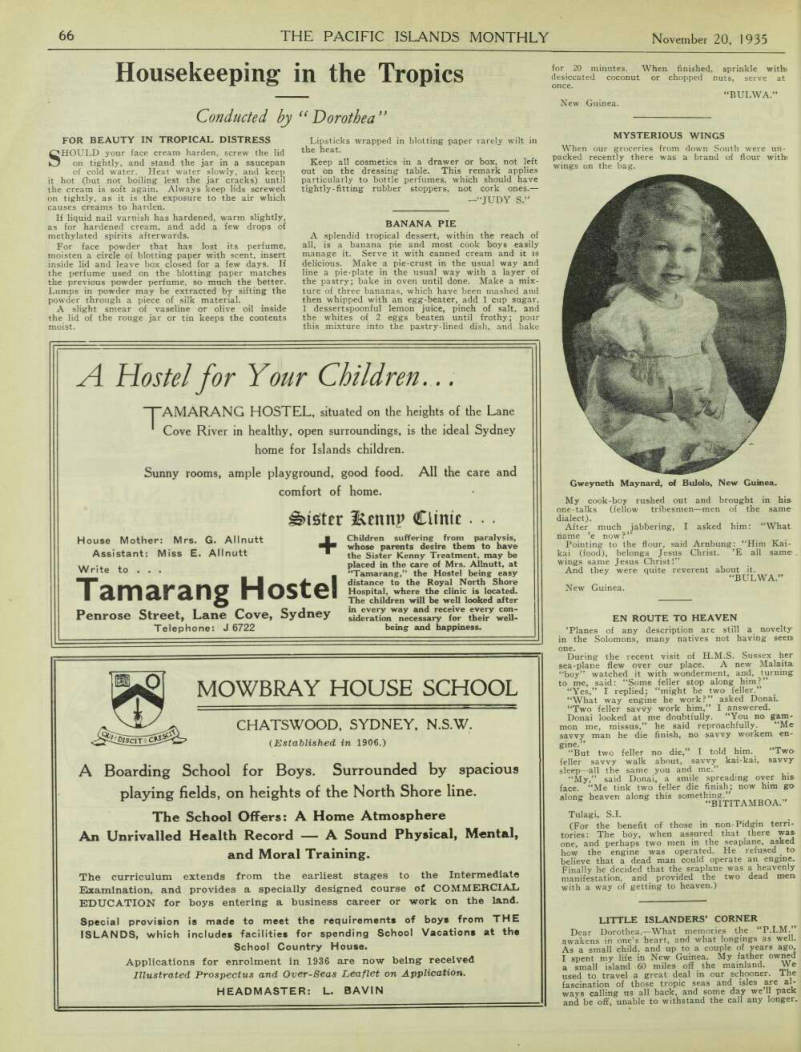
Gweyneth Maynard, of Bulolo, New Guinea.
I have written a serial, and called it Peril Isle —all about our dear isle of Pampus. The serial was accepted by a Queensland paper; it is amaz ing how ignorant people are about my New Guinea —it makes me cross at times.
Could you find me a pen-friend in the Solomons or New Guinea ?
C. Queensland.
Dawn.
Dear Dorothea,—The things the natives do and say quite innocently often cause a good laugh amongst the white folk.
We had a new cook boy, who had never been employed before. He had been with us about a fortnight, when one day, while mother was making pastry, she was surprised to see him staring at the contents of a basin. Not able to keep quiet any longer, he looked up and said, “What here cement?” A few hours later the “cement” was two big pies, which he had the honour to bring round to the table.
It’s quite common to ask the cook boy if ttie kettle is boiling. One of the cooks, when a new chum, was asked if “Kettle he boila?” and, after
looking about him rather amazed, and throwing a glance towards the stove, answered, in a bewildered voice: “No more, missus; water, das all.”
Still another story is told by a friend, who had been out pigeon shooting. Arrived home, he gave his catch to one of his cook-boys, saying, “Here, take out grass alonga this fella” —meaning for the boy to pluck the birds. But the boy was busy, and passed them to the other cook. “Take out grass alonga dis fella,” he repeated.
“What!” said the other boy, scornfully, “You no savvy? Him no grass, him hair.” Their master was laughing too much to tell them it was feathers. (“Grass” is the Pidgin for hair, feathers, and any similar covering.) There came to our house one day a boy who was known and talked about by the natives for
the way he could speak English, having been to a mission school. I can speak Pidgin English and Englsh, but he strung English words together in such a way that I could not understand. So I asked him in his own lingo what he meant.
He told all and sundry afterwards that I couldn’t speak English. However, before he went he noticed upon the wall our barometer, and, thinking it a clock, asked if it had “the right time.”
Tulagi, S.I.
Geoff. Gaskell.
Geoff, and Jack Gaskell, of Tulagi, S.I., with their pet dog.
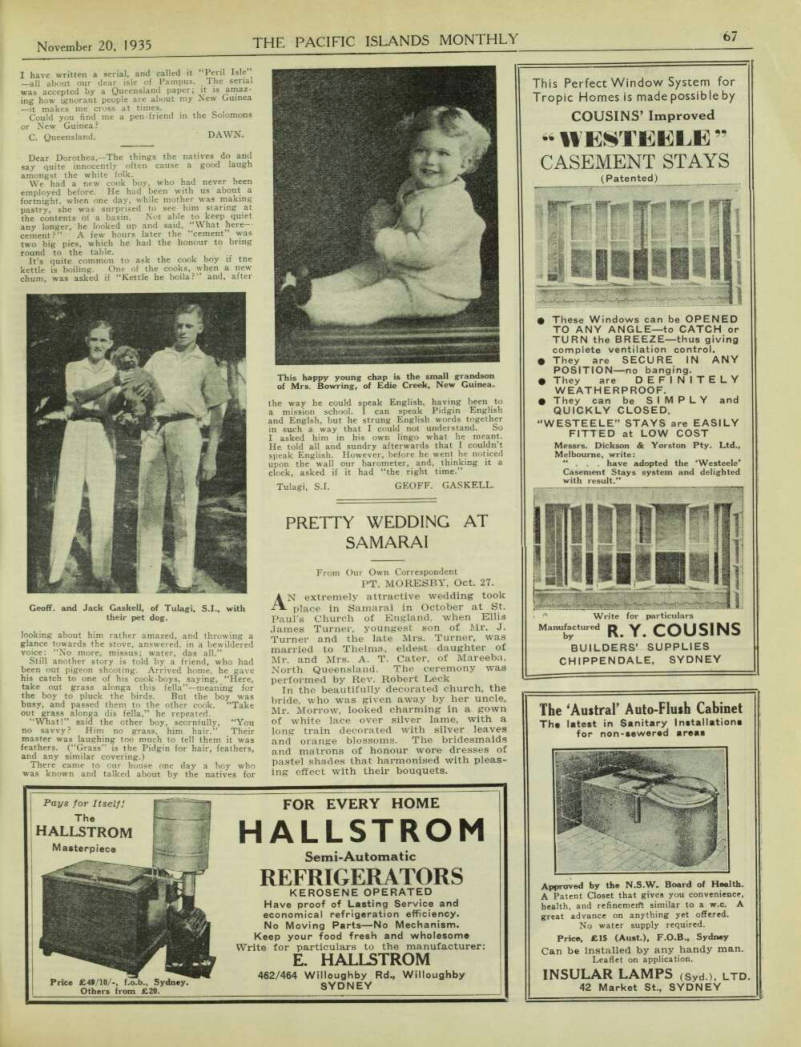
This happy young chap is the small grandson of Mrs. Bowring, of Edie Creek, New Guinea.