Men Who Knew Yesterday
pp. 42-44 · Read in the full issue
By Julian Hillas
3.—Stephan Savage
T>EADERS of the “Journal of Poly nesian Research” already are ac acquainted with the name of Stephan Savage as a contributor and authority on matters Polynesian.
Born in New Zealand, on the Thames Goldfields, Savage hit the Islands trail at the age of 21, coming to Rarotonga in 1894 on the invitation of Henry Nicholas, then a prominent figure in the small white community, and owner of a cotton ginnery erected during the boom which followed the American Civil War. But cotton was never a great success in the Islands and here, as in Tahiti, one comes across the rusting remains of machinery that scarcely paid its own freight charges.
Henry Nicholas, however, had other irons in the fire and young Savage soon found himself building buggies, temper ing steel and acting as a compositor on the “Torea” —first non-sectarian news sheet in the Protectorate. A certain independence of spirit led to differences of opinion and old Mr. Nicholas, having the usual prerogative of employers, used it to terminate their association.
From the “Torea,” Savage went over to the rival “loi Karenga,” published by Oscar Owen, a former Melbourne printer, A year or so later he bought out the latter and, the paper having been in corporated with the “Cook Islands Gazette,” he continued issuing it, with the help of five native assistants, until 1900, when Colonel Gudgeon, C.M.G.,
offered him the appointment of Inter preter and Clerk to the Federal Parlia ment. But the dual position soon created difficulties of its own, the same indepen dent spirit leading Savage to publish several critical and derogatory letters in the “loi Karenga,”
The end of the paper was brought about by Colonel Gudgeon, with charac teristic directness. Marching into the editorial office, the irate old gentleman waved the offending sheet in the air and then pointed to a peculiarly offensive letter. After listening to Savage’s ex planations he turned round suddenly, in terrupting him in the middle of a sen tence.
“What’ll you take to close the paper altogether?” he demanded; and, without giving the other time to reply, he slapped down on the table an appointment as Government Secretary. “How’ll that suit you?” he went on, darkly. “No self respecting Secretary would think of running down his own Administration.”
A week later the “loi Karenga” dis appeared from circulation!
The Federal Parliament continued to exist until the Annexation of the Group in 1901, when it was superceded by a Resident Commissioner and an Island Council consisting of nominated represen tatives of the principal districts. At the last Parliamentary session the Speaker, John Salmon, took advantage of the occasion to have himself awarded the one and only distinction ever conferred by that august body and a motion was duly
passed whereby “he be directed to obtain for himself a medal commemorating his long service as a Speaker.” Where and how he raised the money no one knew, for Parliament never made any grant, but in due course the decoration arrived and, together with a gold-laced cap, made a regular appearance at all the public and social functions their owner attended.
John Salmon was always a little vague about his medal.
Poor John! In the heyday of his youth he had married an island princess, a niece of the great Makea Ariki Nui, and he later reigned with her at Arorangi, where he alternately signed their joint correspondence as “Prince Consort” or “Minister of Finance,” according to the exigencies of the moment. He died in extreme poverty, ejected from the Palace after his wife’s death, and attended by one faithful servant almost as decrepit as himself.
Like a little flash of colour, his story flares up through the prosaic realities of the present, Romance, princesses and medals are, alas, no more to be found in the Islands, where even life and laughter hardly move at the same light-hearted tempo as they did in the days of John Salmon and Queen Tinomana.
Under the New Zealand administration Savage retained his Secretarial post until 1909, when he became Deputy Registrar of Courts and Deeds. In 1919, he was promoted to Registrar of the Court and, again in 1925, received the additional ap pointment of Commissioner of the High Court.
Always an enthusiastic student of Polynesia, he has been in the fortunate position of having held official posts which brought him into close contact with native life. There is probably no better or more reliable authority on the Cook Island dialects than Mr. Savage.
At the request of the N.Z. Maori Research Board, he recently compiled a much needed Rarotongan dictionary, containing some 6,000 words. The manuscript of the various sections was read by that eminent Maori scholar, the late Elsdon Best, and the whole is due shortly to appear in book form.
Twice married and the father of eleven childen, he has had unique facilities for
observing the growth of a local colour bar. Thirty years ago such a thing was virtually unknown. Even the few white women here a?t that time mixed freely with the better-class native families who again,' possessed a courtesy, dignity and hospitality now practically extinct. From subsequent remarks on the subject, I rather gathered that the existing colour prejudices were largely in the nature of a defensive reaction, in the face of un equal sex competition.
Everyone, it appeared, was better off in those days. Exports were more varied and the maze of regulations which has since grown up around them had not yet started. Debts were almost unknown and tc make sure they continued so a “Private Debtors Act’’ prohibited the legal recovery of any debt incurred by a native. The chances of recovery being thus left to the personal honesty of a debtor, store keepers showed a marked aversion to credit transactions. The Act was abolish ed in 1909, and over its grave a monu mental kaiou has raised itself and, still mounting, threatens eventually to crush debtor and creditor alike under its colossal proportions.
In the palmy times of the Federal Par liament, laws against immorality and light dalliance between the sexes oc casionally went hand-in-hand with the grossest corruption in high places. A reminiscent twinkle came into Mr.
Savage’s eyes as he spoke of his own youthful experiences ... There was the affair of Constable lota and Tepou Te rangi, then Chief Judge of the Federal Court. Perhaps that was the best example he could give me of how things were conducted. . . Yes, he certainly thought so. .. Thirty six years ago, now, but Time passes very quickly in the Islands. . Mr. Savage lit one of those twisty little black cheroots which he secretes about his person in odd pockets.
I am afraid Mr. Savage had been mis behaving himself 36 years ago. I am quite sure that he was breaking the Calvinistic law by which it was absolutely verhoten to invite one’s girl-friend indoors after dark. Nevertheless, she was inside and, Mr. Savage was also inside. The incident might not have been worthy of remark, had it not been for the nasty suspicions of Constable lota.
Constable lota heard voices and knock ed. Fortunately, he was unable to get in.
With presence of mind, young Stephan thrust his visitor into a large cedar-wood chest, and closed the lid on her, before opening the door. The constable looked round in surprise. On the floor lay a jaunty little wreath of frangipani flowers.
The creamy white petals gleamed coquet tishly at him and his frown deepened.
Lifting a pillow, he smelt it gingerly. The fragrance of scented coconut-oil wafted upward to the official nose. But where was the lady?
Young Stephan protested strongly against these deductions, and sat himself firmly on the chest. Would Constable lota care for a small “spot” of rum?
Constable lota would. And did. But still he lingered. And, when finally he left, the wreath and pillow accompanied him as evidence to support his charge.
Not lightly was he going to abandon the chances of a ten dollar fine, out of which he would be entitled to receive a quarter share.
After a sleepless night, Stephan was up early and on his way to interview old Tepou Terangi, the chief judge. He found the latter drinking his morning coffee on the verandah.
“Good morning,” said Stephan, politely.
Tepou looked him over shrewdly. “You very early. What you want?”
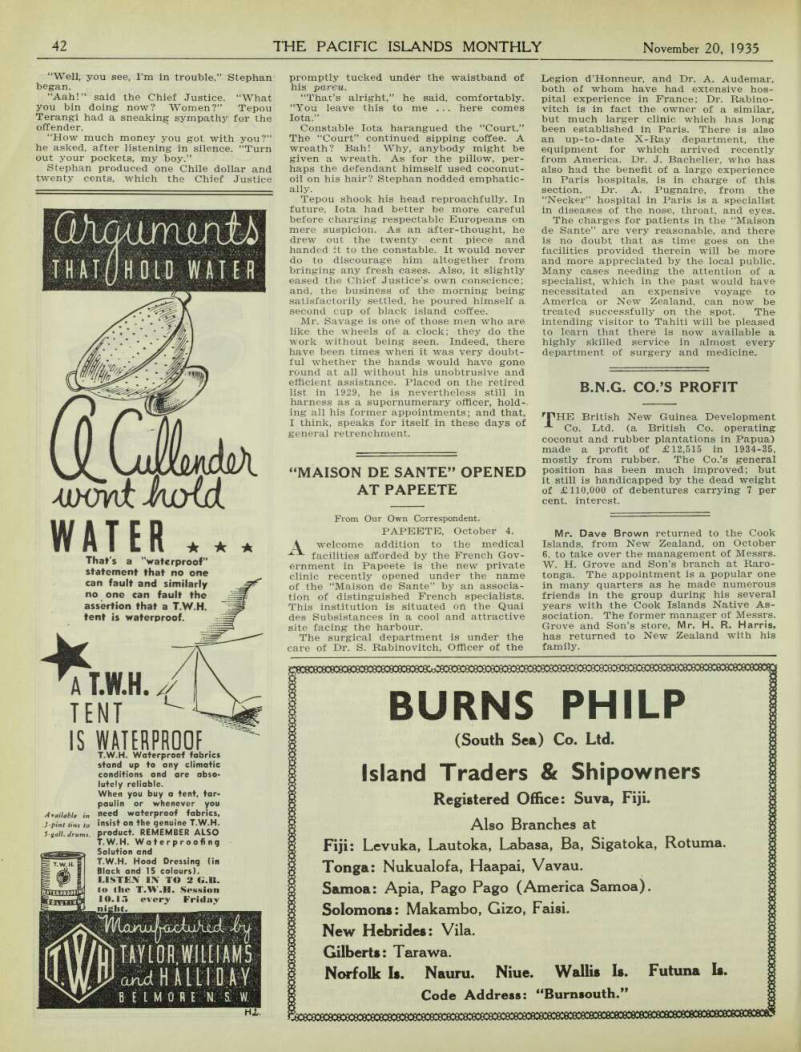
Mr. S. Savage and Mrs. Savage, with Rongo-ma- Tane, Chief of the Island of Atiu (Cook Group); a photograph taken when Mr. Savage was leaving Atiu after a term there as Resident Agent.
“Well, you see, I’m in trouble,” Stephan began.
“Aah!” said the Chief Justice. “What you bin doing now? Women?” Tepou Terangi had a sneaking sympathy for the offender.
“How much money you got with you?” he asked, after listening in silence. “Turn out your pockets, my boy.”
Stephan produced one Chile dollar and twenty cents, which the Chief Justice
promptly tucked under the waistband of his pareu.
“That’s alright,” he said, comfortably.
“You leave this to me ... here comes lota.”
Constable lota harangued the “Court.”
The “Court” continued sipping coffee. A wreath? Bah! Why, anybody might be given a wreath. As for the pillow, per haps the defendant himself used coconut oil on his hair? Stephan nodded emphatic ally.
Tepou shook his head reproachfully. In future, lota had better be more careful before charging respectable Europeans on mere suspicion. As an after-thought, he drew out the twenty cent piece and handed :t to the constable. It would never do to discourage him altogether from bringing any fresh cases. Also, it slightly eased the Chief Justice’s own conscience; and, the business of the morning being satisfactorily settled, he poured himself a second cup of black island coffee.
Mr. Savage is one of those men who are like the wheels of a clock; they do the work without being seen. Indeed, there have been times when it was very doubt ful whether the hands would have gone round at all without his unobtrusive and efficient assistance. Placed on the retired list in 1929, he is nevertheless still in harness as a supernumerary officer, hold ing all his former appointments; and that, I think, speaks for itself in these days of general retrenchment.