Training School
p. 24 · Read in the full issue
Natives As Medical
Practitioners
Remarkable Work of Suva Training School
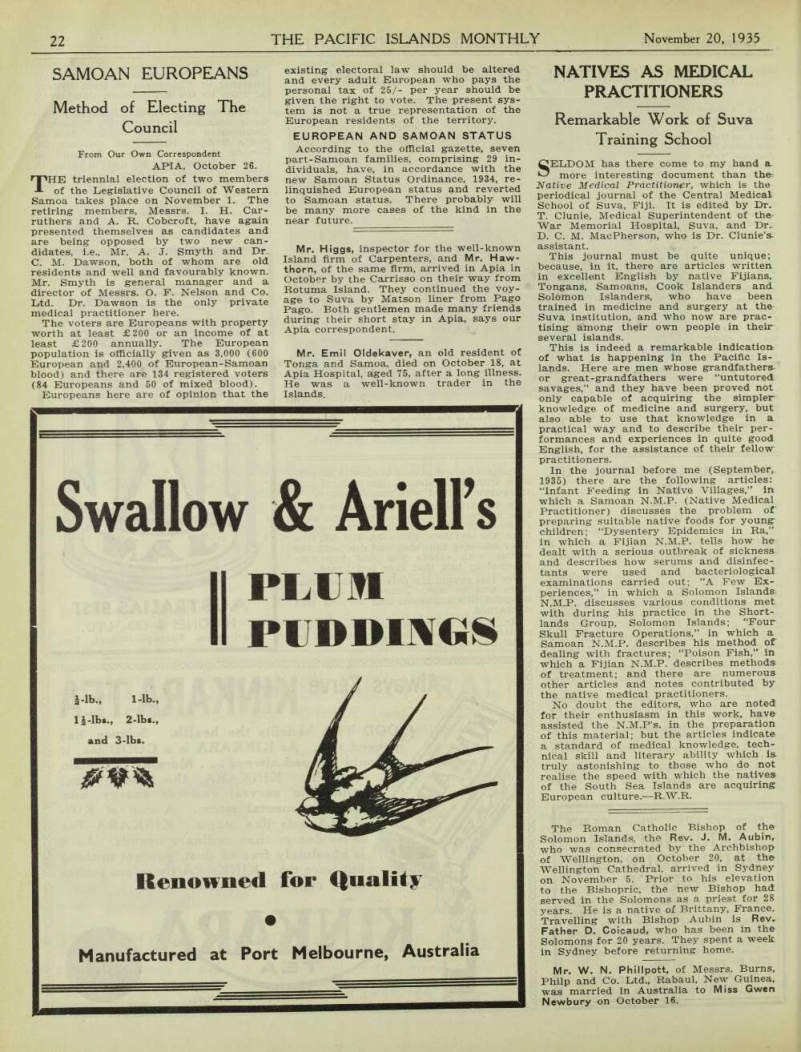
SELDOM has there come to my hand a more interesting document than Native Medical Practitioner, which is the periodical journal of the Central Medical School of Suva, Fiji. It is edited by Dr, T. Clunie, Medical Superintendent of the- War Memorial Hospital, Suva, and D. C. M. MacPherson, who is Dr. assistant.
This journal must be quite unique; because, in it, there are articles written, in excellent English by native Fijians, Tongans, Samoans, Cook Islanders and Solomon Islanders, who have been trained in medicine and surgery at the Suva institution, and who now are prac tising among their own people in their several islands.
This is indeed a remarkable indication of what is happening in the Pacific Is lands. Here are men whose grandfathers or great-grandfathers were “untutored savages,” and they have been proved not only capable of acquiring the simpler knowledge of medicine and surgery, but also able to use that knowledge in a practical way and to describe their per formances and experiences in quite good English, for the assistance of their fellow practitioners.
In the journal before me (September,. 1935) there are the following articles: “Infant Feeding in Native Villages,” in which a Samoan N.M.P. (Native Medical Practitioner) discusses the problem or preparing suitable native foods for young children; “Dysentery Epidemics in Ra,” in which a Fijian N.M.P. tells how he dealt with a serious outbreak of sickness and describes how serums and disinfec tants were used and bacteriological examinations carried out; “A Few Ex periences,” in which a Solomon Islands N.M.P. discusses various conditions met with during his practice in the Short lands Group, Solomon Islands; “Four Skull Fracture Operations,” in which a Samoan N.M.P. describes his method of dealing with fractures; “Poison Fish,” in which a Fijian N.M.P, describes methods of treatment; and there are numerous other articles and notes contributed by the native medical practitioners.
No doubt the editors, who are noted for their enthusiasm in this work, have assisted the N.M.P’s. in the preparation of this material; but the articles indicate a standard of medical knowledge, tech nical skill and literary ability which is truly astonishing to those who do not realise the speed with which the natives of the South Sea Islands are acquiring European culture. —R.W.R.
The Roman Catholic Bishop of the Solomon Islands, the Rev. J. M. Aubin, who was consecrated by the Archbishop of Wellington, on October 20, at the Wellington Cathedral, arrived in Sydney on November 5. Prior to his elevation to the Bishopric, the new Bishop had served in the Solomons as a priest for 28 years. He is a native of Brittany, France.
Travelling with Bishop Aubin is Rev.
Father D. Coicaud, who has been in the Solomons for 20 years. They spent a week in Sydney before returning home.
Mr. W. N. Phillpott, of Messrs. Burns, Philp and Co. Ltd., Rabaul, New Guinea, was married in Australia to Miss Gwen Newbury on October 16.