Future Of Solomon Islands
pp. 11-12 · Read in the full issue
Arguments For and Against Australian Control
Letter to the Editor.
f’ OULD the Solomon Islands be administered from Rabaul?”
The question, given prominence in your issue dated July 23. has for long exercised the minds of settlers and those t°^ er c S ou:t h r°y. haVe ’ indir6Ctly ’ " in The answer vouchsafed by many thinking, responsible persons may be summed up in the phrase “Why not?” This reply, it must be confessed, is based largely on the prevailing feeling that any change in administrative control can hardly fall short of being an improvement on the apathetic, entirely selfish and futile methods that now obtain.
Your contention that S.I. officials are not always to blame for much of the weakness and inefficiency with which they are frequently charged will meet with fairly general acceptance. They are by no means faultless; but that aspect of the matter is subsidiary to the much more important one of London-Suva, or Canberra-Rabaul control, and may be regarded as a detail which doubtless would receive attention if, and when, a change ° f^ dministration took place - The statement that “there is nothing Inherently wrong with what is done by Suva ’ raises a tempest of protest. There is an appalling lack of interest, sympathy ana understanding of the conditions and of th e Solomons, combined with a disdainful attitude towards all representations by those who do know and are e?nme r nt ed nf°^ the p We f lfa f e a + nd S£ d gOV ‘ ernment of the Protectorate. The case fJLcTiT- bUVa r , Ule was / tated at some length m your columns a few months ago under the caption “Should the Governor of Fiji be High Commissioner for the
Western Pacific,- and it is unnecessary to quote here the reasoned arguments advanced by your contributor. Epitom ised, they were (if Mr. Kipling will for give the liberty with his immortal lines): at Su a va 'SSJT* °* *° l — But if this question of change in the territorial ownership of the Solomons is to become a subject of practical politics, and is to receive the serious consideration it deserves, care must be taken to guard against the dissemination of erroneous information and exaggerated statements.
S.I. affairs are not intimately known in Australia, and consequently it is not sur prising to find unintentional errors ap pearing in an article presumably based on a mass of correspondence, much of which is from well-intentioned, but not always well-informed sources.
The statement that the Solomons are a heavy and continuing expense to the Colonial Office is right off the track, and unfortunately conveys the misleading impression that Australia may be asked to take over a bankrupt group of islands.
Unlike Papua, which is a heavy and con tinuing drain upon the Commonwealth Treasury, the Solomons have never re ceived nor asked for a subsidy from the Colonial Office. On the contrary, the Protectorate not only meets its adminis trative costs, but pays a proportion of the expense of maintaining the Western Pacific High Commission, besides contri- J?} 111 ?* £ 3 ’ o .°? pt T annum towards the bloated subsidy which the Commonwealth Government expends on a shipping ser vice that benefits New Guinea not less than it does the Solomons.
Notwithstanding these charges for ex
traneous services the Protectorate bal ance sheet on March 31, 1935, showed an accumulated surplus of over £60,000, The domination of Australian commer cial interests, suggested as constituting an embarrassment to the Colonial Office, is a natural condition inevitable by reason of the contiguity of the group to Australia. There is no embarrassment or ill-feeling on that score; but if Austra lian control promises to result in putting the brake on the near-domination of Chinese commercial interests within the Protectorate (desirable from the point of view of Australian defence policy), you may be assured that that factor alone would weigh heavily with Islanders in favour of the change-over.
It is not at all clear why it should be assumed that Unilever interests would oppose the transfer of the Solomons to Australia; and, even if they did, surely Australia would not allow a commercial combine, however powerful, to dominate considered Imperial and national policy?
But the suggested opposition seems nebu lous. All the copra produced by Lever’s Pacific Plantations in the Solomons is shipped to, and manufactured into Uni lever products, in Australia. Levers would experience less difficulty than al most any other producer in the Solomons in complying with existing New Guinea regulations. Their estates are organised on approved lines, and the quality of the copra they produce will compare favour ably with any in the world.
Incidentally, the higher price obtained for New Guinea copra, as compared with the average Solomon product, is not en tirely due (as appears to be implied) to the system of grading and inspection in force in New Guinea. Grading and in spection may help to maintain and ensure the standard of quality, but the market places a higher value on hot-air dried copra than on that which is smoke-dried, and, in the method of curing, Solomons plantations, with some exceptions, lag behind those of N.G. But that lee-way will be made up in due course, irrespec tive of the Administration in control.
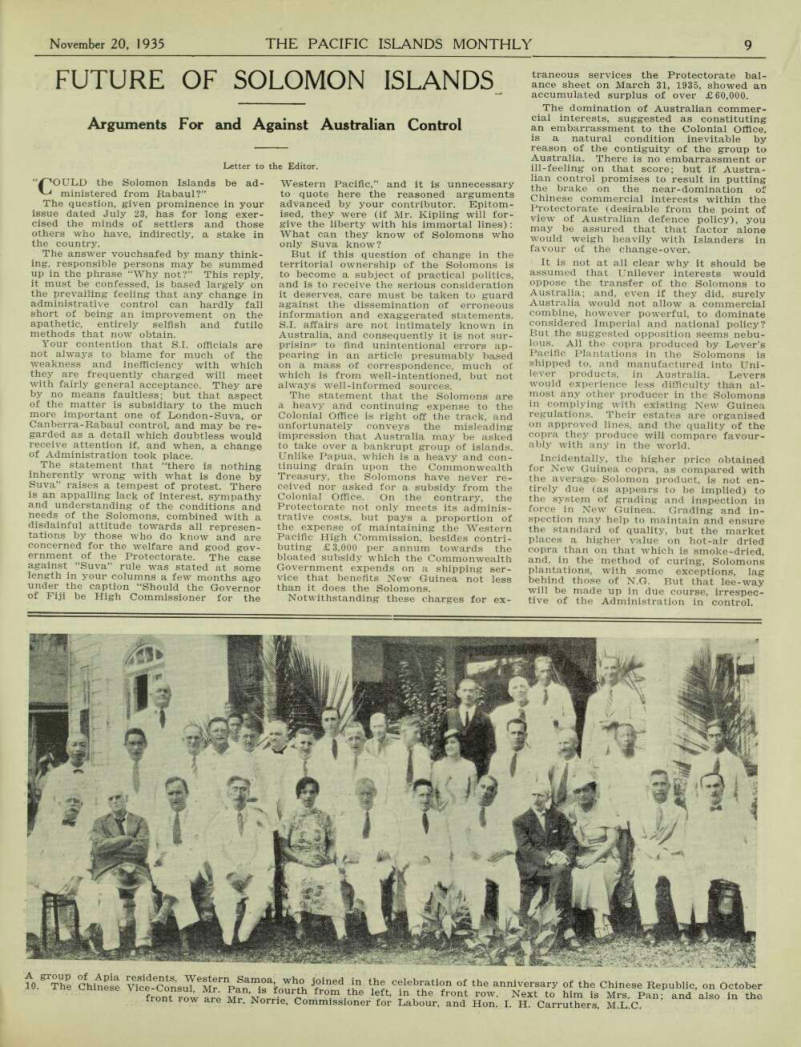
A group of Apia residents, western Samoa, who joined in the celebration of the anniversary of the Chinese Republic, on October 10. The Chinese Vice-Consul, Mr. Pan,is jfourth from the left, in the front row. Next to him is Mis pan; and also in the front row are Mr. Norrie, Commissioner for Labur, and Hon. I. H. Carruthers, M.L.C.
The so-called problem presented by the Malaita-man is absurdly over-rated, and there is not the slightest need to send a platoon of district officers and patrol leaders to subdue him. Heaven save us from any such colossal folly. Malaita is at present administered by one district officer, with a dozen or so native police, and they haven’t had a scrap for years.
The much-maligned Malaita-man is a virile, husky individual, reputed to be the best and most dependable worker in the Pacific. Practically all the plantations in the Solomons are staffed by Malaita labour, and the fear of these “wild” tribesmen being attracted to New Guinea is the chief objection present in the minds of employers to the Solomons com ing under Australian control when, pre sumably, natives would be free to pro ceed from the one territory to the other.
It is true that the Malaita-man dis plays independence and even arrogance on occasion, but in that he is not a unique specimen of humanity—black or white —and properly treated and handled he is loyal, obedient and courageous.
Let it be understood that the Malaita man has a justifiable grievance against the Administration, a grievance which, long simmering in the mind of an un tutored, inarticulate aboriginal, in time assumes the proportions of a serious in justice; and that mental condition has been responsible for any “boil-over” of pent-up feelings that has occurred in the past. In the Solomons generally, and on the island of Malaita particularly, district officers and police are primarily tax collectors. In effect, taxes are extorted at the point of the bayonet.
The Malaita-man cannot understand — and he is not alone in his incomprehen sion—why he should have to pay a tax for which he receives no service in return.
Government, whose paramount aim is to display a financial “profit” in the business of administration, takes, but gives noth ing—except to Civil Servants. It is no exaggeration to say that the provision of a hospital or two, adequately staffed and equipped, and the establishment of an elementary school, would do more good and confer more lasting benefit than a regiment of district officers and police men—and the Malaita problem would cease to trouble.
But in the Solomons the fundamental function and obligation of a “Protec torate” government has been lost sight of, and the spectacle is witnessed of New Guinea, a comparative tyro in the sphere of native administration, setting an example and showing the way in so far at least as the provision of medical and educational services to natives are con cerned.
The advantages and disadvantages of Australian control of the Solomons are too numerous and complex to be dealt with adequately in a letter; but the ques tion you have raised is of profound in terest and importance, and would furnish a fitting subject for close investigation in both territories by an impartial Com mission appointed by the Commonwealth Government, in conjunction with the British Colonial Office.
I am, etc.,
Astrolabe.
Tulagi, S.I., 19/10/’35.
Rev. T. N. Deller, of Bau, who has done notable work in Fiji during the past 14 years for the Methodist Mission, will shortly leave the Colony and settle per manently in Australia. It is reported that he hopes to take a circuit in Queensland for the Methodist Church.