Are They New Racial Types in Papua?
pp. 56-57 · Read in the full issue
Anthropologist Makes Some Biting Comment
WHEN Messrs. Hides and O’Malley, re turning from their recent expedition in Central New Guinea, announced the discovery of a numerous native people of unusual appearance and habits, every silly newspaper commentator in two hemis pheres let himself go in the field of ethno graphical speculation, and some rather dreadful rubbish was published.
Everyone who knows anything about the Pacific Islands races will endorse heartily a letter which the Papuan Gov ernment anthropologist, Mr. F. E. Wil
liams, sent to the Australian newspapers, and which was in the following terms: The Strickland-Purari patrol carried out by Messrs. Hides and O’Malley has natur ally attracted wide publicity. While join ing heartily in the general chorus of praise, I determined to abstain entirely from any premature discussion or com ment on the anthropological aspect of Hides and O’Malley’s discoveries. I was, however, rudely startled out of this re solve by seeing a statement (attributed to Mr. O’Malley) in the “Sydney Morning Herald” of August 16, to the effect that the Government Anthropologist had said the new people “were of a Polynesian rather than a Melanesian type.”
Let me assure you that there has been
some mistake. So far from having ex pressed any opinion to Mr. O’Malley on the racial affinities of the new people, I have never discussed the subject with him at all.
I take this opportunity of denying with all possible emphasis (if it is really ne cessary) that I think these people to be of Polynesian type, and of asserting with equal emphasis that for the time being I would not be so rash as to offer, or even to form, any opinion on the subject whatever. Incidentally, if one were forced to make a guess, I think “Polynesians” would be a lamentably bad one.
The determination of this people’s racial type is work for the physical an thropologist, i.e., the student of compara tive human anatomy; and on the pecu liarly baffling subject of race there are at most a handful of men in Australia who can speak with authority. These men know that the question cannot be an swered until, in time to come, full and accurate observations have been made and measurements taken.
Yet, in the meantime, all manner of amateurs and pseudo-anthropologists are freely expressing their opinions and pro mulgating their guesses through the news papers. Pursuing the subject through a mass of press-cuttings one reads, first of all, that these people are “not Papuans”; then that they are “Asiatic”; in another place that they have affinities with the Mongols; in another with the Malays, and so on.
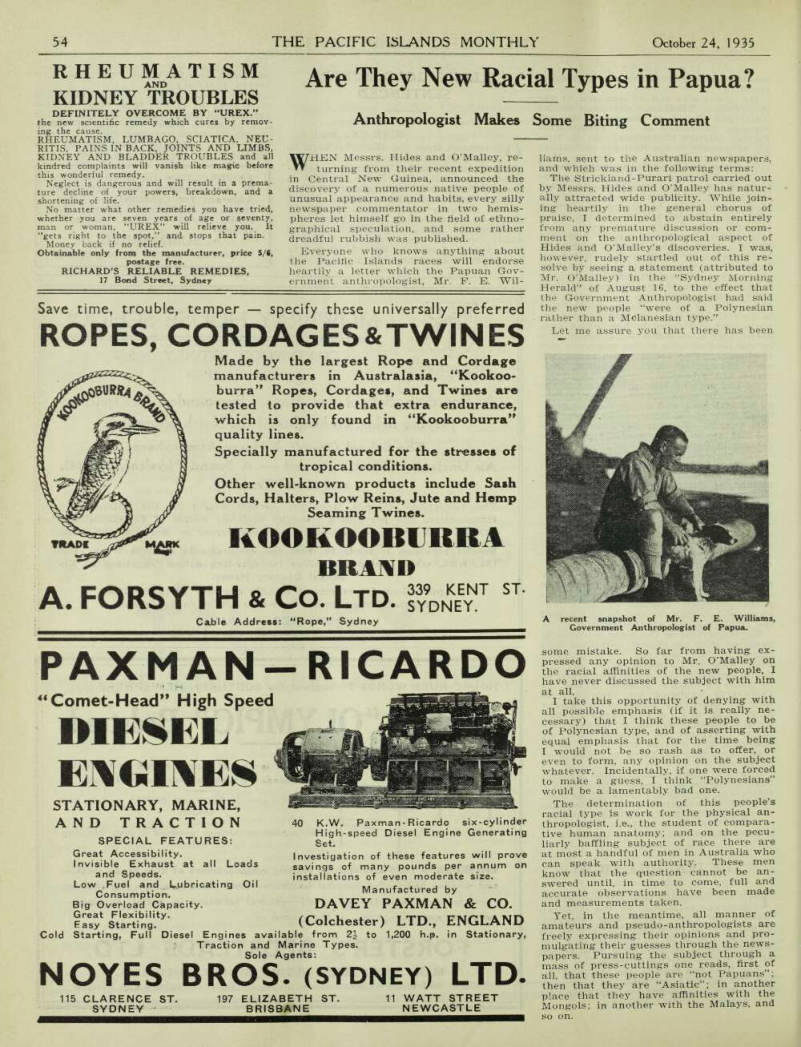
A recent snapshot of Mr. F. E. Williams, Government Anthropologist of Papua.
One of the most prominent of Australian dailies refers (editorially) to the appear ance of the new people as “highly sugges tive of ancient Greek or Assyrian types, yet suggestive, too, of the Semitic.” And one writer actually asks the question whether they can be “an independent sur vival of an almost pure early migration from the cradle of humanity”; and, again, whether “the resemblance to the Wise Men of the East” is merely a coincidence.
You will appreciate my feelings when I found it written down in the papers that I had added to this strange medley by comparing them to Polynesians.
I do not know to what extent the Press itself may be responsible for this balder dash. But there is one especially ridicu lous feature of it for which the Press must surely be to blame. That is the recur rence of the phrase “White Race” in the headlines.
If we examine the letterpress of Mr.
Hides’ own contributions, or of the state ments quoted beneath these very head lines, we find that he refers to the people at most as light-skinned, by which he obviously means that they are of a lighter brown than some others whom he has met with in Papua. Mr. Hides did not describe them as white to me, and I do not believe that he has described them as white to anybody. I can only attribute these misleading headlines to an uncriti cal enthusiasm on the part of certain Pressmen, or else to a deliberate intention to catch the eye of a credulous public.
Whether the newly-discovered people— whatever their skin colour—can be pro perly called a new race seems to me wholly questionable. Most of us, even the handful of competent physical anthro pologists themselves, are still somewhat uncertain as to the meaning of the word.
But we might be discreet enough to leave the matter to them; for even if they dis agree, as they probably will, they still have a good idea of what they are talk ing about.
In the meantime* it may be pointed out that the manners and customs of the people, their dress, weapons, houses, agri culture, etc., are simply not relevant to the question of race. Nothing is so cold, we are informed, as yesterday’s news, and, probably, by the time this letter reaches you, popular attention will have swerved in some different direction. And by the time we are able to say anything of real reliability and value about the anthro pology of the new people, public interest in the subject may be entirely dead. This, however, will not matter greatly. Those who care to follow up the inquiry will have to delve in the pages of some scien tific jeurnal, where writers are more cau tious and less excitable.
Mr. C. T. Halstead, who was recently appointed Suva manager of Messrs. Cable and Wireless Ltd., arrived in Fiji by the Monowai in September. Mr. H. Lanyon, whom he replaced, left for New'Zealand by the Niagara on September 27.
Mr. F. E. Smith, of Clevedon, New Zealand, married Miss Cora Ray Edwards, of Suva, at the Holy Trinity Pro-Cathed ral, Suva, on September 27. They left Fiji by the Niagara the same day for Auckland, where they will make their new home.