Survey of Misima
p. 48 · Read in the full issue
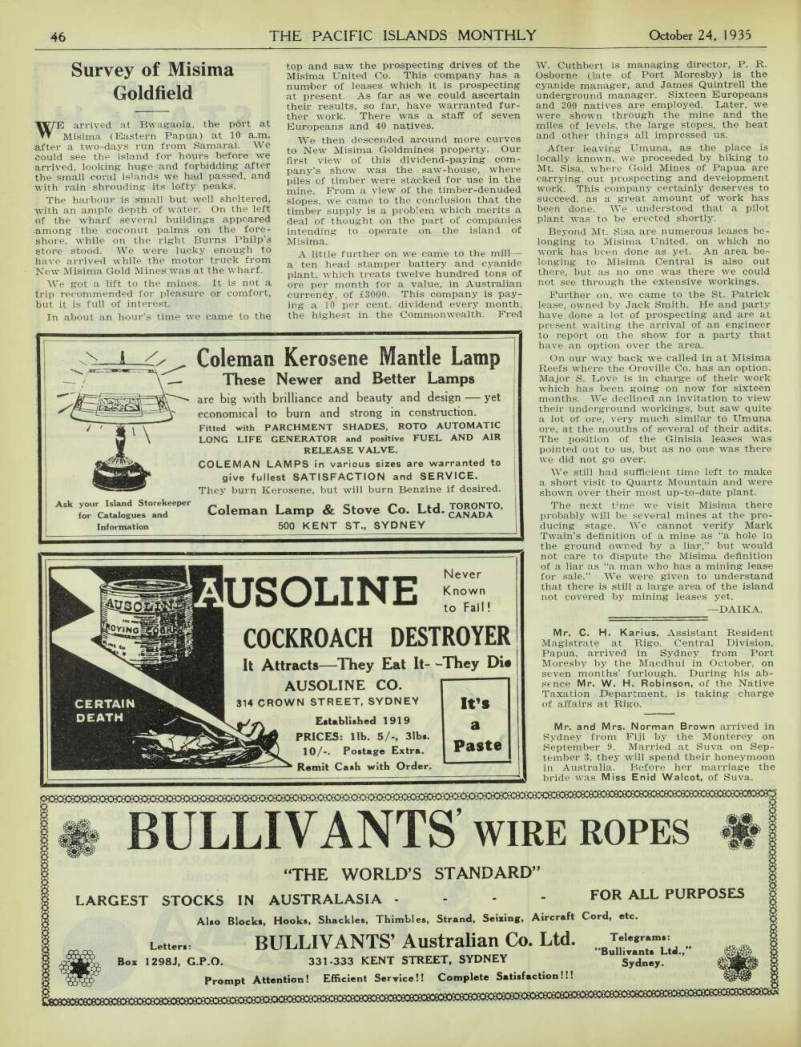
Goldfield
WE arrived at Bwagaoia, the port at Misima (Eastern Papua) at 10 a.m. after a two-days run from Samarai. We could see the island for hours before we arrived, looking huge and forbidding after the small coral islands we had passed, and with rain shrouding its lofty peaks.
The harbour is small but well sheltered, with an ample depth of water. On the left of the wharf several buildings appeared among the coconut palms on the fore shore, while on the right Burns Philp’s store stood. We were lucky enough to have arrived while the motor truck from New Misima Gold Mines was at the wharf.
We got a lift to the mines. It is not a trip recommended for pleasure or comfort, “but it is full of interest.
In about an hour’s time we came to the
top and saw the prospecting drives of the Misima United Co. This company has a number of leases which it is prospecting at present. As far as we could ascertain their results, so far, have warranted fur ther work. There was a staff of seven Europeans and 40 natives.
We then descended around more curves to New Misima Goldmines property. Our first view' of this dividend-paying com pany’s show was the saw-house, where piles of timber were stacked for use in the mine. From a view of the timber-denuded slopes, we came to the conclusion that the timber supply is a problem which merits a deal of thought on the part of companies intending to operate on the island of Misima.
A little further on we came to the mill— a ten head stamper battery and cyanide plant, which treats twelve hundred tons of ore per month for a value, in Australian currency, of £3OOO. This company is pay ing a 10 per cent, dividend every month, the highest in the Commonwealth. Fred
W. Cuthbert is managing director, P. R.
Osborne (late of Port Moresby) is the cyanide manager, and James Quintrell the underground manager. Sixteen Europeans and 200 natives are employed. Later, we were shown through the mine and the miles of levels, the large stopes, the heat and other things all impressed us.
After leaving Umuna, as the place is locally known, we proceeded by hiking to Mt. Sisa, where Gold Mines of Papua are carrying out prospecting and development work. This company certainly deserves to succeed, as a great amount of work has been done. We understood that a pilot plant was to be erected shortly.
Beyond Mt. Sisa are numerous leases be longing to Misima United, on which no work has been done as yet. An area be longing to Misima Central is also out there, but as no one was there we could not see through the extensive workings.
Further on, we came to the St. Patrick lease, owned by Jack Smith. He and party have done a lot of prospecting and are at present waiting the arrival of an engineer to report on the show for a party that have an option over the area.
On our way back we called in at Misima Reefs where the Oroville Co. has an option.
Major S. Love is in charge of their work which has been going on now for sixteen months. We declined an invitation to view their underground workings, but saw quite a lot of ore, very much similar to Umuna ore, at the mouths of several of their adits.
The position of the Ginisia leases was pointed out to us, but as no one was there we did not go over.
We still had sufficient time left to make a short visit to Quartz Mountain and were shown over their most up-to-date plant.
The next time we visit Misima there probably will be several mines at the pro ducing stage. We cannot verify Mark Twain’s definition of a min© as “a hole in the ground owned by a liar,” but would not care to dispute the Misima definition of a liar as “a man who has a mining lease for sale.” We were given to understand that there is still a large area of the island not covered by mining leases yet.
Daika.
Mr. C. H. Karius, Assistant Resident Magistrate at Rigo, Central Division, Papua, arrived in Sydney from Port Moresby by the Macdhui in October, on seven months’ furlough. During his ab sence Mr. W. H. Robinson, of the Native Taxation Department, is taking charge of affairs at Rigo.
Mr. and Mrs. Norman Brown arrived in Sydney from Fiji by the Monterey on September 9. Married at Suva on Sep tember 3, they will spend their honeymoon in Australia. Before her marriage the bride was Miss Enid Walcot, of Suva.