Murnau’s House Destroyed
pp. 46-47 · Read in the full issue
An Ancient Tapu
Is Active
By Fire
From Our Own Correspondent.
Papeete, Sept. 8.
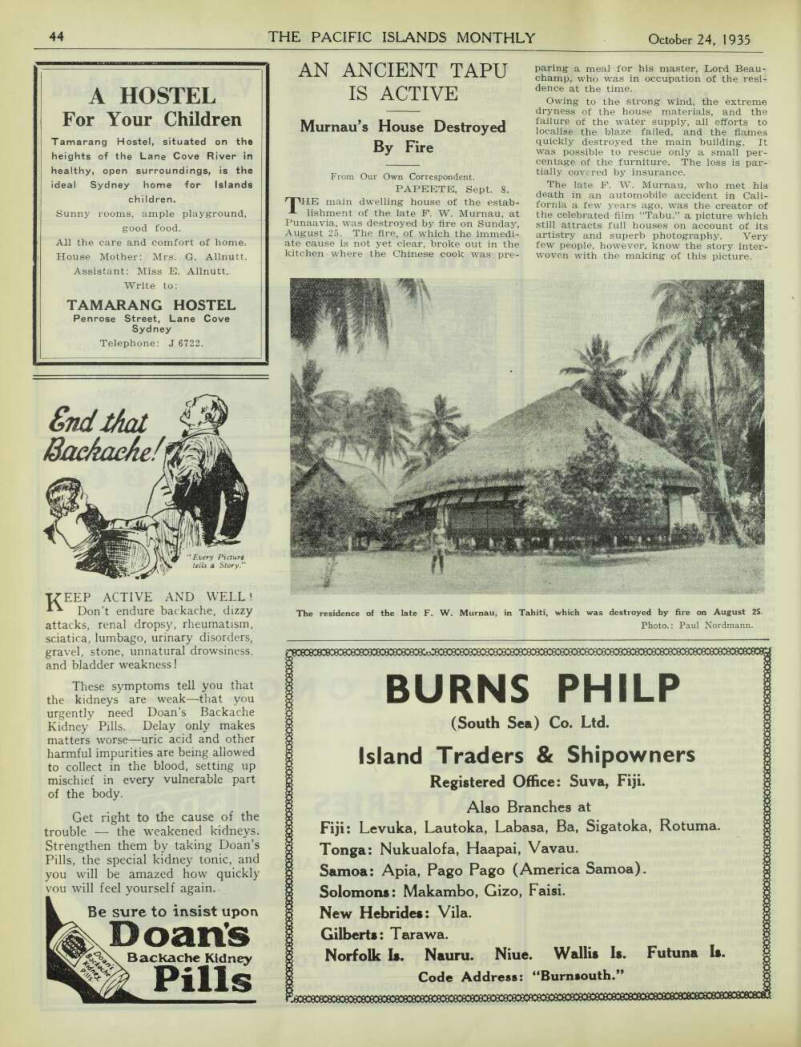
main dwelling house of the estab lishment of the late F. W. Murnau, at Punaavia, was destroyed by Are on Sunday, August 25. The fire, of which the immedi ate cause is not yet clear, broke out in the kitchen where the Chinese cook was pre
paring a meal for his master, Lord Beau champ, who was in occupation of the resi dence at the time.
Owing to the strong wind, the extreme dryness of the house materials, and the failure of the water supply, all efforts to localise the blaze failed, and the flames quickly destroyed the main building. It was possible to rescue only a small per centage of the furniture. The loss is par tially covered by insurance.
The late F. W. Murnau, who met his death in an automobile accident in Cali fornia a few years ago, was the creator of the celebrated film “Tabu.” a picture which still attracts full houses on account of its artistry and superb photography. Very few people, however, know the story inter woven with the making of this picture.
The residence of the late F. W. Murnau, in Tahiti, which was destroyed by fire on August 25.
Photo.: Paul Nordmann.
The name “Tabu” (which really ought to be spelled “Tapu”), is a word which means in the Polynesian language “forbidden,” or “sacred.”
A large part of Murnau’s picture was filmed on a small, low islet, one of many similar islets strung like a necklace along the outer reef of Borabora, in the Leeward group, and which make the enclosed lagoon such an attractive place for yachtsmen and visiting warships.
But Murnau’s particular islet has a sinis ter reputation among the natives. It is a place strewn with the remains of ancient viaraes (temples), and haunted by the ghosts of those who were brought hither to be sacrificed on the altars of the old-time heathen gods. Unearthly voices are said to sigh and whisper through the pendant fronds of the Casuarina trees lining the beach. It is tapu in the real Polynesian meaning of the word.
Murnau was warned of misfortune: but his artistic and romantic soul would not be denied —in fact, the stories connected with this islet made a strong appeal to him, as the most suitable place in which to film the story he had planned. In due time the picture was finished, and his luxurious home in Punaavia was well on the way to completion. Here he intended to spend the remainder of his days, among the natives he had grown to love. When he left for California, to put sound into the picture, the presage of disaster was strong upon him. So overwhelming was his emotion that he could not meet his friends to bid them good-bye. He was killed soon after his arrival in America.
Later on, it is said, a wealthy lady of San Francisco, tenant of the Punaavia establishment, committed suicide therein.
And there have been other incidents which would take too much space to recount here, but all tending to show that the old tapu is still exercising its malevolent influence.
Such at least is the native interpretation of events. Now comes the fire!
Lord Beauchamp removed to the Blue Lagoon Hotel, and later departed from Tahiti for Australia by the Makura on September 7. It is much regretted that he should have been obliged to curtail his visit owing to the unfortunate circum stances of the fire. Much sympathy is felt here for Mr. R. Murnau. brother of the late film director, in the financial and senti mental loss he sustains.