Men Who Knew Yesterday
pp. 31-33 · Read in the full issue
By Julian Hillas
2. Charles James Ward
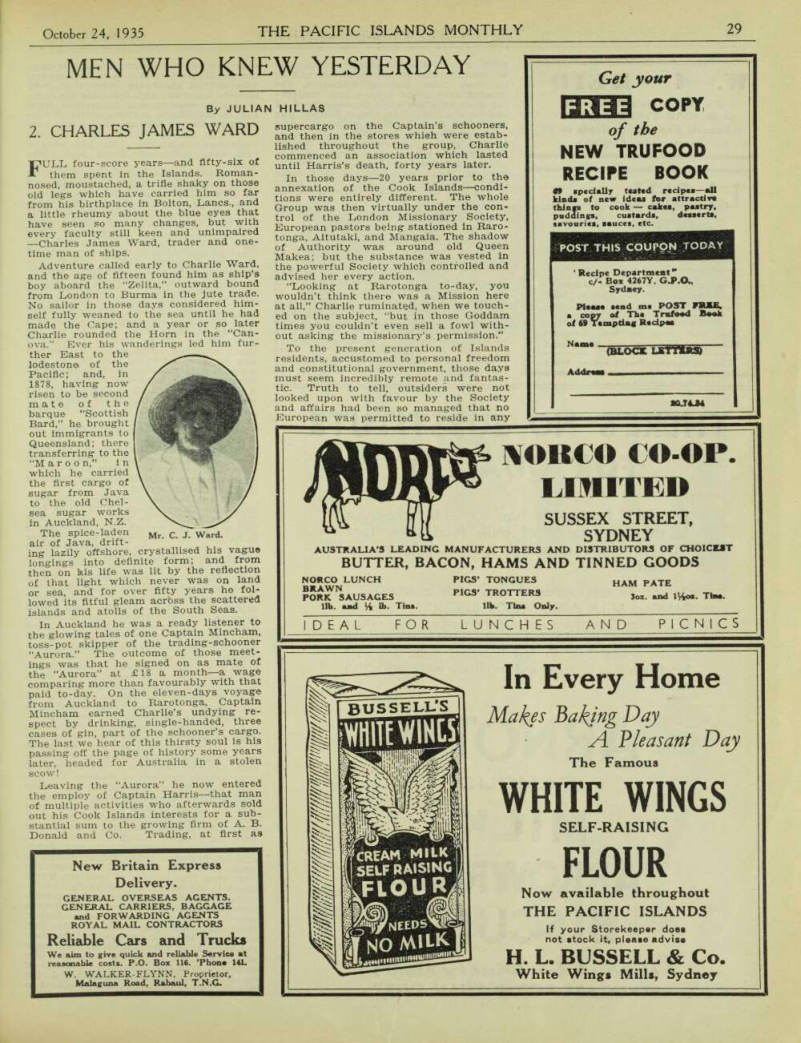
FULL four-score years—and fifty-six of them spent in the Islands. Roman nosed, moustached, a trifle shaky on those old legs which have carried him so far from his birthplace in Bolton, Lancs., and a little rheumy about the blue eyes that have seen so many changes, but with every faculty still keen and unimpaired —Charles James Ward, trader and one time man of ships.
Adventure called early to Charlie Ward, and the age of fifteen found him as ship’s boy aboard the “Zelita,” outward bound from London to Burma in the jute trade.
No sailor in those days considered him self fully weaned to the sea until he had made the Cape; and a year or so later Charlie rounded the Horn in the “Can ova.” Ever his wanderings led him fur
ther East to the lodeston© of the Pacific; and, in 1878, having now risen to be second mate of the barque “Scottish Bard,” he brought out immigrants to Queensland; there transferring to the “M aroo n,” in which he carried the first cargo of sugar from Java to the old Chel sea sugar works in Auckland, N.Z.
The spice-laden
air of Java, drift ing lazily offshore, crystallised his vague longings into definite form; and from then on his life was lit by the reflection of that light which never was on land or sea, and for over fifty years he fol lowed its fitful gleam across the scattered islands and atolls of the South Seas.
In Auckland he was a ready listener to the glowing tales of one Captain Mincham, toss-pot skipper of the trading-schooner “Aurora.” The outcome of those meet ings was that he signed on as mate of the “Aurora” at £lB a month —a wage comparing more than favourably with that paid to-day. On the eleven-days voyage from Auckland to Rarotonga, Captain Mincham earned Charlie’s undying re spect by drinking, single-handed, three cases of gin, part of the schooner’s cargo.
The last we hear of this thirsty soul is his passing off the page of history some years later, headed for Australia in a stolen scow!
Leaving the “Aurora” he now entered the employ of Captain Harris —that man of multiple activities who afterwards sold out his Cook Islands interests for a sub stantial sum to the growing firm of A. B.
Donald and Co. Trading, at first as
supercargo on the Captain’s schooners, and then in the stores whieh were estab lished throughout the group, Charlie commenced an association which lasted until Harris’s death, forty years later.
In those days—2o years prior to the annexation of the Cook Islands —conditions were entirely different. The whole Group was then virtually under the con trol of the London Missionary Society, European pastors being stationed in Raro tonga, Aitutaki, and Mangaia, The shadow of Authority was around old Queen Makea; but the substance was vested in the powerful Society which controlled and advised her every action.
“Looking at Rarotonga to-day, you wouldn’t think there was a Mission here at all,” Charlie ruminated, when we touch ed on the subject, “but in those Goddam times you couldn’t even sell a fowl with out asking the missionary’s permission.”
To the present generation of Islands residents, accustomed to personal freedom and constitutional government, those days must seem incredibly remote and fantas tic. Truth to tell, outsiders were not looked upon with favour by the Society and affairs had been so managed that no European was permitted to reside in any
Mr. C. J. Ward.
Cook Island other than Rarotonga, and all trading, except in the latter, had to be done from visiting schooners, the supercargoes going ashore and conduct ing their business while the ship stood off and on the reef. The trader himself was prohibited from handling either his own goods or those of the natives; and, after he had stated the price of each article, the market-men, who were usually church deacons, acted as salesmen, de positing the money received in a large bowl which was turned over to the trader at the end of the day’s business. The “market” lasted for two or three days, and the schooner then continued on her way.
In ’B5, acting on the advice of Johnny Endicott, Charlie went over to Mangaia with the intention of operating a store there. Endicott, w r hose real field was the Societies, traded out from Bora Bora periodically in his own schooner, and it was on one of these round trips that he ferried Charlie across from Rarotonga.
But no sooner had the schooner left again than Charlie found himself under a special ban placed upon him by Mr. Harris, then resident missionary. The Mangaians were not only forbidden to trade, but were ordered not to sell him fowls, taro or other foodstuffs, with the result that he was
soon obliged to consume the edible por tion of his own stock! A second trader, who arrived about the same time, was forcibly deported; and, following his com plaints, a warship was despatched from Fiji to investigate matters under “Com modore’s Law.” Strong censure was now passed on Mr. Harris’s conduct, and the unfortunate islanders who had obeyed him were collectively fined 3000 Chile dollars.
In Rarotonga the law —based, with little alteration, on the original code drawn up by John Williams in 1826—was particu larly severe on moral offences. For those with any sense of humour the 80’s and 90’s must have provided no small amuse ment. No one was allowed out after dark without legitimate reason, and even those in possession of such were required to carry a lighted torch! A man was also liable to be punished if found mourn ing publicly over the grave of any woman not a close relation! In Rarotonga there were 300 policemen—approximately one “cop” to every eighteen inhabitants —and, since their only remuneration was a per centage of these fines imposed on the guilty, there was no lack of enthusiasm about pursuing offenders! Fornication was punished by fining both parties, and, where a case was suspected, police would unceremoniously enter and search a house.
A smell of coconut oil on the bed-pillows was accepted by the court as evidence of guilt, and a fine of ten dollars followed automatically.
Speaking of the native population, Mr.
Ward was emphatic.
“A great deal better then,” he declared, “more honest and manly. Nowadays, you can’t believe a word that’s said —they’ll steal the very buttons off your pants if they get half a chance.”
With the Jubilee celebrations just con cluded Rarotongans—and even those fur ther afield —might do well to reflect that had it not been for old Charlie’s patriotic initiative, over forty years ago, the flag flying t©-day from the Government offices would very probably be that of the French Republic.
One afternoon, early in the 90’s, a schooner approached the island, and, an choring off Avarua, sent a boat hurriedly ashore. She had come down from Tahiti to warn the Rarotongans that a French vessel was on the point of leaving Papeete with the intention of officially annexing the Cook Islands —at that time still inde pendent territory.
Eight Europeans—seven of them British subjects—listened gloomily to the news, and then informed Queen Makea, who re fused to credit the report, although ex pressing her readiness to do anything in her power to avert such a proceeding.
It was next suggested that a Union Jack be flown above the Palace; but, un fortunately, there was not such an article in Rarotonga—and, meanwhile, the war ship was expected hourly. For six of the eight whites that settled matters.
But not for Charlie Ward. Together with a Miss Frances Nicholas, he sat long into the night cutting out and stitching strips of red, white, and blue material, and, in the morning, hurried to the Palace with the completed flag.
But the Queen refused to have it flown.
Charlie, however, induced her to let him bend it on the cord, and left with the assurance that in case of need she would break it out with her own hands.
The whole island now waited in a state of tension. Late that afternoon, the French vessel appeared; and Queen Makea, thoroughly alarmed, broke out the flag.
Perplexed by this unexpected reception the ship, after standing off and on for a short time, shook out her sails and dis appeared over the horizon. A month or so later H.M.S. Hyacinth visited the island, and Rarotonga was declared a
British Protectorate by Captain Burke.
Miss Nicholas, now an old lady living In Sydney, N.S.W., still maintains a sporadic correspondence with Mr. Ward.
And so, through the long corridors of the years, Charlie has wandered, staying first on one small island and then on another.
“But Time is fleet for those who play the rover, And lengthy marches turn to weary whiles.”
Almost imperceptibly, the seasons of youth and middle-life have merged into the winter of advanced age. For a num ber of years, he has lived quietly in Raro tonga, the recipient of a small Govern ment pension, and his white-coated figure, crowned by a broad-brimmed Manihiki hat, is a familiar one to everybody in Avarua. Environment has stamped him deeply, and, unconsciously, he has ac quired much of that easy attitude towards life which enables the Polynesian to pass to-day pleasantly without thought of to morrow. In a restless world he has found time to grow old leisurely, without enemies, leaning ever more heavily on his memories and the trivial interests of the moment.