Queen Salote Meets Mariner’S Grandson
pp. 27-28 · Read in the full issue
The Tortoise Will Not Go to England
By Eric Ramsden
KING GEORGE will not, after all, receive the Royal tortoise of Tonga as a Jubilee gift. It was never the intention of the Tongans to send the veteran (who has been a resident of the Friendly Islands since 1777, the year in which he was brought as a gift by Captain Cook), to London.
In an audience granted me before leaving on her visit to the Methodist centenary celebrations in Fiji, the Queen said: “I do not know how the report emanated,
or who, for that matter, authorised it. I certainly did not. Anyway, Ido not think it would be quite fair to our tortoise to send him to London. I hardly think he would survive for long in that climate."
Neither is it the intention of the Queen to go to London. After the festivities at Fiji, where she will be an honoured guest, Queen Salote will go direct to her home at Nukualofa. “No, I am not homesick.,” remarked Her Majesty, who sat in front of the fire in the home of the Rev. J, W.
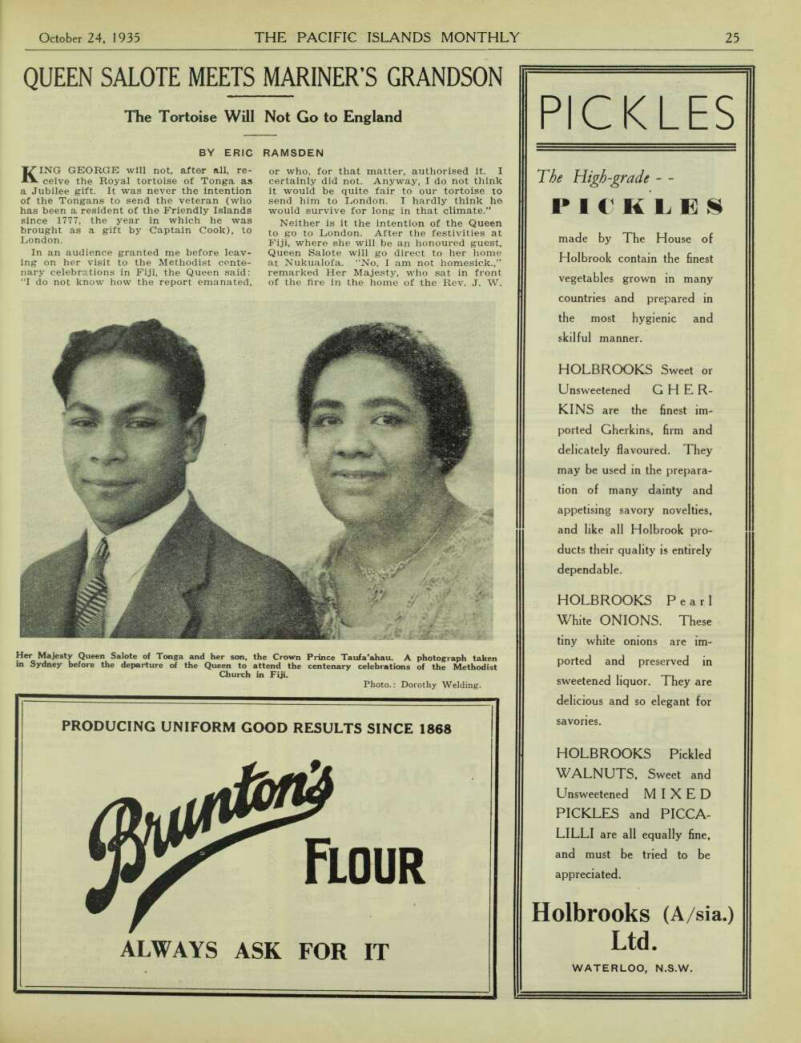
Her Majesty Queen Salote of Tonga and her son, the Crown Prince Taufa’ahau. A photograph taken m Sydney before the departure of the Queen to attend the centenary celebrations of the Methodist Church in Fiji.
Photo.: Dorothy Welding.
Burton at Haberfield, a rug across her knees. “But I shall not be sorry to be back in Tonga again. After all, I have many responsibilities, and I am as busy there as I have been here.”
It was unfortunate for the Queen that, owing to illness, her Australian itinerary was considerably curtailed; it had been her particular wish to visit the Blue Mountains, also Melbourne. The operation that Her Majesty underwent in Sydney was of a more serious character than was generally realised. It will be some time before she is completely restored to health.
Nevertheless, Queen Salote found time before leaving Sydney to grant an audience to Mr. Harris McCulloch, of Mosman, the 76-year-old grandson of Mariner of Tonga.
Mr. McCulloch was disappointed some years ago at not meeting the Queen’s hus band, Prince Tugi, the Tongan Prime Minister. Tugi is the direct descendant of Finau, the fierce chief who captured William Charles Mariner and other sur vivors of the massacre of the crew of the “Port au Prince” in 1806. The book that Mariner subsequently wrote in con junction with Dr. John Martin, an Edin burgh medical man, is still regarded as one of the classics of Polynesia, and is a positive repository of information con cerning the manners, customs, and histori cal happenings of the Tonga of his day.
The Queen, incidentally, told Mr. Me-
Culloch that she is a descendant of a younger brother of Finau.
Queen Salote and her husband have read Mariner’s “Tonga” on many occa sions. When her visitor asked Her Majesty whether the vocabulary compiled by his ancestor was of any use to-day, the Queen replied; “Certainly. We regard it as extremely valuable.” Many of the young Tongans, she added, were keenly interested in the past, and Mariner’s book was re garded as a unique record, not merely for its vocabulary, but because of its de tailed description of many of the ancient ceremonies.
“Your grandfather’s name is still re membered in Tonga,” declared the Queen.
“The cave that he described on the island of Yavau so vividly is always known as ‘Mariner's Cave’.”
When Mr. McCulloch stated that he was desirous of visiting the Tongan Islands but had been prevented by the irregular steamer communication between Australia and Nukualofa, the Queen said: “Come next year! The new steamer will be in service then.”
Her Majesty answered many questions asked by Mr. McCulloch concerning the islands in which his grandfather spent five impressionable years of his boyhood —he was under twenty years of age when he managed to escape from Finau’s son and successor —and also showed a keen interest in the additional biographical details with which he was able to supply her. The Queen showed that she was well versed in Tonga’s history.
After discussing the problems of other branches of the Polynesian family in other parts of the Pacific, the Queen re marked that she was grateful for the many benefits her people had received.
“We have indeed been fortunate,” she said, simply.
Salote is an excellent conversationalist in English. When speaking in public not withstanding, it is her invariable custom to use Tongan. Often enough, hswever, she will add a few words in English. Her Majesty spoke of her five years at school in New Zealand, and recalled many of the friends she had known in those days, including such well-known Maori per sonalities as the late Sir James Carroll and Sir Maui Pomare, and Professor Peter H. Buck (Te Rangihiroa). Both Sir Maul and Dr. Buck had visited her in Tonga.
Salote impressed one as a kindly, gra cious personality, one well acquainted with current affairs, and, though fully cognisant of her own rank and responsi bilities as the First Lady of Tonga, is essentially a womanly woman. In her stately carriage and simplicity of de meanour the Queen of Tonga personified the long line of ancestors, famous as war riors, renowned in song, from whom she is descended.
Mr. J. E. P. Walker, who died in New South Wales early in October at an ad vanced age, had visited many parts of Fiji, Samoa, and Tonga, where he estab lished agencies for the National Mutual Life Assurance Ltd.
Miss Beatrice Grimshaw has just re turned to Australia from a visit to Wes tern Samoa, American Samoa, and Tonga, where she had been gathering material for her 36th book. Miss Grimshaw will remain in Sydney until she has written her novel —which, of course, has a South Seas setting—and then she will spend some time in N.S.W. with her brother, Mr. Ramsay Grimshaw. She does not intend immediately to return to Papua, but probably will visit England in the coming year.