Training Papuan Medical Assistants
p. 11 · Read in the full issue
Progress of Dr. Strong’s System of Sending Young Natives to Sydney University
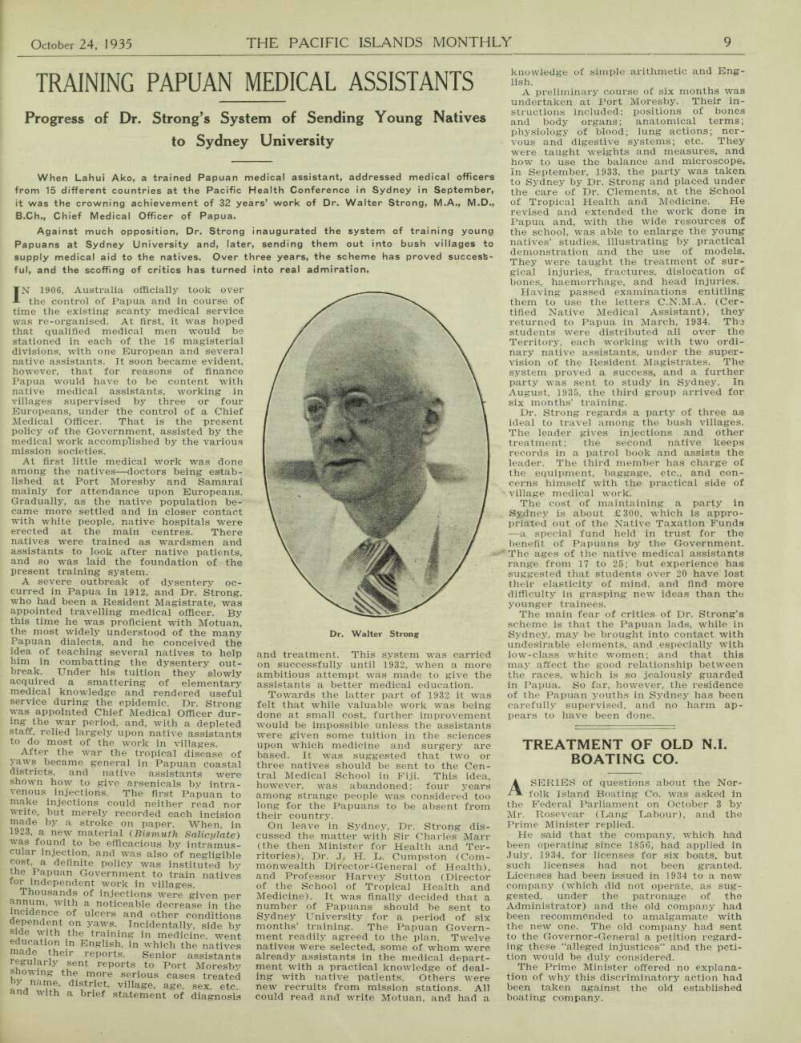
When Lahui Ako, a trained Papuan medical assistant, addressed medical officers from 15 different countries at the Pacific Health Conference in Sydney in September, it was the crowning achievement of 32 years’ work of Dr. Walter Strong, M.A., M.D., B.Ch., Chief Medical Officer of Papua.
Against much opposition, Dr. Strong inaugurated the system of training young Papuans at Sydney University and, later, sending them out into bush villages to supply medical aid to the natives. Over three years, the scheme has proved success ful, and the scoffing of critics has turned into real admiration.
IN 1906, Australia officially took over the control of Papua and in course of time the existing scanty medical service was re-organised. At first, it was hoped that qualified medical men would be stationed in each of the 16 magisterial divisions, with one European and several native assistants. It soon became evident, however, that for reasons of finance Papua would have to be content with native medical assistants, working in villages supervised by three or four Europeans, under the control of a Chief Medical Officer. That is the present policy of the Government, assisted by the medical work accomplished by the various mission societies.
At first little medical work was done among the natives—doctors being estab lished at Port Moresby and Samarai mainly for attendance upon Europeans.
Gradually, as the native population be came more settled and in closer contact with white people, native hospitals were erected at the main centres. There natives were trained as wardsmen and assistants to look after native patients, and so was laid the foundation of the present training system.
A severe outbreak of dysentery oc curred in Papua in 1912, and Dr. Strong, who had been a Resident Magistrate, was appointed travelling medical officer. By this time he was proficient with Motuan, the most widely understood of the many Papuan dialects, and he conceived the idea of teaching several natives to help him in combatting the dysentery out break. Under his tuition they slowly acquired a smattering of elementary medical knowledge and rendered useful service during the epidemic. Dr. Strong was appointed Chief Medical Officer dur ing the war period, and, with a depleted staff, relied largely upon native assistants to do most of the work in villages.
After the war the tropical disease of yaws became general in Papuan coastal districts, and native assistants were shown how to give arsenicals by intra venous injections. The first Papuan to make injections could neither read nor write, but merely recorded each incision made by a stroke on paper. When, in 1923, a new material (Bismuth Salicylate) was found to be efficacious by intramus cular injection, and was also of negligible cost, a definite policy was instituted by the Papuan Government to train natives for independent work in villages.
Thousands of injections were given per annum, with a noticeable decrease in the incidence of ulcers and other conditions dependent on yaws. Incidentally, side by side with the training in medicine, went education in English, in which the natives made their reports. Senior assistants regularly sent reports to Port Moresby snowing the more serious cases treated by name, district, village, age. sex, etc. and with a brief statement of diagnosis
and treatment. This system was carried on successfully until 1932, when a more ambitious attempt was made to give the assistants a better medical education.
Towards the latter part of 1932 it was felt that while valuable work was being done at small cost, further improvement would be impossible unless the assistants were given some tuition in the sciences upon which medicine and surgery are based. It was suggested that two or three natives should be sent to the Cen tral Medical School in Fiji. This idea, however, was abandoned; four years among strange people was considered too long for the Papuans to be absent from their country.
On leave in Sydney, Dr. Strong dis cussed the matter with Sir Charles Marr (the then Minister for Health and Ter ritories), Dr. J. H. L. Cumpston (Com monwealth Director-General of Health), and Professor Harvey Sutton (Director of the School of Tropical Health and Medicine). It was finally decided that a number of Papuans should be sent to Sydney University for a period of six months’ training. The Papuan Govern ment readily agreed to the plan. Twelve natives were selected, some of whom were already assistants in the medical depart ment with a practical knowledge of deal ing with native patients. Others were new recruits from mission stations. All could read and write Motuan, and had a
knowledge of simple arithmetic and Eng lish.
A preliminary course of six months was undertaken at Port Moresby. Their in structions included: positions of bones and body organs; anatomical terms; physiology of blood; lung actions; ner vous and digestive systems; etc. They were taught weights and measures, and how to use the balance and microscope.
In September, 1933, the party was taken to Sydney by Dr. Strong and placed under the care of Dr. Clements, at the School of Tropical Health and Medicine. He revised and extended the work done in Papua and, with the wide resources of the school, was able to enlarge the young natives’ studies, illustrating by practical demonstration and the use of models.
They were taught the treatment of sur gical injuries, fractures, dislocation of bones, haemorrhage, and head injuries.
Having passed examinations entitling them to use the letters C.N.M.A. (Cer tified Native Medical Assistant), they returned to Papua in March, 1934. The students were distributed all over the Territory, each working with two ordi nary native assistants, under the super vision of the Resident Magistrates. The system proved a success, and a further party was sent to study in Sydney. In August, 1935, the third group arrived for six months’ training.
Dr. Strong regards a party of three as ideal to travel among the bush villages.
The leader gives injections and other treatment; the second native keeps records in a patrol book and assists the leader. The third member has charge of the equipment, baggage, etc., and con cerns himself with the practical side of village medical work.
The cost of maintaining a party in Sydney is about £3OO, which is appro priated out of the Native Taxation Funds —a special fund held in trust for the benefit of Papuans by the Government.
The ages of the native medical assistants range from 17 to 25; but experience has suggested that students over 20 have lost their elasticity of mind, and find more difficulty in grasping new ideas than the younger trainees.
The main fear of critics of Dr. Strong’s scheme is that the Papuan lads, while in Sydney, may be brought into contact with undesirable elements, and especially with low-class white women; and that this may affect the good relationship between the races, which is so jealously guarded in Papua. So far, however, the residence of the Papuan youths in Sydney has been carefully supervised, and no harm ap pears to have been done.
Dr. Walter Strong