Missionaries’ Triumph In Fiji
Methodists Celebrate Centenary of First Landing
ON October 12, 1835, there landed on the beach at Lakemba, in the Lau Archipelago Fiji, the Rev. William Cross and Rev. David Cargill, M.A., pioneer missionaries. They had come to introduce Christianity to the Fijians, than whom there were then no more bloodthirsty cannibals on earth. They had come directly from Tonga, which had embraced Christianity, and they carried to the Fijian chiefs commendations and presents from the ruler of Tonga, King George.
On October 12, 1935, on the very same spot, there was a great gathering of Methodist missionaries and other churchmen to cele brate the centenary.
There were numerous ceremonies, including the opening and dedi cation of a memorial church. Among the notable people present was Dame Salote, Queen of Tonga, direct descendant of that King of Tonga who sent Cross and Cargill to Fiji to start the great work of Chris tianity.
The gathering at La kemba was only one of a score of import ant events connected with the centenary,
which was fittingly celebrated. The condition of Fiji and of the Fijians to-day, compared with 1835, is one of the world’s outstanding examples of the benefits of Christianity, sensibly ap plied to a primitive people. The Fijians in 1835, although a race of fine physique and intelligence, and of considerable culture, were addicted to practices so horrible and repugnant —universal cannibalism was only one of them—that Fiji became known throughout the world as a synonym for the most repellant kind of savagery.
To-day the Fijians are among the most attractive of the South Seas races. They are intelligent and easily acquire the arts and crafts of Europeans; they have praise worthy social qualities, and are hospitable and law-abiding; they have a fine .spirit and national pride; they are generally Christians; and, although “Europeanised, they are steadily increasing in numbers.
There need be no fear for the Fijian people of the future.
For this remarkable metamorphosis, the Christian missionaries are entitled to full credit. Many of them, going among the early savages, made the ultimate sacrifice some were actually cooked and eaten but they stuck bravely to the job, and they had 100 per cent, success. All the Christian churches had a share in this work, but, as Messrs. Cross and Cargill were non-con formists, the Methodist missionary organi sations took a leading part in this month’s centenary celebrations.
The liner Katoomba sailed from Sydney on October 5 with a party of 435 persons, efficiently organised by the Australian Methodist Church. The party included the president of the Methodist General Con ference (Rev. A. J. Barclay), the president of the New South Wales Conference (Rev.
M. K. Gilmour), the general secretary of the Methodist Missionary Society of Aus tralia (Rev. J. W. Burton), the various
State secretaries for oversea missions, the Rev. R. C. G. Page (president of the Tonga Methodist Church), and the Queen of Tonga, who was returning home after a visit to Australia.
One interesting personality in the party was Miss H. Baker, a famous missionary, and herself the daughter of the late Rev.
Thomas Baker, who was murdered by the mountaineers of Central Fiji in 1867, and whose body was dismembered, cooked and eaten by this once-savage people. Many
years later the descendants of these very people made a great ceremonial presenta tion to the Methodist Mission as an atone ment for the evil deeds of their fathers, and took their part in erecting the great Baker Memorial Hall, which stands near to the original mission station from which Mr. Baker went to his death. That hall is now used for the training of Fijian ministers, teachers and pastors, and Miss Baker, on this occasion, unveiled a memorial tablet that has been placed in this building to perpetuate the name of her martyred father.
The Katoomba party’s itinerary was:— October 10. —Arrival at Lautoka; visit to various places in district, including historic Vunda, where it is said that the ancestors of the present Fijian races, coming from an unknown land, beached their canoes some six or seven hundred years ago.
October 11. —At Suva.
October 12, 13.—At Lakemba— centenary celebrations.
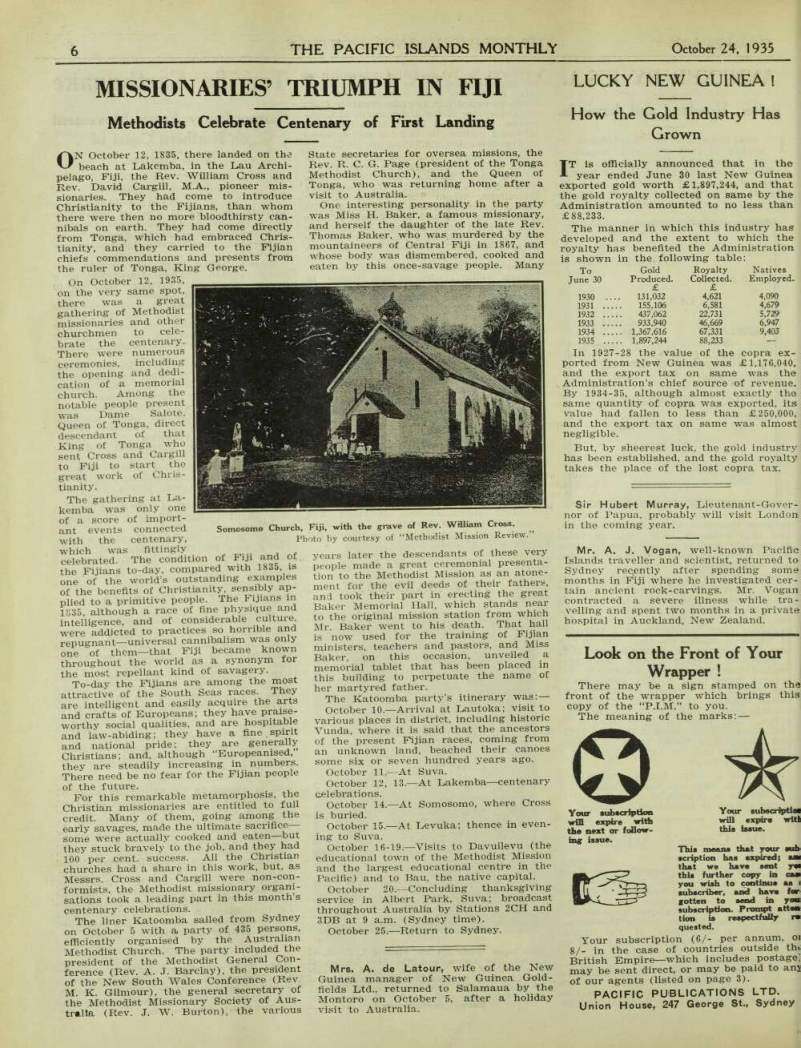
October 14. —At Somosomo, where Cross is buried.
October 15. —At Levuka; thence in even ing to Suva.
October 16-19. —Visits to Davuilevu (the educational town of the Methodist Mission and the largest educational centre in the Pacific) and to Bau, the native capital.
October 20. —Concluding thanksgiving service in Albert Park, Suva; broadcast throughout Australia by Stations 2CH and 3DB at 9 a.m. (Sydney time).
October 25.—Return to Sydney.
Mrs. A. de Latour, wife of the New Guinea manager of New Guinea Gold fields Ltd., returned to Salamaua by the Montoro on October 5, after a holiday visit to Australia.
Somosomo Church, Fiji, with the grave of Rev. William Cross.
Photo by courtesy of “Methodist Mission Review."