Polynesia In Australia
pp. 28-30 · Read in the full issue
The Brown-skinned Children of Oceania are Attracted, Moth-like, by the Lights of Sydney
Crown the hair and come away!
Hear the calling of the moon And the whispering scents that stray About the idle warm lagoon.
Hasten, hand in human hand Down the dark, the flowered way, Along the whiteness of the sand, And in the water’s soft caress Wash the mind of foolishness. —“Tiare Tahiti.”
THOSE lines were written when Rupert Brooke was intoxicated with the beauty and the simplicity of Tahitian life.
When he reached San Francisco some months later, he wrote in a letter to a friend: “Oh God! Oh God! How I hate civilisation and houses and trams and collars! ”
Most of us can sympathise with the
poet. Whether suited, temperamentally or not, we long for a tropic isle; long to inhale “the whispering scents that stray about the idle warm lagoon”; for an existence where the battle of life is not so strenuous as in a modern city.
Such, however, is not the case with young Tahiti.
Young Tahiti wants the bright lights of civilisation: the hustle and the bustle of the great world outside: the glamour and the glitter, motor cars, movies, wire less —in fact, everything to which we are accustomed and which we would gladly put aside. The race of life is to the swift. What has Papeete to offer its ambitious sons and daughters? There, the Chinaman is in economic supremacy.
These young people have seen enough of waving palms arid blue lagoons.
To them the lights of Sydney attract, and moth-like, from all parts of the Pacific, they come.
From the days when old Parson Mars den sent a sugar mill to Tahiti, and encouraged that enterprising monarch, Pomare II., to send shiploads of pigs to Port Jackson, Sydney has been the natural commercial centre of the Pacific.
To the young Tahitian, the adolescent Cook Islander, the adventurous Maori, Sydney represents life itself! That is why, although sometimes ill-fitted to bear the brunt of battle, these brown-skinned children of Oceania come to the met ropolis. Foreigners on an alien strand, though still inheriting all the natural prejudice of their ancestors, they meet on a common ground—all Polynesians.
Yet each preserves his own identity.
The Maori still finds the accent of the Rarotongan a little strange; the Tahitian considers himself superior to the more ceremonious Samoan; when it comes to family trees the Tongan believes that he has no peer in the whole Pacific. But a, common bond, a common heritage, unites them. All are children of the sun. Therefore, they come together, constituting; Sydney’s smallest colony, dance their dances, sing their songs.
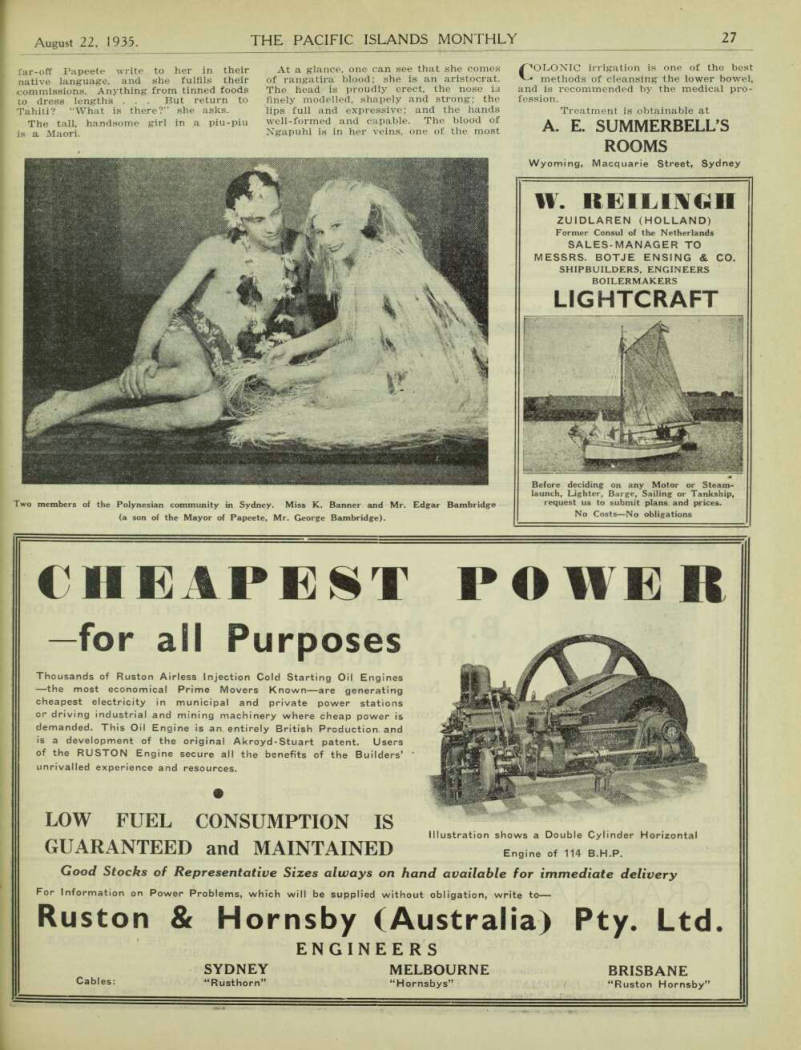
Take, for instance, the little French: girl, Pepe, dancing in a magnificent head dress, which falls, like a cascade, across her shoulders. Beneath the soft, paper— like draperies of her costume, a recent gift from her relatives in Papeete, is a scarlet and white pareu. No European woman could ever dance like Pepe. Yet, strangely enough, she is as fair as a lily; her eyes are of the blue of a Tahitian lagoon.
Though she chatters like a French woman, Pepe is not French. Neither is she Tahitian.
Born in New Zealand and taken to Papeete as a child, she is a curious ma ture, an unusual psychological study.
British by birth, French by environment, at heart she is Polynesian. The dance is her method of expression. French, Eng lish Tahitian —in all three languages she is adept. Therefore, on coming to Syd ney, Pepe had little difficulty in obtaining employment. By day she is employed in a commercial house translating the letters that arrive from Tahiti and othen French possessions in the Pacific. Now that Pepe is in Australia, friends from
far-off Papeete write to her in their native language, and she fulfils their commissions. Anything from tinned foods to dress lengths . . . But return to Tahiti? “What is there?” she asks.
The tall, handsome girl in a piu-piu is a Maori.
At a glance, one can see that she comes of rangatira blood; she is an aristocrat.
The head is proudly erect, the nose is finely modelled, shapely and strong; the lips full and expressive; and the hands well-formed and capable. The blood of Ngapuhi is in her veins, one of the most
Two members of the Polynesian community in Sydney. Miss K. Banner and Mr. Edgar Bambridge (a son of the Mayor of Papeete, Mr. George Bambridge).
northern tribes in New Zealand, noted warriors, famous carvers, gifted in speech and in song. She has a pedigree of a length that few European noblemen could claim. It reaches far beyond the canoe that brought her ancestors to Aotearoa (New Zealand), beyond the horizon to “far distant Hawaiki,” and is lost in the mists of antiquity. Around her shoulders is a kakahu, a softly woven mat of flax decorated with downy feathers of the kiwi, that flightless bird of her native New Zealand.
What brought HER across the Great Ocean of Klwa?
A desire to see the world. “I always wanted to see Sydney,” she said, in her soft, musical English.
Tall and slender, a crown of yellow eyed daisies in his hair (for the sweet
scented Tiare Tahiti of his native island is not procurable in Sydney), and a scar let pareu around his hips, Edgar came to Australia for a different reason. Despite his English name, the lad is French; there is native blood, too, in his veins. Des pite the fact that he has spent six years in Australia, he still speaks with a marked French accent. His father is an import ant official in Papeete.
Edgar came to Sydney to learn the wool trade.
La Belle France demands, however, that her sons shall all bear arms. There fore, Edgar will soon return to Tahiti for his military training. Eight months in barracks at pay that cannot even keep him in cigarettes, and then he will return to Australia, Andre, on the other hand, has only been
in Sydney a few months. Yet, he speaks good English, using his eyes and his hands to emphasise his points. Andre came to Australia from New Caledonia to learn English. It was not altogether an easy task. The English that he had ac quired in school at Noumea was useless.
Andre’s ambition is to be an “officer”; soon, he, too, will return for military training. . . .
Slender and graceful, sedately swaying from the hips in a dance of Rarotonga, where centuries ago her ancestors settled from Tahiti, is a Cook Island maiden.
Delicately featured, she, too, shows every trace of distinguished breeding, and her hands are tapered and slender.
Beside her is a handsome Samoan; her features are finely cast, the eyes deep brown and expressive. In the little com pany she is distinguished for her intri cate footwork in the dance, a branch in which her people are experts. She wears the head-dress of a taupo. Its human hair is distressing to the Maori, for it reminds her of the dead.
The little woman from Rotumah, an island not far distant from Fiji, is a nurse, highly qualified and skilled in her profession. But, in the excitement of the dance, she forgets the civilisation of the European, with all its attendant prob lems. For the time being, with her sis ters and brothers of Oceania, she is back: home. The lights of Sydney are forgotten.
Tum-tum-tum —Edgar, with his inher ent sense of rhythm, taps the drum, in cessantly.
Solo, with a chorus of ukeleles, Andre strums a Spanish guitar. We are all a little homesick, each for a corner of the Pacific we call home . . . Rupert Brooke expressed it when he said: Mamua, when our laughter ends And hearts and bodies, brown and white Are dust about the door of friends; Or scent, a-blowing down the night.
Then, Oh, then, the wise agree, Comes our immortality!
E.R.