of Melanesia
pp. 19-21 · Read in the full issue
Producing Books in Heart of Melanesia Interesting History of The Mission Press
MORE than 90 years ago, when Bishop G. A. Selwyn took charge of his vast diocese, which included the islands of Melanesia, and which he visited almost at once, he saw the need of being able to teach those Melanesians by print ing for them in their own tongues. To do this he established a printing press at his own expense at Kohimarama, New Zealand, and from there was first sent forth the Word of God in Melanesian languages.
The plant comprised a Columbia press, a large fount of Small Pica Roman (with Italics), a fount of Great Primer, and one of 2-line Great Primer. A Mr. Booth and
a Mr. Sherrad were in charge, and they turned out many small preliminary works, various portions of Scripture, and the Prayer Book, alphabet and reading sheets, vocabularies of the most useful words in the various languages, etc., etc.
During Bishop Patteson’s time (1866), the Mission headquarters were moved to Norfolk Island, and the Rev. J. Palmer, who had had some experience in N.Z., took charge of the press. After a year or two, Dr. Codrington took charge, and, with native helpers, printed the Minor Prophets and other portions of Scripture in the Mota language, and various small jobs in other languages.
In the days of Bishop J. R. Selwyn, a trained printer, Mr. H. Menges, had settled on Norfolk Island, and in 1880 the Bishop induced him to take charge of the Press. In 1885 the Printery was enlarged, a Demy Albion Press was added, and good founts of Pica, Long Primer, Brevier and Nonpareil were procured. The old Small Pica type was condemned.
In 1896 the Press was further enlarged, and Bishop Wilson procured from Eng land a Crown Wharfdale cylinder ma chine and a small assortment of new type. On Bishop Wood’s arrival, in 1912, the old Long Primer type was condemned, and a large fount of 10 point Roman (with Italics) was substituted.
Mr. Menges remained in charge of tho
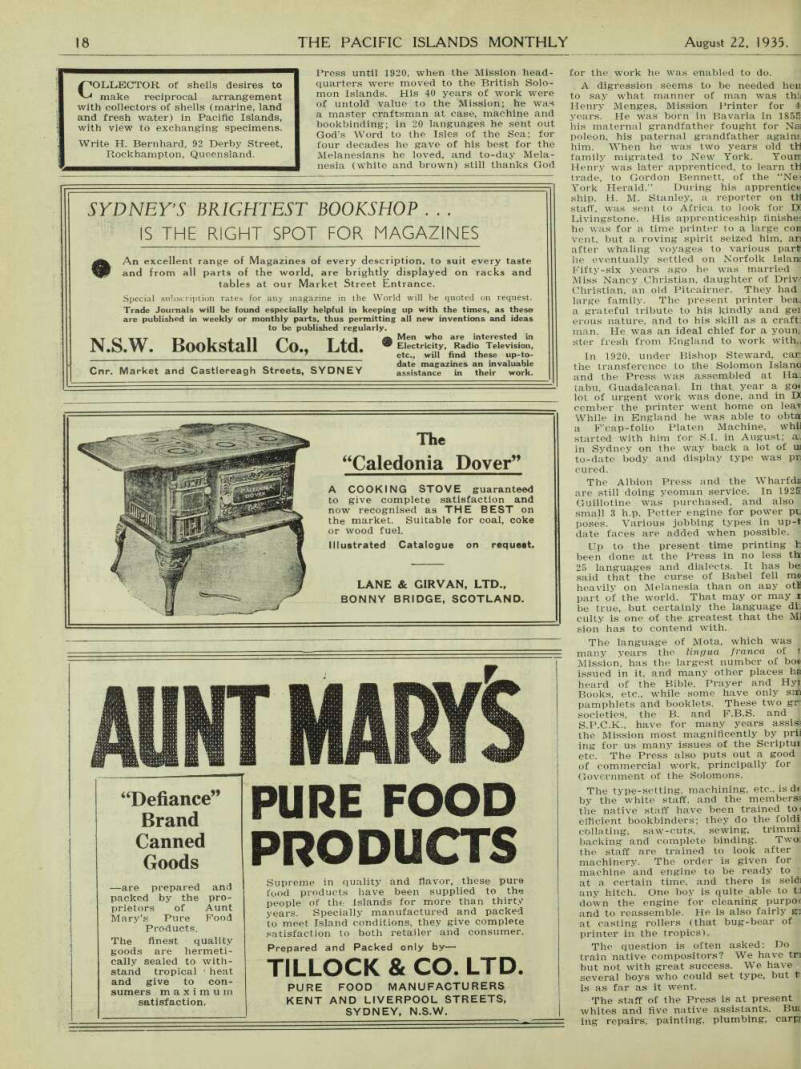
The staff of the Melanesian Mission Press, at Maravovo Lagoon, Guadalcanal, Solomon Is lands, where pamphlets and books, well printed and well bound, are produced. In the group are—Left Centre: Mr. F. R. Isom (printer); right centre: Rev. R. P. Fallowes; and, seated, Mrs, Isom, with the Isom baby.
Press until 1920, when the Mission head quarters were moved to the British Solo mon Islands. His 40 years of work were of untold value to the Mission; he was a master craftsman at case, machine and bookbinding; in 20 languages he sent out God’s Word to the Isles of the Sea; for four decades he gave of his best for the Melanesians he loved, and to-day Mela nesia (white and brown) still thanks God
for the work he was enabled to do.
A digression seems to be needed here to say what manner of man was this Henry Menges, Mission Printer for 40 years. He was born in Bavaria in 1855 his maternal grandfather fought for Napoleon, his paternal grandfather against him. When he was two years old the family migrated to New York. Young Henry was later apprenticed, to learn the trade, to Gordon Bennett, of the “New York Herald.” During his apprenticeship, H. M. Stanley, a reporter on the staff, was sent to Africa to look for Dr.
Livingstone. His apprenticeship finished he was for a time printer to a large convent, but a roving spirit seized him, and after whaling voyages to various parts, he eventually settled on Norfolk Island.
Fifty-six years ago he was married to Miss Nancy Christian, daughter of Driver Christian, an old Pitcairner. They had a large family. The present printer been a grateful tribute to his kindly and generous nature, and to his skill as a craftsman. He was an ideal chief for a youngster fresh from England to work with.
In 1920, under Bishop Steward, came the transference to the Solomon Islands and the Press was assembled at Hatabu, Guadalcanal. In that year a good lot of urgent work was done, and in December the printer went home on leave.
While in England he was able to obtain a F’cap-folio Platen Machine, which started with him for S.I. in August; a. in Sydney on the way back a lot of upto-date body and display type was procured.
The Albion Press and the Wharfds are still doing yeoman service. In 1925 Guillotine was purchased, and also a small 3 h.p. Petter engine for power purposes. Various jobbing types in up-todate faces are added when possible.
Up to the present time printing has been done at the Press in no less than 25 languages and dialects. It has been said that the curse of Babel fell more heavily on Melanesia than on any other part of the world. That may or may not be true, but certainly the language diffculty is one of the greatest that the Mission has to contend with.
The language of Mota, which was for many years the lingua franca of the Mission, has the largest number of books issued in it, and many other places have heard of the Bible, Prayer and Hymn Books, etc., while some have only small pamphlets and booklets. These two great societies, the B. and F.B.S. and S.P.C.K., have for many years assisted the Mission most magnificently by printing for us many issues of the Scripture etc. The Press also puts out a good of commercial work, principally for the Government of the Solomons.
The type-setting, machining, etc., is done by the white staff, and the members of the native staff have been trained to be efficient bookbinders; they do the folding, collating, saw-cuts, sewing, trimming, backing and complete binding. Two of the staff are trained to look after the machinery. The order is given for a machine and engine to be ready to go at a certain time, and there is seldom any hitch. One boy is quite able to take down the engine for cleaning purposes and to reassemble. He is also fairly good at casting rollers (that bug-bear of a printer in the tropics).
The question is often asked; Do you train native compositors? We have tried but not with great success. We have several boys who could set type, but that is as far as it went.
The staff of the Press is at present whites and five native assistants. Building repairs, painting, plumbing, carpentry
tering—all come within the scope of the staff. Two other natives act as cooks for the establishment. The output of the Press for a full year is from £600 to £700. It may be as well to state that all work for Mission schools and stations is debited at rock-bottom cost.
Work is always plentiful; idle working hours are not known at the Hautabu Printing Press. We have a splendid situation, on a hill 200 feet up, within a stone’s throw of the sea. The work is congenial, health good, and grousing quite uncalled for. In conclusion, may not one re-echo the words of the Psalmist — “The lot is fallen unto me on a fair ground: Yea, I have a goodly heritage.”