Central New Guinea Gives Up Its Secrets
pp. 9-77 · Read in the full issue
Hides Proves Existence of Vast Fertile Tableland, Densely Inhabited by Skilled Agriculturists of Peculiar Racial Type
By R. W. Robson
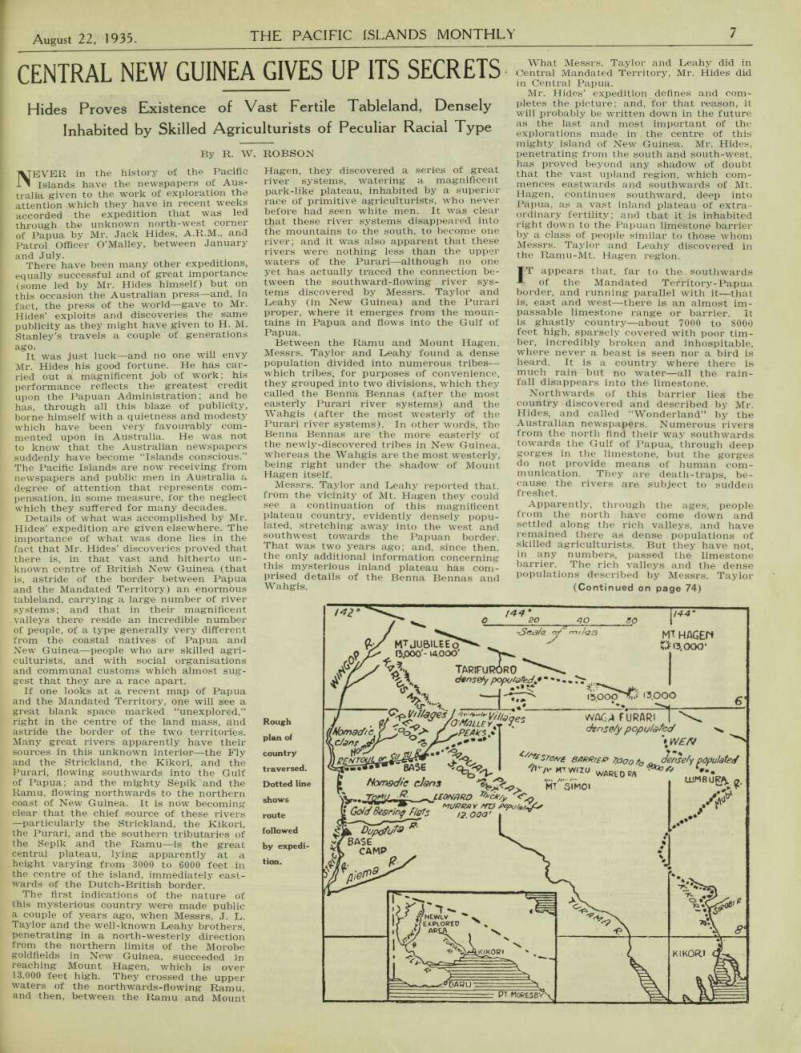
NEVER in the history of the Pacific Islands have the newspapers of Aus tralia given to the work of exploration the attention which they have in recent weeks accorded the expedition that was led through the unknown north-west corner of Papua by Mr. Jack Hides, A.R.M., and Patrol Officer O’Malley, between January and July.
There have been many other expeditions, equally successful and of great importance (some led by Mr. Hides himself) but on this occasion the Australian press—and, in fact, the press of the world —gave to Mr.
Hides’ exploits and discoveries the same publicity as they might have given to H. M.
Stanley’s travels a couple of generations ago.
It was just luck —and no one will envy Mr. Hides his good fortune. He has car ried out a magnificent job of work; his performance reflects the greatest credit upon the Papuan Administration; and he has, through all this blaze of publicity, borne himself with a quietness and modesty which have been very favourably com mented upon in Australia. He was not to know that the Australian newspapers suddenly have become “Islands conscious.”
The Pacific Islands are now receiving from newspapers and public men in Australia a degree of attention that represents com pensation, in some measure, for the neglect which they suffered for many decades.
Details of what was accomplished by Mr.
Hides’ expedition are given elsewhere. The importance of what was done lies in the fact that Mr. Hides’ discoveries proved that there is, in that vast and hitherto un known centre of British New Guinea (that is, astride of the border between Papua and the Mandated Territory) an enormous tableland, carrying a large number of river systems; and that in their magnificent valleys there reside an incredible number of people, of a type generally very different from the coastal natives of Papua and New Guinea —people who are skilled agri culturists, and with social organisations and communal customs which almost sug gest that they are a race apart.
If one looks at a recent map of Papua and the Mandated Territory, one will see a great blank space marked “unexplored,” right in the centre of the land mass, and astride the border of the two territories.
Many great rivers apparently have their sources in this unknown interior—the Fly and the Strickland, the Kikori, and the Purari, flowing southwards into the Gulf of Papua; and the mighty Sepik and the Ramu, flowing northwards to the northern coast of New Guinea. It is now becoming clear that the chief source of these rivers —particularly the Strickland, the Kikori, the Purari, and the southern tributaries of the Sepik and the Ramu —is the great central plateau, lying apparently at a height varying from 3000 to 6000 feet in the centre of the island, immediately east wards of the Dutch-British border.
The first indications of the nature of this mysterious country were made public a couple of years ago, when Messrs. J. L.
Taylor and the well-known Leahy brothers, penetrating in a north-westerly direction from the northern limits of the Morobe goldfields in New Guinea, succeeded in reaching Mount Hagen, which is over 13,000 feet high. They crossed the upper waters of the northwards-flowing Ramu, and then, between the Ramu and Mount
Hagen, they discovered a series of great river systems, watering a magnificent park-like plateau, inhabited by a superior race of primitive agriculturists, who never before had seen white men. It was clear that these river systems disappeared into the mountains to the south, to become one river; and it was also apparent that these rivers were nothing less than the upper waters of the Purari—although no one yet has actually traced the connection be tween the southward-flowing river sys tems discovered by Messrs. Taylor and Leahy (in New Guinea) and the Purari proper, where it emerges from the moun tains in Papua and flows into the Gulf of Papua.
Between the Ramu and Mount Hagen, Messrs. Taylor and Leahy found a dense population divided into numerous tribes— which tribes, for purposes of convenience, they grouped into two divisions, which they called the Benna Bennas (after the most easterly Purari river systems) and the Wahgis (after the most westerly of the Purari river systems). In other words, the Benna Bennas are the more easterly of the newly-discovered tribes in New Guinea, whereas the Wahgis are the most westerly, being right under the shadow of Mount Hagen itself.
Messrs. Taylor and Leahy reported that, from the vicinity of Mt. Hagen they could see a continuation of this magnificent plateau country, evidently densely popu lated, stretching away into the west and southwest towards the Papuan border.
That was two years ago; and, since then, the only additional information concerning this mysterious inland plateau has com prised details of the Benna Bennas and Wahgis.
What Messrs. Taylor and Leahy did in Central Mandated Territory, Mr. Hides did in Central Papua.
Mr. Hides’ expedition defines and com pletes the picture; and, for that reason, it will probably be written down in the future as the last and most important of the explorations made in the centre of this mighty island of New Guinea. Mr. Hides, penetrating from the south and south-west, has proved beyond any shadow of doubt that the vast upland region, which com mences eastwards and southwards of Mt.
Hagen, continues southward, deep into Papua, as a vast inland plateau of extra ordinary fertility; and that it is inhabited right down to the Papuan limestone barrier by a class of people similar to those whom Messrs. Taylor and Leahy discovered in the Ramu-Mt. Hagen region.
IT appears that, far to the southwards of the Mandated Territory-Papua border, and running parallel with it—that is, east and west —there is an almost im passable limestone range or barrier. It is ghastly country—about 7000 to 8000 feet high, sparsely covered with poor tim ber, incredibly broken and inhospitable, where never a beast is seen nor a bird is heard. It is a country where there is much rain but no water—all the rain fall disappears into the limestone.
Northwards of this barrier lies the country discovered and described by Mr.
Hides, and called “Wonderland” by the Australian newspapers. Numerous rivers from the north find their way southwards towards the Gulf of Papua, through deep gorges in the limestone, but the gorges do not provide means of human com munication. They are death-traps, be cause the rivers are subject to sudden freshet.
Apparently, through the ages, people from the north have come down and settled along the rich valleys, and have remained there as dense populations of skilled agriculturists. But they have not, in any numbers, passed the limestone barrier. The rich valleys and the dense populations described by Messrs. Taylor
(Continued on page 74)
Rough plan of country traversed.
Dotted line shows route followed by expedi tion.
and Leahy in New Guinea, and by Mr.
Hides in Papua, end suddenly against the limestone barrier. Southwards of the barrier, apparently, there are different kinds of people inhabiting a different kind of country. There clearly has been com munication and intermixture between them, but not to any marked extent.
Without any doubt, explorations with in the next few years will confirm and extend the discoveries of these young ex plorers. It will be found that in that vast region that lies between Morobe in the east and the Dutch border on the west, and between the Sepik and Ramu rivers in the north and the limestone barrier in the south, there is an enormous native population, inhabiting innumerable well-watered valleys which in all direc tions intersect the fertile central table land. , It will be found, also, that generally these people, although they display many tribal differences, are of a special racial type —a people, for the most parß of good stature, and with markedly aquiline fea tures. In many places they show strong Papuan or Melanesian characteristics, but the great majority do not appear to be
Papuans or Melanesians. Neither are they Polynesians But there seems to be one distinctive section. Mr. Hides, in the most definite fashion, has described to me a people who in habit a valley at the western (or Stride ]and) end of the country he explored. He said that these people have a skin almost Anglo-Saxon in colour; that they are lightly built and even effeminate in ap pearance; and that he estimated that there were at least 50,000 of them.
These light-skinned folk were at the wes f ern e nd of the districts he pene trated and he said that the tribes there abouts clearly had never previously been contact with whites. But towards the eagtern end of his pa trol, southwards and south-eastwards of Mount Hagen, and near the p ura ri River, he found much ev i de nce that the tribes had been in con t with white people in the north, north wa^s ‘” ( e ®f mestone barrle r appeared
mmmmm
tion of crops; they appeared to have a remarkable system of communal life, adapted to their practice of living on iso lated farms rather than in villages; and they are notable for a variety of curious customs, which on investigation may es tablish affinities which will allow scien tists to trace something of their history.
It certainly seems to be a rich field for the anthropologist.
The Papuan Police
An outstanding feature of the Hides expedition was the extraordinarily fine service rendered by the Papuan Armed Constabulary. Mr. Hides had with him less than a dozen native police; yet they stood by him with such staunchness and loyalty that the little party was able to come unscathed through a territory that was always strange and dangerous, and often actively hostile.
The two leaders, Messrs. Hides and O’Malley, appear to have worked together in a fine spirit of comradeship and mutual trust; that, of course, was to be expected.
But the thing that is most worthy of praise, and concerning which we should like much further information, is the splendid service rendered to the two white officers by those Papuan policemen. There is not much wrong with an Administra tion which has service of this kind at its command.
Young Explorers In A
Maelstrom
Messrs. Hides and O’Malley were given special leave to come South by the Mon toro, early in August. Immediately, they were involved in a press hullabulloo which they must have found more terrifying" than anything encountered north of the limestone barrier.
Mr. Hides was met in Queensland by a representative of the Sydney Morning Herald-Melbourne Argus group, who signed him up for a series of illustrated articles. This stirred a rival newspaper group to activity, and some funny things happened. The rival group evidently protested to the Federal authorities. “Mr.
Hides,” they probably said, “is a Papuan Government official. Who gave him the right to sell to our rivals an exclusive story based on material gathered in his duties as a Government officer? If he has a report to make, all newspapers are entitled to it.”
It would appear that the Federal au thorities accepted this argument. Mr.
Hides had submitted to the Lieutenant- Governor a 35,000-words report on his expedition; and the Governor had promptly transmitted it to Canberra. A few hours after it reached Canberra it was released to the newspapers.
So we had the interesting spectacle of the Herald-Argus group publishing a specially compiled account of Mr. Hides expedition; while the rival group, on the same days, were publishing copious ex
tracts from Mr. Hides’ official report.
For over a week, therefore, Mr. Hides and his “Papuan Wonderland” were front page news in every city of the Common wealth. Summaries of the articles evi dently were cabled overseas, for there were interesting comments in overseas newspapers: even the London “Times” de voted a leading article to the subject of whether an attempt should be made to preserve these newly-discovered natives in an unspoiled condition.
The rival group, however, in their eagerness to beat the Herald-Argus group, made rather a hash of the official report. The series of articles in the Herald-Argus newspapers gave a clear, graphic account of what had been achieved: but the material that was dished up from the official report by special correspondents at Canberra was such a jumble that few could make head or tail of it—it was just a series of dis connected incidents and descriptions.
Meanwhile, Mr. Hides had arrived in Sydney, where he was more or less torn to pieces by reporters, overcome by a first-class dose of malaria and driven nearly frantic by demands for speeches and articles from a multitude of pub lishers, luncheon-club organisers, broad casting stations, etc. He fled into the bush to nurse his malaria and his new baby, and he still is there at the moment of this writing.