Carvings in Fiji
pp. 40-41 · Read in the full issue
More Strange Reck Carvings in Fiji
Further interesting archaeological discoveries are reported hy Mr. A. J.
Vogan who has been engaged in the self imposed task of scientific investigation in the Pacific for many years.
Mr. Vogan in 1933 discovered and made plaster casts of very strange rock carvings in a cave in the Yasawas, north-west Fiji; and experts who examined copies of the queer script declared that they were Chinese characters pre-dating the Christian era.
Mr. Vogan early this year received fur ther information, and left Sydney in April and proceeded direct to Daku-Niba, Wai kara, Vanua Levu, in Fiji, where he dis covered further carvings of a similar character, on what appeared to be the remains of ancient fortifications.
Writing from Suva, on June 6, Mr.
Vogan said he was about to return to Vanua Levu, but that he had already found evidence that the ancient folk who made the deep groovings in the very hard vol canic rock were the same as those who made the carvings he found in the Yasawa cave. The native name of the new find is “Daku-Niba” which means “Behind the fence or wall.”
“A steep climb brings one to a step or stone that is still in its original position across the jungle path,” says Mr. Vogan.
“On this stone is a strange castellated device which is not in any language, apparently.
“Further up the hill, a chain or so, two great stones, about 16 feet high, once stood on either side of the entrance to the Fort, or Holy Place. Earthquakes prob
ably (once very common here) brought these to earth —happily, face upwards (un less they are inscribed on both sides, which I have reason for thinking they are not).
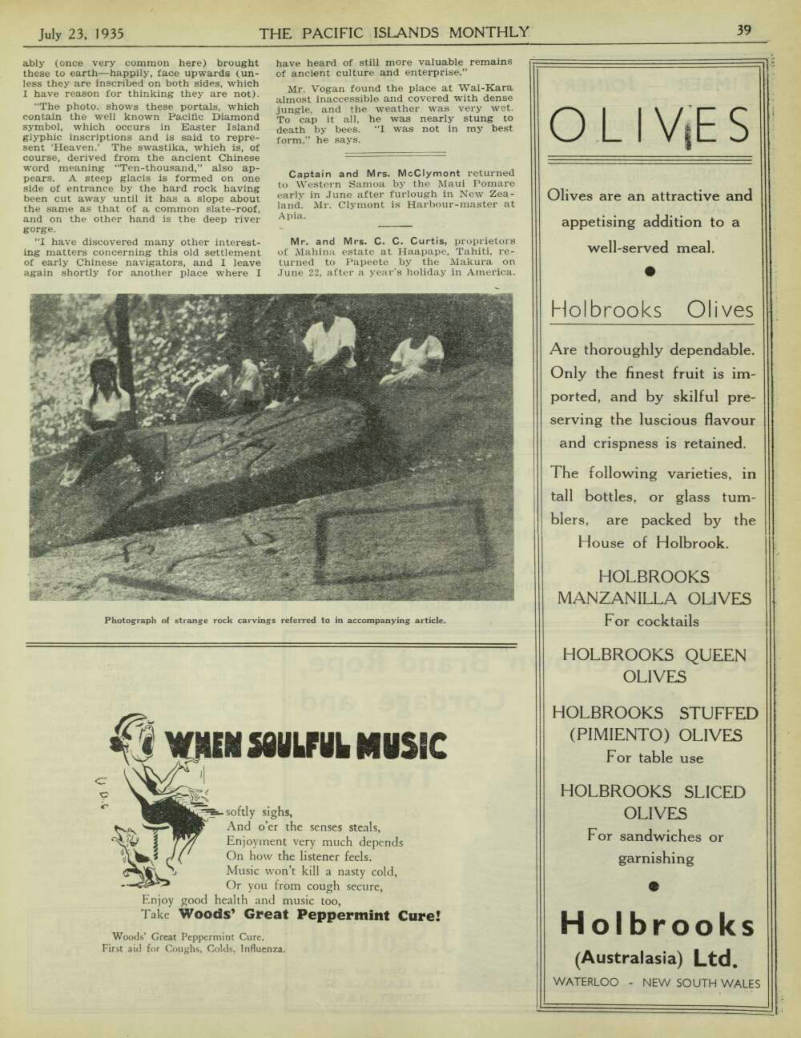
“The photo, shows these portals, which contain the well known Pacific Diamond symbol, which occurs in Easter Island glyphic inscriptions and is said to repre sent ‘Heaven.’ The swastika, which is, of course, derived from the ancient Chinese word meaning “Ten-thousand,” also ap pears. A steep glacis is formed on one side of entrance by the hard rock having been cut away until it has a slope about the same as that of a common slate-roof, and on the other hand is the deep river gorge.
“I have discovered many other interest ing matters concerning this old settlement of early Chinese navigators, and I leave again shortly for another place where I
have heard of still more valuable remains of ancient culture and enterprise.”
Mr. Vogan found the place at Wai-Kara almost inaccessible and covered with dense jungle, and the weather was very wet.
To cap it all, he was nearly stung to death by bees. “I was not in my best form,” he says.
Captain and Mrs. McClymont returned to Western Samoa by the Maui Pomare early in June after furlough in New Zea land. Mr. Clymont is Harbour-master at Apia.
Mr. and Mrs. C. C. Curtis, proprietors of Mahina estate at Haapape, Tahiti, re turned to Papeete by the Makura on June 22, after a year’s holiday in America.
Photograph of strange rock carvings referred to in accompanying article.