Islands As Landing Grounds
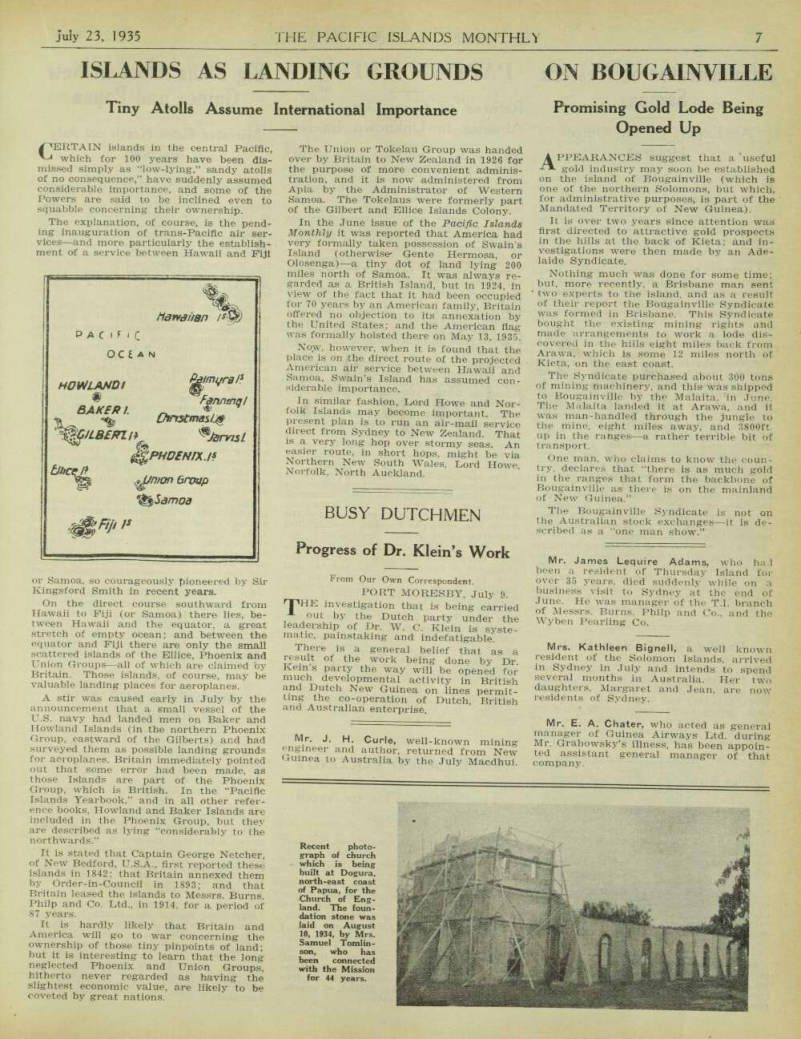
Tiny Atolls Assume International Importance
islands in the central Pacific, which for 100 years have been dis missed simply as “low-lying,” sandy atolls of no consequence,” have suddenly assumed considerable importance, and some of the Powers are said to be inclined even to squabble concerning their ownership.
The explanation, of course, is the pend ing inauguration of trans-Pacific air ser vices—and more particularly the establish ment of a service between Hawaii and Fiji
or Samoa, so courageously pioneered by Sir Kingsford Smith in recent years.
On the direct course southward from Hawaii to Fiji (or Samoa) there lies, be tween Hawaii and the equator, a great stretch of empty ocean; and between the equator and Fiji there are only the small scattered islands of the Ellice, Phoenix and Union Groups—all of which are claimed by Britain. Those islands, of course, may be valuable landing places for aeroplanes.
A stir was caused early in July by the announcement that a small vessel of the U.S. navy had landed men on Baker and Howland Islands (in the northern Phoenix Group, eastward of the Gilberts) and had surveyed them as possible landing grounds for aeroplanes. Britain immediately pointed out that some error had been made, as those Islands are part of the Phoenix Group, which is British. In the “Pacific Islands Yearbook,” and in all other refer ence books, Howland and Baker Islands are included in the Phoenix Group, but they are described as lying “considerably to the northwards.”
It is stated that Captain George Netcher, of New Bedford, U.S.A., first reported these islands in 1842; that Britain annexed them by Order-in-Council in 1893; and that Britain leased the islands to Messrs. Burns, Philp and Co. Ltd., in 1914, for a period of 87 years.
It is hardly likely that Britain and America will go to war concerning the ownership of those tiny pinpoints of land; but it is interesting to learn that the long neglected Phoenix and Union Groups, hitherto never regarded as having the slightest economic value, are likely to be coveted by great nations.
The Union or Tokelau Group was handed over by Britain to New Zealand in 1926 for the purpose of more convenient adminis tration, and it is now administered from Apia by the Administrator of Western Samoa. The Tokelaus were formerly part of the Gilbert and Ellice Islands Colony.
In the June issue of the Pacific Islands Monthly it was reported that America had very formally taken possession of Swain’s Island (otherwise Gente Hermosa, or Olosenga)—a tiny dot of land lying 200 miles north of Samoa. It was always re garded as a British Island, but in 1924, in view of the fact that it had been occupied for 70 years by an American family, Britain offered no objection to its annexation by the United States; and the American flag was formally hoisted there on May 13, 1935.
No t w, however, when it is found that the place is on the direct route of the projected American air service between Hawaii and Samoa, Swain’s Island has assumed con siderable importance.
In similar fashion, Lord Howe and Nor folk Islands may become important. The piesent plan is to run an air-mail service direct from Sydney to New Zealand. That is a very long hop over stormy seas. An easier route, in short hops, might be via Northern New South Wales, Lord Howe Norfolk. North Auckland.