Across Primitive New Guinea In 1895
p. 48 · Read in the full issue
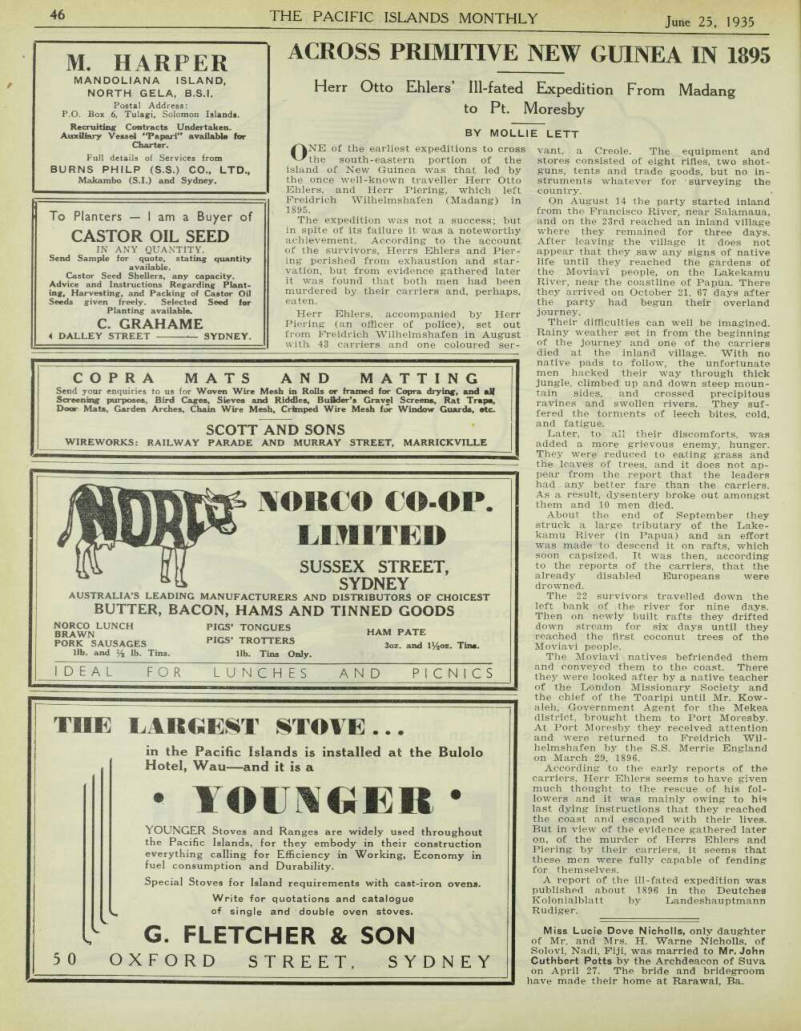
Herr Otto Ehlers’ Ill-fated Expedition From Madang to Pt. Moresby
By Mollie Lett
ONE of the earliest expeditions to cross the south-eastern portion of the island of New Guinea was that led by the once well-known traveller Herr Otto Ehlers, and Herr Piering, which left Freidrich Wilhelmshafen (Madang) in 1895.
The expedition was not a success; but in spite of its failure it was a noteworthy achievement. According to the account of the survivors, Herrs Ehlers and Piering perished from exhaustion and star vation, but from evidence gathered later it was found that both men had been murdered by their carriers and, perhaps, eaten.
Herr Ehlers, accompanied by Herr Piering (an officer of police), set out from Freidrich Wilhelmshafen in August with 43 carriers and one coloured ser-
vant, a Creole. The equipment and stores consisted of eight rifles, two shot guns, tents and trade goods, but no in struments whatever for surveying the country.
On August 14 the party started inland from the Francisco River, near Salamaua, and on the 23rd reached an inland village where they remained for three days.
After leaving the village it does not appear that they saw any signs of native life until they reached the gardens of the Moviavi people, on the Lakekamu River, near the coastline of Papua. There they arrived on October 21, 67 days after the party had begun their overland journey.
Their difficulties can well be imagined.
Rainy weather set in from the beginning of the journey and one of the carriers died at the inland village. With no native pads to follow, the unfortunate men hacked their way through thick jungle, climbed up and down steep mountain sides, and crossed precipitous ravines and swollen rivers. They suffered the torments of leech bites, cold, and fatigue.
Later, to all their discomforts, was added a more grievous enemy, hunger.
They were reduced to eating grass and the leaves of trees, and it does not appear from the report that the leaders had any better fare than the carriers.
As a result, dysentery broke out amongst them and 10 men died.
About the end of September they struck a large tributary of the Lake kamu River (in Papua) and an effort was made to descend it on rafts, which soon capsized. It was then, according to the reports of the carriers, that the already disabled Europeans were drowned.
The 22 survivors travelled down the left bank of the river for nine days.
Then on newly built rafts they drifted down stream for six days until they reached the first coconut trees of the Moviavi people.
The Moviavi natives befriended them and conveyed them to the coast. There they were looked after by a native teacher of the London Missionary Society and the chief of the Toaripi until Mr. Kowaleh, Government Agent for the Mekea district, brought them to Port Moresby.
At Port Moresby they received attention and were returned to Freidrich Wilhelmshafen by the S.S. Merrie England on March 29, 1896.
According to the early reports of the carriers, Herr Ehlers seems to have given much thought to the rescue of his followers and it was mainly owing to his last dying instructions that they reached the coast and escaped with their lives.
But in view of the evidence gathered later on, of the murder of Herrs Ehlers and Piering by their carriers, it seems that these men were fully capable of fending for themselves.
A report of the ill-fated expedition was published about 1896 in the Deutches Kolonialblatt by Landeshauptmann Rudiger.
Miss Lucie Dove Nicholls, only daughter of Mr. and Mrs. H. Warne Nicholls, of Solovi, Nadi, Fiji, was married to Mr. John Cuthbert Potts by the Archdeacon of Suva on April 27. The bride and bridegroom have made their home at Rarawai, Ba.