Library
pp. 42-43 · Read in the full issue
Historical Document
“Pity Poor Fiji” in Mitchell Library
The Mitchell Library in Sydney possesses a Pacific document of great his torical interest —the original draft of "Pity Poor Fiji,” from the pen of Rev.
James Watkin, a pioneer of Wesleyanism in Tonga and New Zealand. Following its publication in England, in a missionary journal, attention was directed towards Fiji in such a way that, eventually, the path was prepared for annexation.
In a covering letter, its former owner, (to whom the manuscript had been given by his father), the Rev. Dr. Edwin J.
Watkin, D.D., says: “The effect of the appeal on the British Wesleyan Church led to John Hunt, James Calvert, and Thomas Williams, early missionaries, going to Fiji. More than any thing else, outside of the work of the missionaries, both English-speaking and Tongan, it contributed to Fiji being to-day part of the British Empire. When Fiji was offered to the British Govern ment, Mr. Gladstone, who was then in power, opposed its acceptance. He held that colonies were a source of weakness to the Empire.”
It was the persistence of Sir William Macarthur, M.P. (says Dr. Watkin), that ultimately led to the annexation of those islands. The information received by Sir William, who was the son of an Irish Wesleyan minister, was based on “the oral and written reports” as to the commercial possibilities of Fiji, from the missionaries. The Rev. James Watkin spent the remainder of his days in Sydney, where he died on May 14, 1886, aged 81. He arrived in Tonga in 1831, travelling via New Zealand in a whaler, to find the Tongans ablaze with the fire of a religious revival. —E.R.
Archdeacon Richard Godfrey, who recently retired from the Melanesian Mission owing to eye trouble, has been appointed curate at St. James’ Church, Sydney. Mr. Godfrey served in New Hebrides for 17 years.
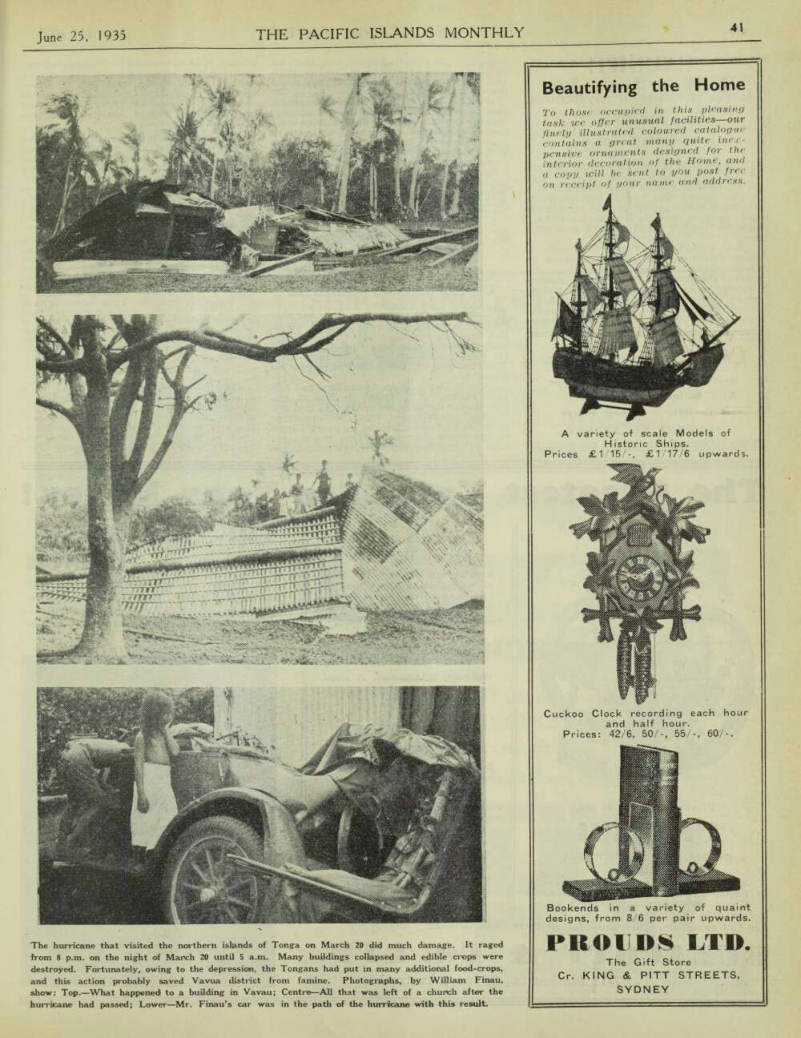
The hurricane that visited the northern islands of Tonga on March 20 did much damage. It raged from 8 p.m. on the night of March 20 until 5 a.m. Many buildings collapsed and edible crops were destroyed. Fortunately, owing to the depression, the Tongans had put in many additional food-crops, and this action probably saved Vavua district from famine. Photographs, by William Finau, show: Top.—What happened to a building in Vavau; Centre—All that was left of a church after the hurricane had passed; Lower —Mr. Finau’s car was in the path of the hurricane with this result.