America Annexes Swain’S Island
pp. 28-30 · Read in the full issue
Romantic Little Atoll Comes Into Limelight
ON Monday, May 13, 1935, the flag of the United States was hoisted, with ceremony, over Swain’s Island, and the tiny atoll now is completely and finally American territory, administered from American Samoa.
There are reports—quite unofficial—that Swain’s Island is to play some part in the plan of American fortifications in the Pacific. It is even said that the famous lagoon (freshwater) is to become a landing place for a line of American trans-Pacific seaplanes.
Thus, one of the most beautiful, romantic and least known of the Pacific Islands is brought into the limelight.
ALL over the world to-day there are imaginative men who dream of a life of idyllic ease on a South Sea island, where work is unknown, and lustrous maidens attend joyously to one’s every whim.
Hard-bitten traders and planters, hearing of such things, swear horribly: in their view, life in the South Seas is just as hard and cruel and unromantic as it is any where else.
But there are a few places left, far off
the roads of sea-traffic, where dreams seem to have come true; where natives and whites alike do lead lives free from worldly cares.
Such a beauty spot is the little known island of Gente Hermosa, commonly called Swain’s Island or Olosenga; situated away by itself about 200 miles north of the Samoan Islands; a flat atoll with an area of about 800 acres. It always has been regarded as part of the Union or Tokelau Islands which lie to the North, only 100 miles distant, and which are administered by the New Zealand Administrator of the Mandated Territory of Western Samoa.
But Swain’s Island —as it is generally known nowadays—though inhabited since 1856 by a European family with a numerous retinue of natives, was not annexed by any Power for about 70 years. In 1924 the present owner, Mr. A. E. Jennings, born on the island and of part Samoan blood, applied formally to the American Naval Administration at Pago Pago, American Samoa, for annexation of his island by the United States Government. This was granted soon afterwards, but the American flag was not hoisted on Swain’s Island until this year, on May 13th.
Little is known about the discovery and early history of the island; though the name Gente Hermosa seems to indicate that the place was known to the old Spanish seafarers. The island is very remarkable in that it has a large freshwater lake and therefore was popular as a port of call for the numerous whaling ships during the greater part of the nineteenth century.
Whaling crews told of the island when they went to Apia, Western Samoa. Apia was a favourite port of call for whaling ships; and there, in the year 1856, the German Arm of Godeffroy, later known as the “D.H. & P G.,” or the “firm with the long handle,” had just started operations.
There lived in Apia at this time a young American, E. Jennings, of New York, who had landed in Samoa from one of the American whalers. He had married the daughter of a Samoan Chief and, attracted by the description of the mysterious island, he made up his mind to go and settle there.
After buying building material for a house, and all necessary equipment, Jennings departed with his family for the island. He met there only a few natives from the neighbouring Tokelau islands, who periodically paid Swain’s a visit for fishing purposes. Otherwise, the island was uninhabited.
Jennings built his house and settled down to work and plant the island with coconuts. He succeeded in inducing some of the Tokelau islanders, with their families, to stay with him and work for him in his fertile little South Sea Paradise.
Eli Jennings and, later, his son and grandson, have done splendid work in
their island kingdom—constructed good roads, on which motor trucks are running nowadays; erected a pretty little church for their native subjects; and so on.
About a hundred natives live on this happy isle, where there are no taxes and duties, no officials or police, and where also the scourges of other islands, yaws and elephantiasis, malaria and malaria-carry ing mosquitoes, are unknown. The natives —mostly Polynesians with some admixture of European blood —are a strong and healthy race, happy and contented with their lot working a few hours per day at gathering coconuts and cutting copra, and devoting the balance of their time to fish ing or looking after their own small plantations of taro and bananas, or feeding the numerous pigs and fowls on the island.
Swain’s Island is of coral formation, and
men. Going out at night with their large outrigger canoes, they use torches made of dry coconut leaves to attract the fish, which are then caught with “butterfly nets” at the end of long poles. Turtles and crayfish also appear frequently on the bill of fare at Swain’s Island.
There are no wage disputes on the island—the value of money is illusory, as it cannot be spent. The native men and women work on five week-days for three or four hours, at gathering and cutting copra for their island king. In exchange, they receive some goods, mostly clothing, at the value of six shillings a man and four shillings a woman per month.
A small motor schooner, owned by an Apia firm of merchants, represents Swain’s Island’s communication with Western Samoa and the outside world. More recently
an American motor launch, from Pago Pago, has started making trips to the island.
The American coastguard cutter Ithasca called at the island twice during April and May, leaving some members of the Naval
about three miles long and one mile broad.
The island is completely surrounded by a coral reef, broken only at one point, where entrance through the reef is possible.
Here, the village of the natives, with their church, is situated; while the residence of the “island king,” Mr. Jennings, named appropriately “Eden,” is some distance away.
The natives here, as in Samoa, are all devoted members of the church, which is in charge of a dignified old Samoan missionary. The latter conducts a school for the children, who number about half the total population of the island.
Inside and outside the encircling reef, the sea abounds with fish of all sizes and kinds, and the natives are all expert fisher-
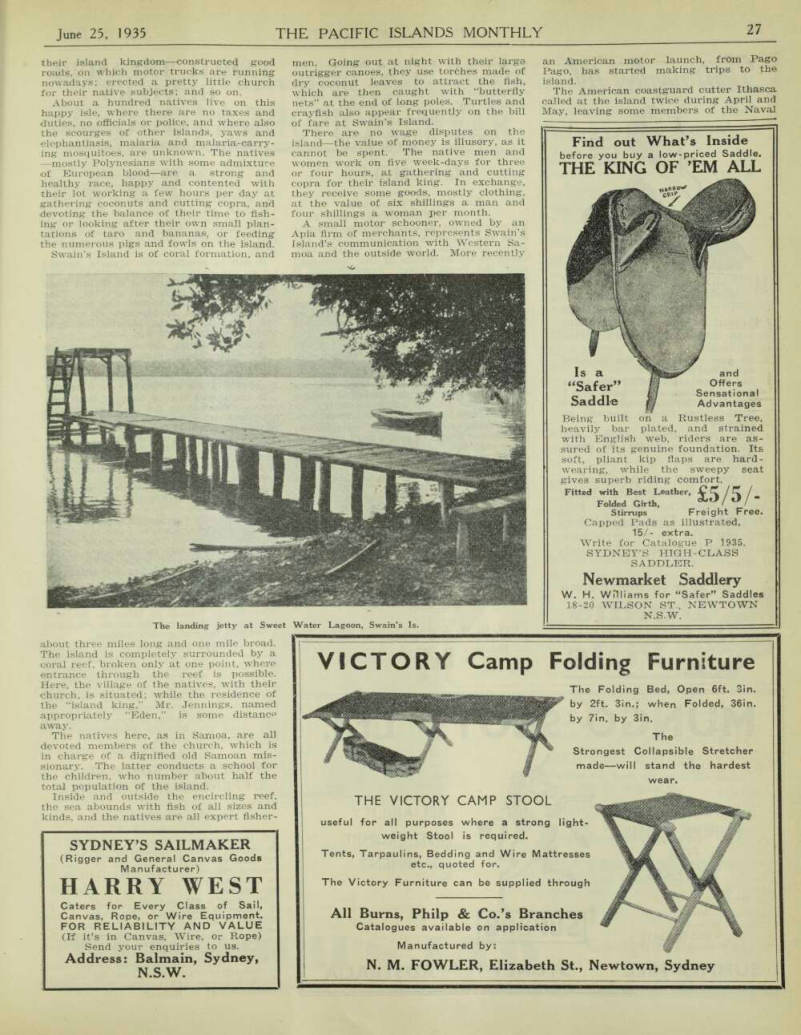
The landing jetty at Sweet Water Lagoon, Swain’s Is.
Commission, to stay for a short visit on Swain’s. There seems to be a possibility that Uncle Sam will buy the island from the present owner, Mr. Jennings, for use as a supply station or health resort.