Fight, N.G.
p. 22 · Read in the full issue
Where Australia Was
Blooded
Memorial on Scene of Bitapaka Fight, N.G.
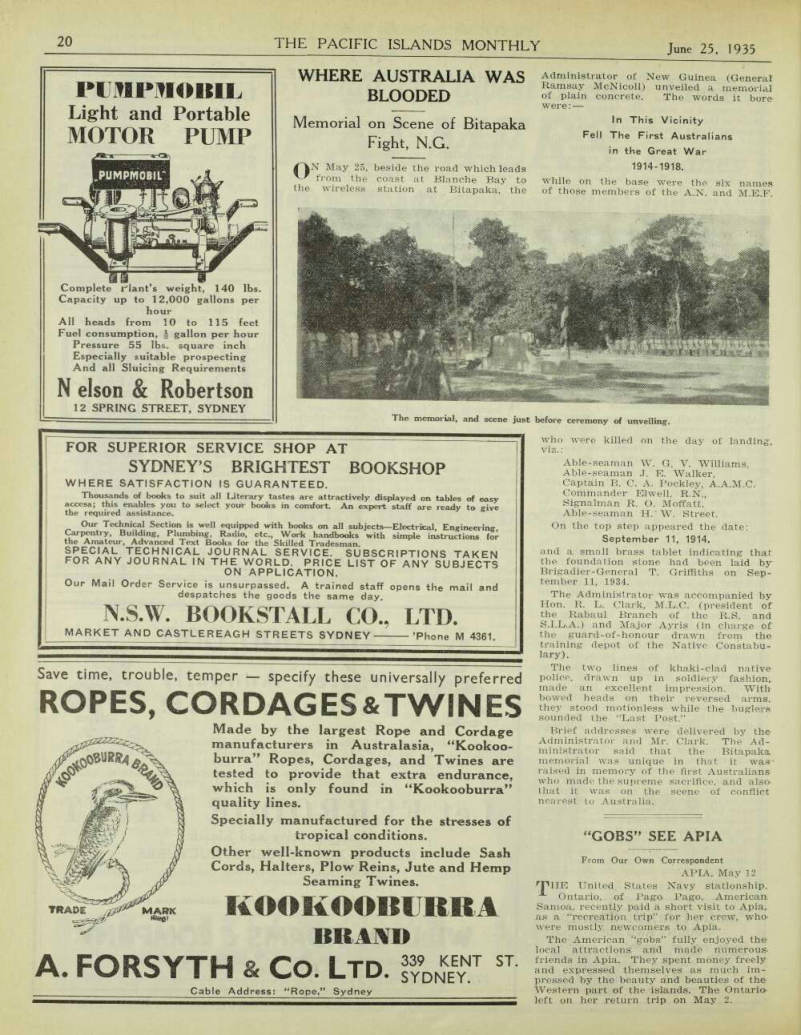
On May 25, beside the road which leads from the coast at Blanche Bay to the wireless station at Bitapaka, the
Administrator of New Guinea (General Ramsay McNicoll) unveiled a memorial of plain concrete. The words it bore were: In This Vicinity Fell The First Australians in the Great War 1914-1918. while on the base were the six names of those members of the A.N. and M.E.F.
who were killed on the day of landing, viz.: Able-seaman W. G. V. Williams, Able-seaman J. E. Walker, Captain B. C. A. Pockley, A.A.M.C.
Commander Elwell, R.N., Signalman R. O. Moffatt.
Able-seaman H. W. Street.
On the top step appeared the date: September 11, 1914. and a small brass tablet indicating that the foundation stone had been laid by Brigadier-General T. Griffiths on Sep tember 11, 1934.
The Administrator was accompanied by Hon. R. L. Clark, M.L.C. (president of the Rabaul Branch of the R.S. and S.I.L.A.) and Major Ayris (in charge of the guard-of-honour drawn from the training depot of the Native Constabulary).
The two lines of khaki-clad native police, drawn up in soldiery fashion, made an excellent impression. With bowed heads on their reversed arms, they stood motionless while the buglers sounded the “Last Post.”
Brief addresses were delivered by the Administrator and Mr. Clark. The Administrator said that the Bitapaka memorial was unique in that it was raised in memory of the first Australians who made the supreme sacrifice, and also that it was on the scene of conflict nearest to Australia.
The memorial, and scene just before ceremony of unveiling.