Suitable House For Tropics
pp. 42-44 · Read in the full issue

How to Let in Air and Keep Out Mosquitoes
Written for Pacific Islands Monthly by Rev. R. R. Hansehnann, of Madang, New Guinea
NEW GUINEA is becoming every day, in every way, a better place for the white man to live. The sooner we all realise that the tropics will not change to please us, but that we must adapt our selves to conditions, the happier and healthier we shall be and the better able to develop New Guinea’s resources and solve our specific problems.
Housing has been a problem and will become more so, for buildings of German
times are rapidly deteriorating, and cer tainly as soon as better times arrive, many new houses will be erected. Discussion and planning of tropical houses therefore should be timely and of benefit.
The usual tropical house has a few rooms in a straight row, with huge verandahs all around. The window and door space may be a trifle more than rooms have in our home countries; nevertheless the rooms are dark and stuffy and greatly lack the
friendly atmosphere of a home. Near the ceiling one frequently finds an opening in the wall for ventilation, but what a farce — for the heat, as it rises under the slanting verandah roof, forces itself into the rooms.
To screen such rooms would be unbear able for heat; therefore, nets over the beds are used as protection against mosquitoes during the night, and a corner of the verandah is screened in to give one peace at least while eating. As these screened corners are small and lack proper ventila tion, refuge for cool breezes and light is sought on the open verandahs, offering of course happy hunting-grounds for mos quitoes.
The kitchen resembles an attractive fly catcher.
Studying tropical home-construction and plans of other countries, I find we can adapt our homes to our specific climate more economically and practically than has been done. I have erected two houses and have applied, to our great satisfaction and comfort, many news ideas.
“More air and light for tropical rooms” must be the goal for New Guinea houses.
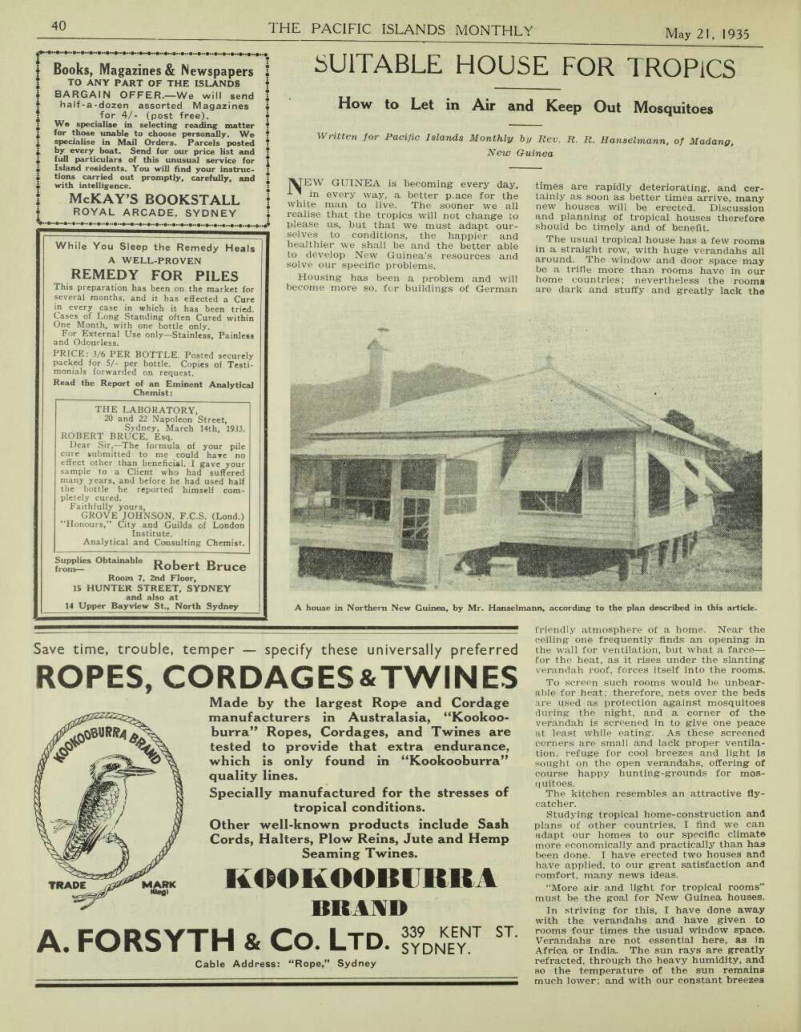
In striving for this, I have done away with the verandahs and have given to rooms four times the usual window space.
Verandahs are not essential here, as in Africa or India. The sun rays are greatly refracted, through the heavy humidity, and so the temperature of the sun remains much lower; and with our constant breezes
A house in Northern New Guinea, by Mr. Hanselmann, according to the plan described in this article.
the room temperature is not much dif ferent, whether the house has verandahs or not. Therefore, away with the huge verandahs, enlarge the rooms, and save money!
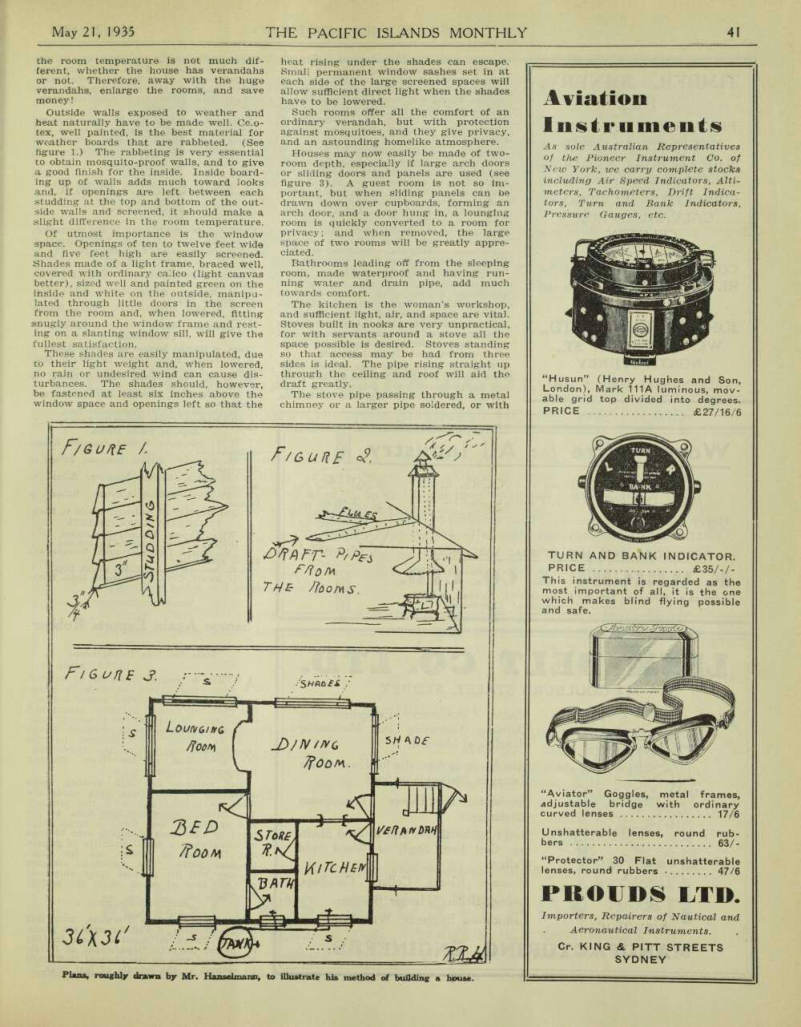
Outside walls exposed to weather and heat naturally have to be made well. Celo tex, well painted, is the best material for weather boards that are rabbeted. (See figure 1.) The rabbeting is very essential to obtain mosquito-proof walls, and to give a good finish for the inside. Inside board ing up of walls adds much toward looks and, if openings are left between each studding at the top and bottom of the out side walls and screened, it should make a slight difference in the room temperature.
Of utmost importance is the window space. Openings of ten to twelve feet wide and five feet high are easily screened.
Shades made of a light frame, braced well, covered with ordinary calico (light canvas better), sized well and painted green on the inside and white on the outside, manipu lated through little doors in the screen from the room and, when lowered, fitting snugly around the window frame and rest ing on a slanting window sill, will give the fullest satisfaction.
These shades are easily manipulated, due to their light weight and, when lowered, no rain or undesired wind can cause dis turbances. The shades should, however, be fastened at least six inches above the window space and openings left so that the
heat rising under the shades can escape.
Small permanent window sashes set in at each side of the large screened spaces will allow sufficient direct light when the shades have to be lowered.
Such rooms offer all the comfort of an ordinary verandah, but with protection against mosquitoes, and they give privacy, and an astounding homelike atmosphere.
Houses may now easily be made of two room depth, especially if large arch doors or sliding doors and panels are used (see figure 3). A guest room is not so im portant, but when sliding panels can be drawn down over cupboards, forming an arch door, and a door hung in, a lounging room is quickly converted to a room for privacy; and when removed, the large space of two rooms will be greatly appre ciated.
Bathrooms leading off from the sleeping room, made waterproof and having run ning water and drain pipe, add much towards comfort.
The kitchen is the woman’s workshop, and sufficient light, air, and space are vital.
Stoves built in nooks are very unpractical, for with servants around a stove all the space possible is desired. Stoves standing so that access may be had from three sides is ideal. The pipe rising straight up through the ceiling and roof will aid the draft greatly.
The stove pipe passing through a metal chimney or a larger pipe soldered, or with
Plans, roughly drawn by Mr. Hanselmann, to illustrate his method of building a house.
shoes resting over the galvanised roof, will prevent any rain coming down. A metal hood fastened to the bottom of this pipe or chimney, about four feet above and cover ing the stove, will catch heat, smoke and vapors and keep the temperature of the kitchen low. (Figure 2.) Screening of kitchens is the first step for sanitary homes.
Should more air circulation be desired, it can easily be achieved by connecting each room with a flue eight inches in diameter, rising from a register in the ceiling to a rotary style ventilator on the ridge of the roof; or, when possible, connected with the above-mentioned chimney, and a draft will be caused by the heat rising and escaping.
Registers in the floors, with wind funnels under the house, cause a flow of air into the rooms usually not considered possible.
With dampers in these flues, the draft can be controlled. (See figure 2.) A cut-off in the water pipe, leading from the water guttering to the tank, would mean much for cleaner water. After the roof has been rinsed off, permit water to flow into the tank. Just these little things mean much for health and happiness—and even a new house is not beyond the limits of any permanent tropical dweller.
With pit saws, have logs broken down to a two or three-inch thick slabs. These are easily handled and transported. On a portable saw mill, flooring, weather boards,
tongue and grooving, moulding, and all can be cut and dressed. These plants are light and not costly. Pit saws and a five horse power plant is the most practical and economical equipment for small undertak ings and repair work.
Although we may not be carpenters by trade, we can all do much to make our houses and stations practical, adapted to the tropics, sanitary and comfortable.