Seeking Gold
p. 24 · Read in the full issue
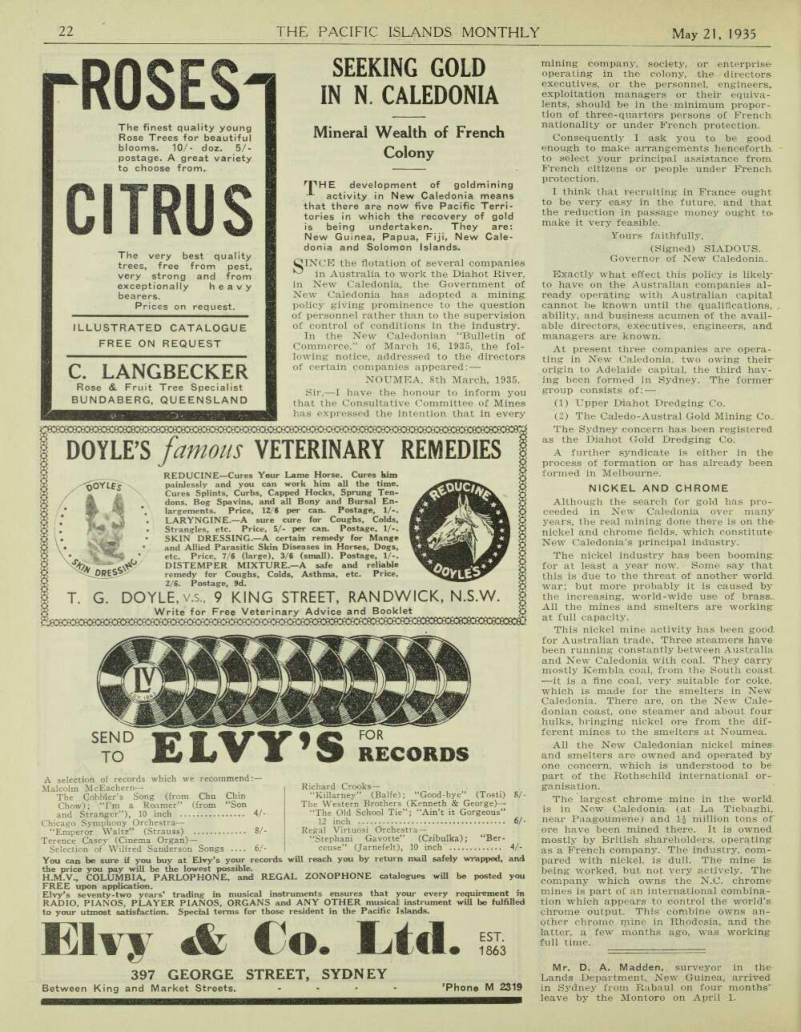
In N. Caledonia
Mineral Wealth of French Colony
THE development of goldmining activity in New Caledonia means that there are now five Pacific Terri tories in which the recovery of gold is being undertaken. They are: New Guinea, Papua, Fiji, New Cale donia and Solomon Islands. the flotation of several companies in Australia to work the Diahot River, in New Caledonia, the Government of New Caledonia has adopted a mining policy giving prominence to the question of personnel rather than to the supervision of control of conditions in the industry.
In the New Caledonian “Bulletin of Commerce,” of March 16, 1935, the fol lowing notice, addressed to the directors of certain companies appeared; NOUMEA, 8th March, 1935.
Sir, —I have the honour to inform you that the Consultative Committee of Mines has expressed the intention that in every
mining company, society, or enterprise operating in the colony, the directors executives, or the personnel, engineers, exploitation managers or their equiva lents, should be in the minimum propor tion of three-quarters persons of French nationality or under French protection.
Consequently I ask you to be good enough to make arrangements henceforth to select your principal assistance from French citizens or people under French protection.
I think that recruiting in France ought to be very easy in the future, and that the reduction in passage money ought to make it very feasible.
Yours faithfully, (Signed) SIADOUS.
Governor of New Caledonia.
Exactly what effect this policy is likely to have on the Australian companies al ready operating with Australian capital cannot be known until the qualifications, ability, and business acumen of the avail able directors, executives, engineers, and managers are known.
At present three companies are opera ting in New Caledonia, two owing their origin to Adelaide capital, the third hav ing been formed in Sydney. The former group consists of: (1) Upper Diahot Dredging Co. (2) The Caledo-Austral Gold Mining Co.
The Sydney concern has been registered as the Diahot Gold Dredging Co.
A further syndicate is either in the process of formation or has already been formed in Melbourne.
Nickel And Chrome
Although the search for gold has pro ceeded in New Caledonia over many years, the real mining done there is on the nickel and chrome fields, which constitute New Caledonia’s principal industry.
The nickel industry has been booming for at least a year now. Some say that this is due to the threat of another world war; but more probably it is caused by the increasing, world-wide use of brass.- All the mines and smelters are working at full capacity.
This nickel mine activity has been good for Australian trade. Three steamers have been running constantly between Australia and New Caledonia with coal. They carry mostly Kembla coal, from the South coast —it is a fine coal, very suitable for coke, which is made for the smelters in New Caledonia. There are, on the New Cale donian coast, one steamer and about four hulks, bringing nickel ore from the dif ferent mines to the smelters at Noumea.
All the New Caledonian nickel mines and smelters are owned and operated by one concern, which is understood to be part of the Rothschild international or ganisation.
The largest chrome mine in the world is in New Caledonia (at La Tiebaghi, near Paagoumene) and 1½ million tons of ore have been mined there. It is owned mostly by British shareholders, operating as a French company. The industry, com pared with nickel, is dull. The mine is being worked, but not very actively. The company which owns the N.C. chrome mines is part of an international combina tion which appears to control the world’s chrome output. This combine owns an other chrome mine in Rhodesia, and the latter, a few months ago, was working full time.
Mr. D. A. Madden, surveyor in the Lands Department, New Guinea, arrived in Sydney from Rabaul on four months’ leave by the Montoro on April 1.