Child Welfare In Fiji
pp. 46-47 · Read in the full issue
Natives Themselves Provide Successful Medical Service
THE proposal to establish a home for A the treatment and cure of ailing and ill-nourished children is one of the hoped for schemes of the Central Executive Council of Child Welfare in Fiji.
To-day, active interest in child wel fare work has rapidly extended from the comparatively small white population of the chief centres to the large and scat tered native race, and Indian and Chinese communities resident on the many islands in the Fijian group.
The scheme for the conduct of child welfare for the Fijians was inaugurated in 1927 by the Central Executive Council, consisting of the Secretary for Native Affairs, the Chief Medical Officer, and the Governor’s Commissioner.
The object of this Council is to work in co-operation with the Native Medical School, which has its headquarters at the Colonial War Memorial Hospital in Suva.
Native (Fijian) medical practitioners and native obstetric nurses receive special training in welfare work, and are sent out under the supervision of District Commissioners and District Medical Offi cers to the six Provinces into which Fiji’s populated islands are divided. Reports are forwarded quarterly from each Pro vince and all questions of policy are sent for the decision of the Central Executive Council.
At first, six specially trained European nurses were installed at the different centres, and in spite of the language diffi culty, the stubborn adherence to uncleanly superstitious habits, and the many hard ships due to weather conditions and means of transport, they did splendid pioneering work.
We learn, however, that recent vacan cies have not been filled, and the money thus saved is being utilized in equipping Fijian Women’s Committees, where there are no European nurses, and in supply ing the necessary drugs.
Previous distribution of canned milk and patent foods failed in their purpose as special and additional nourishment for weak and ailing children. From the irresponsible Fijians’ point of view, these comforting beverages, so easy of access, provided a popular sweetening fillip to the morning cup of tea, and were considered entirely wasted on their helpless and apparently unappreciative offspring. Con sequently, those expensive commodities have been withdrawn from the list of essentials which at first were considered indispensable to the work in connection with this movement. Instead, babies de prived of their mothers by death, or chil dren suffering from malnutrition, are conveyed to the district hospitals and there cared for until well enough to re turn to their villages.
And so Women’s Committees of four members are now formed under the super vision of the district native medical prac titioner, and the native nurse. These committee women, usually the wives of chiefs and native government officials, in spect the children daily, for cleanliness and minor ailments, if necessary. Regu lar visits are made to dwelling houses with the object of improving sanitary conditions generally. A very useful work is being done in this way, making it pos sible to extend the campaign to every part of Fiji.
Annual visits of inspection are made to every village in each Province by the Governor’s Commissioner (Dr. McGusty), who is also Inspecting Medical Officer.
The growing enthusiasm on the part of the natives and their keen appreciation of its beneficial results was especially shown on one occasion by the presenta tion of a huge pile of mats and enormous quantities of native vegetables. Sur rounded by these very sustaining edibles, Dr. McGusty sat himself comfortably on the lofty stack of mats and from this imposing height delivered his instruc tional lecture, to the evident delight of his squatting listeners.
During his recent tour of inspection this genial and energetic doctor expressed his gratification at the continued improved appearance of the children in the different villages. Where, less than a decade ago, native children, very often, presented an unwholesome sight, to-day we see clear, bright eyes in clean, healthy bodies. Won derful tributes to a wonderful work. The
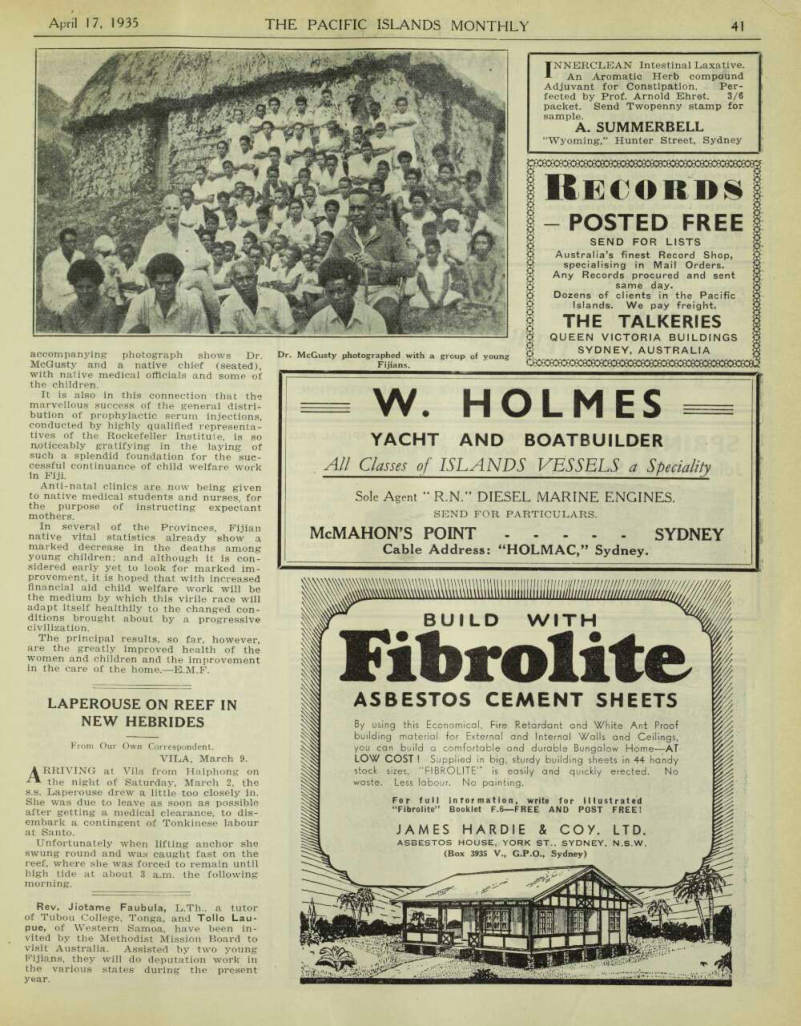
accompanying photograph shows Dr.
McGusty and a native chief (seated), with native medical officials and some of the children.
It is also in this connection that the marvellous success of the general distri bution of prophylactic serum injections, conducted by highly qualified representa tives of the Rockefeller Institute, is so noticeably gratifying in the laying of such a splendid foundation for the suc cessful continuance of child welfare work in Fiji.
Anti-natal clinics are now being given to native medical students and nurses, for the purpose of instructing expectant mothers.
In several of the Provinces, Fijian native vital statistics already show a marked decrease in the deaths among young children; and although it is con sidered early yet to look for marked im provement, it is hoped that with increased financial aid child welfare work will be the medium by which this virile race will adapt itself healthily to the changed con ditions brought about by a progressive civilization.
The principal results, so far, however, are the greatly improved health of the women and children and the improvement
in the care of the home.
E.M.F.
Dr. McGusty photographed with a group of young Fijians.