The Pomare Family
pp. 42-43 · Read in the full issue
Name Borne by Famous Men in Tahiti and New Zealand
By Eric Ramsden
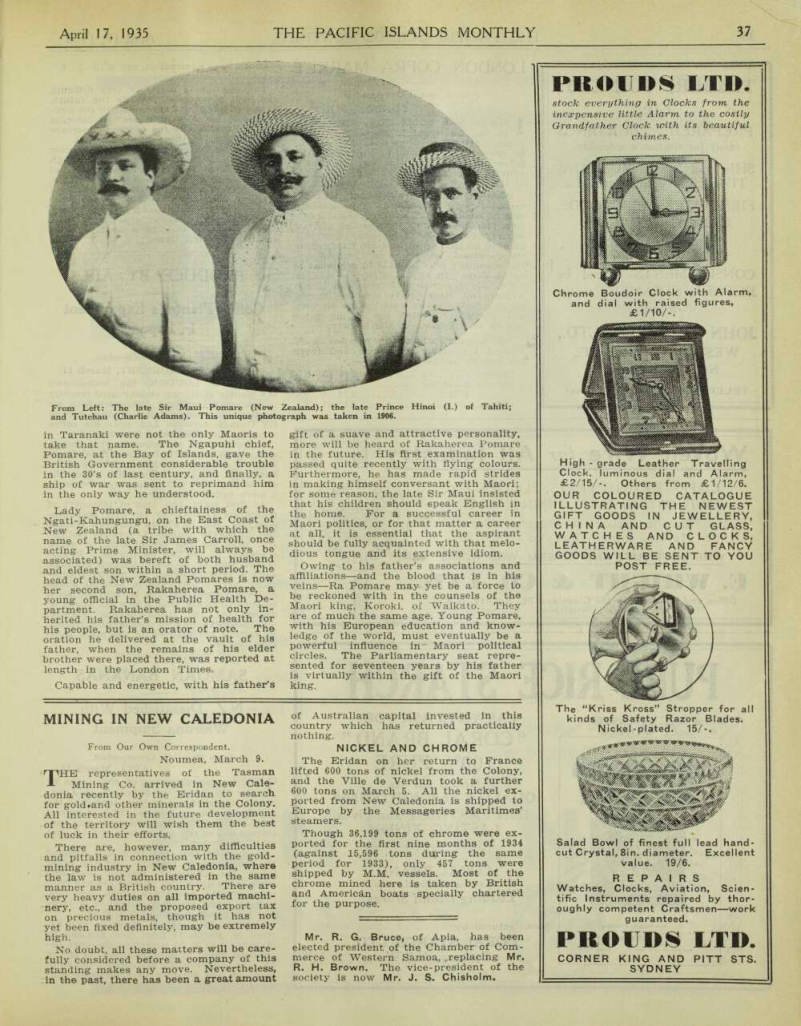
The accompanying photograph is of more than usual historic interest inasmuch as two of the sitters bore the same name but came from quarters of the Pacific hundreds of miles apart. Yet in the dim distant past Pomare of New Zealand claimed that the forbears of Pomare of Tahiti—who came from the Tuamotus'— were related to his own Polynesian people. The photograph also testifies to the marked physical resemblance between Sir Maui Pomare (formerly Dr.
Pomare), the Maori “Apostle of Health,” and Prince Hinoi (I.), of Tahiti.
The late Sir Maui is shown on the left wearing a Manihiki hat. Prince Hinoi stands in the centre. Tutehau (Charlie Adams), the figure on the right, is still living in Papeete. The photograph aroused keen interest when, by courtesy of Lady
Pomare, of Wellington, I was able to show it to some of the residents of Papeete. Sir Maui was well-known in Tahiti, for he passed through there on his way to and from the United States on several occa sions, from the days when he first crossed the Pacific to an American University to study for his medical degree. The know ledge gained by Sir Maui Pomare and his colleagues has enabled the Maori race to more than double its numbers since 1900.
His last visit to Tahiti was when, an ailing man, he decided to visit California in search of health for himself —a quest that did not bring the reward that he sought. On the return journey South Lady Pomare brought the ashes of her husband, and both Tahitians and Raro tongans paid tribute to a great fellow Polynesian.
Prince Hinoi was a grandson of Queen Pomare IV., and, if the Royal succession had been permitted by the French, he might have been King of Tahiti. Hinoi was the son of Prince Tereiitua, better known as “Joinville.” Pomare V., the last monarch, decided that the succession should go first to the daughter of his brother Prince Tamatoa—the Princess Terii-Vaetua (then aged twelve) and her issue. Failing that line, Prince Hinoi, then ten years of age, was to succeed. Hinoi’s son, the second Hinoi, a man of gargan tuan proportions, died in 1933, and the line is extinct.
The Hinois, father and son, are buried in the Pomare family burial plot at Arue, not far distant from the town of Papeete.
A wall to keep out pigs surrounds them; no tombs mark their last resting place.
In fact, it would now be difficult to say wherein that half-acre or so lie the bodies of Tu, the first Pomare; Pomare II., the friend of the missionaries; the boy king, Pomare III., and finally, the latter’s sister, the tragic Aimata (Queen Pomare IV.).
The gigantic walking stick of the second Hinoi, which is placed on his grave, is the only mark of identification.
The “Frenchified” Pomare V., the last of his line, is buried in a pretentious mauso leum, erected by the French Government, on a point of land some distance away.
Members of the Pomare family still reside in that immediate vicinity. His remains were not placed in the family burial ground, in the district with which his family was identified for centuries.
The name Pomare was borne by more than one New Zealand chief—probably by way of compliment to the Tahitian King, Pomare 11., then a figure of much import ance in the Pacific. Sir Maui’s forbears
in Taranaki were not the only Maoris to take that name. The Ngapuhi chief, Pomare, at the Bay of Islands, gave the British Government considerable trouble in the 30’s of last century, and finally, a ship of war was sent to reprimand him in the only way he understood.
Lady Pomare, a chieftainess of the Ngati-Kahungungu, on the East Coast of New Zealand (a tribe with which the name of the late Sir James Carroll, once actmg Prime Minister, will always be associated) was bereft of both husband and eldest son within a short period. The head of the New Zealand Pomares is now her second son, Rakaherea Pomare, a young official in the Public Health Department. Rakaherea has not only inherited his father’s mission of health for his people, but is an orator of note. The oration he delivered at the vault of his father, when the remains of his elder brother were placed there, was reported at length in the London Times.
Capable and energetic, with his father’s
gift of a suave and attractive personality, more will be heard of Rakaherea Pomare in the future. His first examination was passed quite recently with flying colours, Furthermore, he has made rapid strides in making himself conversant with Maori; for some reason, the late Sir Maui insisted that his children should speak English in the home. For a successful career in Maori politics, or for that matter a career at all, it is essential that the aspirant should be fully acquainted with that meloous tongue and its extensive idiom.
Owing to his father's associations and affiliations and the blood that is in his veins—Ra Pomare , may yet be a force to be reckoned with in the counsels of the Maori king, Koroki, of Waikato. They are of much the same age. Young Pomare, with his European education and know ledge of the world, must eventually be a powerful influence in Maori political circles. The Parliamentary seat represented for seventeen years by his father is virtually within the gift of the Maori king.
From Left: The late Sir Maui Pomare (New Zealand); the late Prince Hinoi (I.) of Tahiti; and Tutehau (Charlie Adams). This unique photograph was taken in 1906.