Foreign Shipping In
p. 40 · Read in the full issue
The Pacific
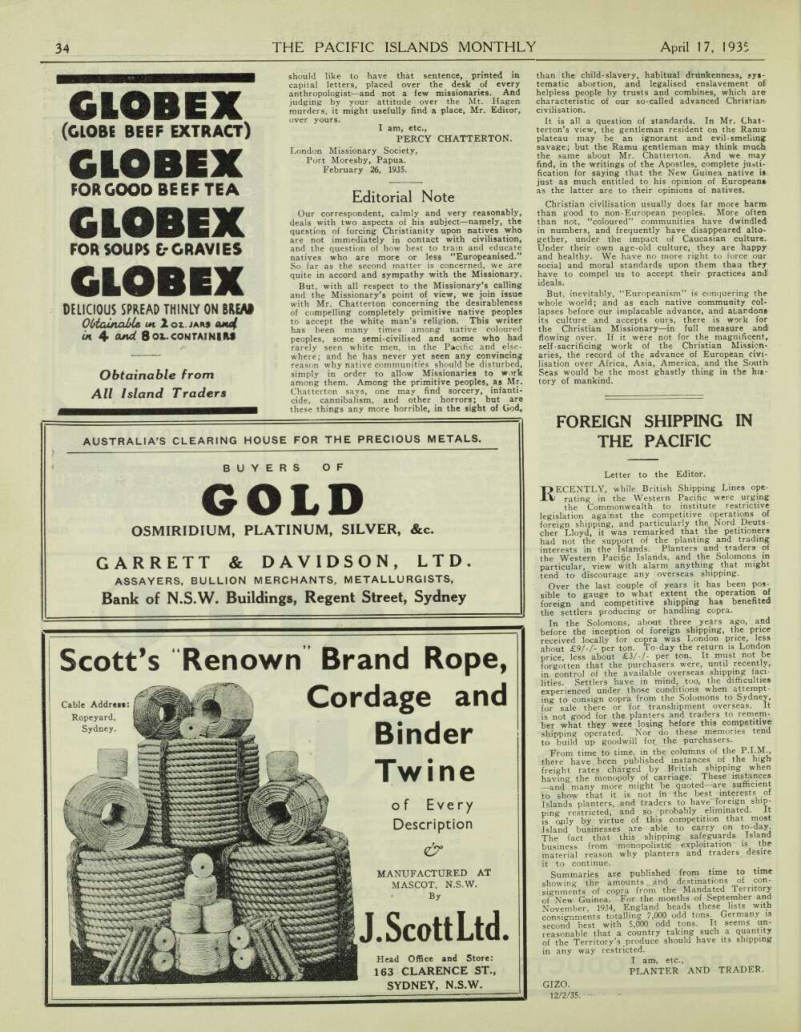
Letter to the Editor.
RECENTLY, while British Shipping Lines ope rating in the Western Pacific were urging the Commonwealth to institute restrictive legislation against the competitive operations of foreign shipping, and particularly the Nord Deuts cher Lloyd, it was remarked that the petitioners had not the support of the planting and trading, interests in the Islands. Planters and traders of the Western Paci£c Islands, and the Solomons in particular, view with alarm anything that might tend to discourage any overseas shipping.
Over the last couple of years it has been pos sible to gauge to what extent the operation of foreign and competitive shipping has benefited the settlers producing or handling copra.
In the Solomons, about three years ago, and before the inception of foreign shipping, the price received locally for copra was London price, less about £9/-/- per ton. To-day the return is London price, less about £3/-/- per ton. It must not be forgotten that the purchasers were, until recently, in control of the available overseas shipping faci lities. Settlers have in mind, too, the difficulties experienced under those conditions when attempt ing to consign copra from the Solomons to Sydney, for sale there or for transhipment overseas. It is not good for the planters and traders to remem ber what they were losing before this competitive shipping operated. Nor do these memories tend to build up goodwill for the purchasers.
From time to time, in the columns of the there have been published instances of the high freight rates charged by British shipping when having the monopoly of carriage. These instances —and many more might be quoted are sufficient to show that it is not in the best interests of Islands planters, and traders to have" foreign ship ping restricted, and so probably eliminated. It is only by virtue of this competition that most Island businesses are able to carry on to-day The fact that this shipping safeguards Island business from monopolistic exploitation is the material reason why planters and traders desire it to continue.
Summaries are published from time to time showing the amounts , and destinations of con signments of copra from the Mandated Territory of New Guinea. For the months of September and November, 1934, England heads these lists with consignments totalling 7,000 odd tons. Germany is second best with 5,000 odd tons. It seems un reasonable that a country taking such a quantity of the Territory’s produce should have its shipping in any way restricted.
I am, etc.,
Planter And Trader.
Gizo.
12/2/35.