Sir Hubert Murray
pp. 27-29 · Read in the full issue
Why His Strong Hand Is Needed Still in Papua
(Contributed.)
IN the P.I.M. of February, 1932, appeared an eulogy on Mr. Justice Gore, paving the way for the suggestion that the learned Judge would make the best possible successor to Sir Hubert Murray as Lieutenant-Governor of Papua.
In the “Sydney Morning Herald,” of 3rd November, 1934, a paragraph, whose origin has not been made known, stated quite definitely that Mr. C. W. Marr was to assume the position at an early date.
Various other paragraphs have ap peared, putting forward the claims of various people to this important position.
Both before and since the publication of these puffs, there has been a great deal of speculation; and many views have been more or less openly expressed as to the most suitable successor; and even in Papua, which should know bet ter, a certain amount of impatience is shown for the arrival of the millennium that will open with his appointment.
Now, the mere volume of sound pro duced is no proof of the musical value of the instrument that produces it. A well-bred dog barks seldom, and growls only when his duty demands it; and he leaves it to his less aristocratic brethren to snarl and snap unceasingly for any reason or for none.
The two published suggestions men tioned above were obviously inspired; and they are as noteworthy for their stupidity as for their bad taste.
It is quite clear that Sir Hubert Mur ray has no intention of retiring. He is
at the height of his brilliant powers, and fully capable of continuing his succesful administration.
Further, the affairs of Papua seem now to have reached a stage where they need, more than ever before, all the wisdom, far-sightedness, and single minded devotion to the welfare of the Territory, which Sir Hubert has exer cised for so long, and of which he alone has given proof.
Every sincere well-wisher of Papua hopes ardently that the present Admin istration may continue undisturbed at least for some years. It does not reflect credit on residents in Papua that, from the time when he first assumed office as Administrator in 1906, there has been
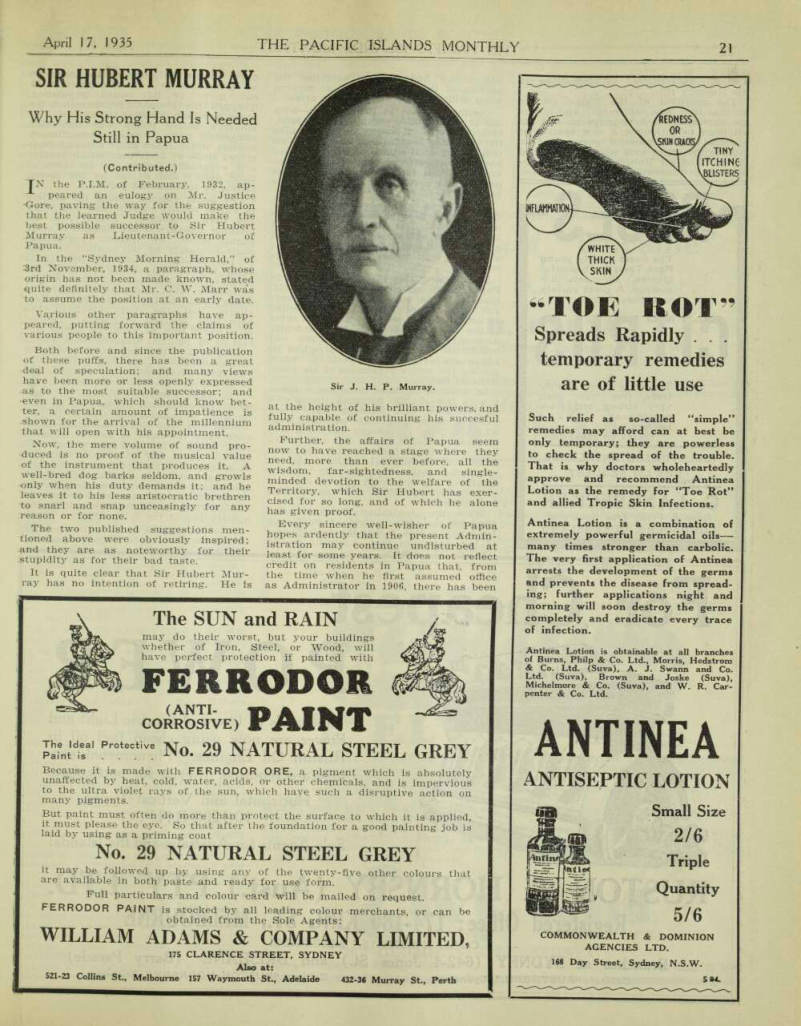
Sir J. H. P. Murray.
a small undercurrent of opposition to Sir Hubert’s rule.
The condition of the Public Service at that time was deplorable; and it was his unpleasant task to purge it, and his privilege to introduce a new system of coherent and purposeful government to replace the chaos into which Papua had fallen. And Sir Hubert was hardly ap pointed permanently as Administrator,
had hardly had time to establish the nucleus of the present excellent service, when difficulties of another kind arose.
Commerce came to Papua. Not —with one or two notable exceptions—the solid, creative form of commerce that builds its own firm foundations, and erects on them a dignified edifice of lasting value; but the fraternity of uncreative specula tors who look for large and immediate profits, and care not at all how they are gained.
Papua was an undeveloped country that seemed to offer vast wealth to the unscrupulous; just another savage land in which fat dividends might be gained at the cost of small sacrifice, or of none; a land of easy money for the incompet ent.
It is among this class, represented in Papua as in all countries of the world, that it seems most of the malcontents are to be found. And it is instructive to note that they are quite unable to agree to the necessary reforms. Each ardently desires reform; but only such as will benefit his own business, and give him an advantage over his competitors, while placing the native population at his ques tionable mercy.
In addition to these there are a few — a very few —Public Servants whose own incompetence and lethargy have rele gated them to subordinate positions from which nothing but energy and loyal ser vice can extricate them. The real griev ance with these few, as with the more numerous commercial malcontents, is solely that their own prosperity must be measured by their own efforts, and not by their purely selfish and unproductive aspirations.
When the Australian Commonwealth assumed complete control of Papua on Ist January, 1906, it was the daring boast of her statesmen that Australia would
prove to the world that civilisation could be introduced to a black country with out harm to its native population.
Through the present administration, the boast has been justified to the full. Sir Hubert’s native policy was something completely new. It was a revolutionary method which made other Colonial Gov ernors smile at first; then watch keenly; and eventually imitate to the best of their ability and so far as the sacred claims of trade would permit.
The better element among the settlers in Papua readily concede that the policy has been successful. Industry, in its teething stages, was handicapped to some slight extent by irksome regulations made necessary by the conduct of some of the settlers themselves. But it is plain to all who can see beyond the range of their personal ambition, and can understand that their own welfare is firmly bound to the welfare of the Terthat the slight handicap has been fully justified by results. To-day, in a world torn as much by labour un rest as by political disagreements, Papua possesses a native population educated to civilised labour; and can boast a lab our force as efficient, as contented, and as disciplined as any in the world.
The chief complaint among the com mercial malcontents appears to be that no form of commercial slavery is per mitted, and that the Administration In sists upon the right of natives to spend their wages when and where they will.
Forced labour (for natives), a reduction of wages (for natives), more stringent working conditions (again, for natives), are among the reforms suggested; and the witholding of these benefits from the hard-worked speculator is magnified into a grievance of the first order.
It is largely due to these irresponsible chatterers that such ridiculous sugges
tions and reports arise as the two that have been mentioned.
In their great minds they have skinned the bear, portioned out the flesh, and pegged out the skin to dry, while the bear himself still roams the forest, force ful and unassailable.
Does it not seem that, apart from the question of good taste, it would be wiser not to nominate a motley multitude of successors until a man appears on the horizon who would not look merely ridi culous in the mantle that Sir Hubert Murray has worn for so long, and with so fine a dignity.