Copra Market
p. 10 · Read in the full issue
Reports From Many Places
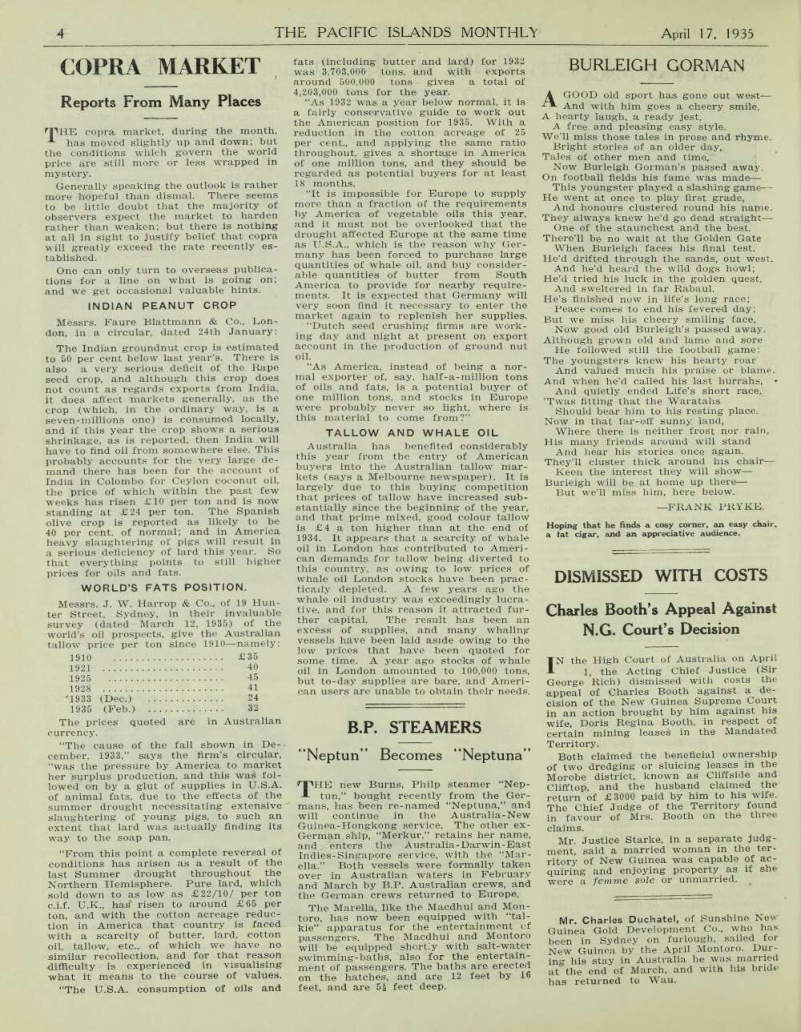
THE copra market, during the month, has moved slightly up and down; but the conditions which govern the world price are still more or less wrapped in mystery.
Generally speaking the outlook is rather more hopeful than dismal. There seems to be little doubt that the majority of observers expect the market to harden rather than weaken; but there is nothing at all in sight to justify belief that copra will greatly exceed the rate recently es tablished.
One can only turn to overseas publica tions for a line on what is going on; and we get occasional valuable hints.
Indian Peanut Crop
Messrs. Faure Blattmann & Co., Lon don, in a circular, dated 24th January: The Indian groundnut crop is estimated to 50 per cent below last year’s. There is also a very serious deficit of the Rape seed crop, and although this crop does not count as regards exports from India, it does affect markets generally, as the crop (which, in the ordinary way, is a seven-millions one) is consumed locally, and if this year the crop shows a serious shrinkage, as is reported, then India will have to find oil from somewhere else. This probably accounts for the very large de mand there has been for the account of India in Colombo for Ceylon coconut oil, the price of which within the past few weeks has risen £10 per ton and is now standing at £24 per ton. The Spanish olive crop is reported as likely to be 40 per cent, of normal; and in America heavy slaughtering of pigs will result in a serious deficiency of lard this year. So that everything points to still higher prices for oils and fats.
World’S Fats Position.
Messrs. J. W. Harrop & Co., of 19 Hun ter Street, Sydney, in their invaluable survey (dated March 12, 1935) of the world’s oil prospects, give the Australian tallow price per ton since 1910—namely; 1910 £35 1921 40 1925 45 1928 41 1933 (Dec.) 24 1935 (Feb.) 32 The prices quoted are in Australian currency.
“The cause of the fall shown in De cember, 1933,” says the firm’s circular, “was the pressure by America to market her surplus production, and this was followed on by a glut of supplies in U.S.A. of animal fats, due to the effects of the summer drought necessitating extensive slaughtering of young pigs, to such an extent that lard was actually finding its way to the soap pan.
“From this point a complete reversal of conditions has arisen as a result of the last Summer drought throughout the Northern Hemisphere. Pure lard, which sold down to as low as £22/10/ per ton c.i.f. U.K., has risen to around £65 per ton, and with the cotton acreage reduc tion in America that country is faced with a scarcity of butter, lard, cotton oil, tallow, etc., of which we have no similar recollection, and for that reason difficulty is experienced in visualising what it means to the course of values.
“The U.S.A. consumption of oils and
fats (including butter and lard) for 1932 was 3,703,000 tons, and with exports around 500,000 tons gives a total of 4,203,000 tons for the year.
“As 1932 was a year below normal, it is a fairly conservative guide to work out the American position for 1935. With a reduction in the cotton acreage of 25 per cent., and applying the same ratio throughout, gives a shortage in America of one million tons, and they should be regarded as potential buyers for at least 18 months.
“It is impossible for Europe to supply more than a fraction of the requirements by America of vegetable oils this year, and it must not be overlooked that the drought affected Europe at the same time as U.S.A., which is the reason why Ger many has been forced to purchase large quantities of whale oil, and buy consider able quantities of butter from South America to provide for nearby require ments. It is expected that Germany will very soon find it necessary to enter the market again to replenish her supplies.
“Dutch seed crushing firms are work ing day and night at present on export account in the production of ground nut oil.
“As America, instead of being a nor mal exporter of, say, half-a-million tons of oils and fats, is a potential buyer of one million tons, and stocks in Europe were probably never so light, where is this material to come from?”
Tallow And Whale Oil
Australia has benefited considerably this year from the entry of American buyers into the Australian tallow mar kets (says a Melbourne newspaper). It is largely due to this buying competition that prices of tallow have increased sub stantially since the beginning of the year, and that prime mixed, good colour tallow is £4 a ton higher than at the end of 1934. It appears that a scarcity of whale oil in London has contributed to Ameri can demands for tallow being diverted to this country, as owing to low prices of whale oil London stocks have been prac tically depleted. A few years ago the whale oil industry was exceedingly lucra tive, and for this reason it attracted fur ther capital. The result has been an excess of supplies, and many whaling vessels have been laid aside owing to the low prices that have been quoted for some time. A year ago stocks of whale oil in London amounted to 100,000 tons, but to-day supplies are bare, and Ameri can users are unable to obtain their needs.