Coconuts And Goldmines
pp. 5-6 · Read in the full issue
IT seems useless to urge anything of the kind; but, if ever economic con ditions demanded a move towards co-operation by the Administrations of the principal territories in central and western Pacific, the time is now.
For one hundred years the chief pro duct of the Pacific Islands has been copra. In recent times we have seen the oil of the coconut fall out of favour, with the result that many important Pacific concerns have looked blue ruin in the face. The market now has im proved and the planters have been saved; but a great deal remains yet to be done if the copra industry of the future is to be anything like as profitable as the copra industry of the normal years before the war.
Copra growers are faced with the competition of such products as whale oil, soya bean oil, peanut oil, cotton seed oil, and various related commodities; but it is the considered judgment of experts that there always will be a demand for the sweet and wholesome oil of the coconut. But competition from a dozen directions will tend to keep the
price down to a fighting level; so that copra producers, like the producers of any other commodity in world-wide use, must systematically study every possible means of reducing production cost and increasing the quality of their copra.
It is in this connection that there seems to be a really urgent need for co-operation between the Administra tions of such important South Seas territories as New Guinea, Papua, Fiji, and the various other groups under the jurisdiction of the High Commissioner for the Western Pacific. A coconut is a coconut whether it be grown in Ceylon, Malaya, East Indies, New Guinea, or Fiji. Yet consider the wide difference in price commanded by the copra of those various islands. In London at the end of February the copra from Ceylon was worth £14/15/- per ton; Straits sun-dried, on the same day, brought £13/7/6; Dutch East Indies was worth about £13; whereas the best quotation for South Seas was £12/2/6.
There always has been a difference between the price of Cingalese-East Indies copra and the copra that is made
in the South Pacific Islands. It is said that the London quotations represent the difference in the quality of the respective products; but we have more than a sus picion that the difference is not all represented by quality, and that organ ised marketing has a good deal to do with it. However that may be, it surely is a desirable and necessary thing that the South Seas Administrations should get together in some way to see whether it is not possible, by co-operative action, to reduce that long-standing, irritating gap of from 20/- to 40/- per ton, between the London price of the reputed best copra and the average price of South Seas copra. If the gap could be wiped out it would mean the distribution each year of tens of thousands of pounds of additional money in the South Seas. It goes without saying that the Adminis trations in such a move would have the
heartiest co-operation of the big trading
firms, shipping companies, and the
planters.
Then there is something of very recent development which demands the attention of all the Administrations, acting in unison, and that is the rapid growth of the gold industry. Raw gold has doubled in value, and it is present, apparently in quite payable quantities, in
New Guinea, Papua, Solomon Islands, and Fiji. The industry has been most profitably established in New Guinea; and there is great developmental activity in Papua and Fiji. But so far as the Administrations are concerned —and this applies also to the great majority of bona fide shareholders in gold companies—the only people who have made any money worth talking about (apart from the Bulolo group in New Guinea) are the share merchants of Sydney, Melbourne and Adelaide. Those cities, for some years past, have been literally alive with the cunning and exceedingly undesirable animal known as “wild-cat.” In other words, company promoters have had a marvellous time, fleecing the incautious people who wish to invest in goldmines; while the actual goldmining done in the Islands has received a comparatively small portion of the capital subscribed.
If this aspect of the goldmining business of recent years were to be investigated by a competent tribunal it would be shown up as a first-class scandal.
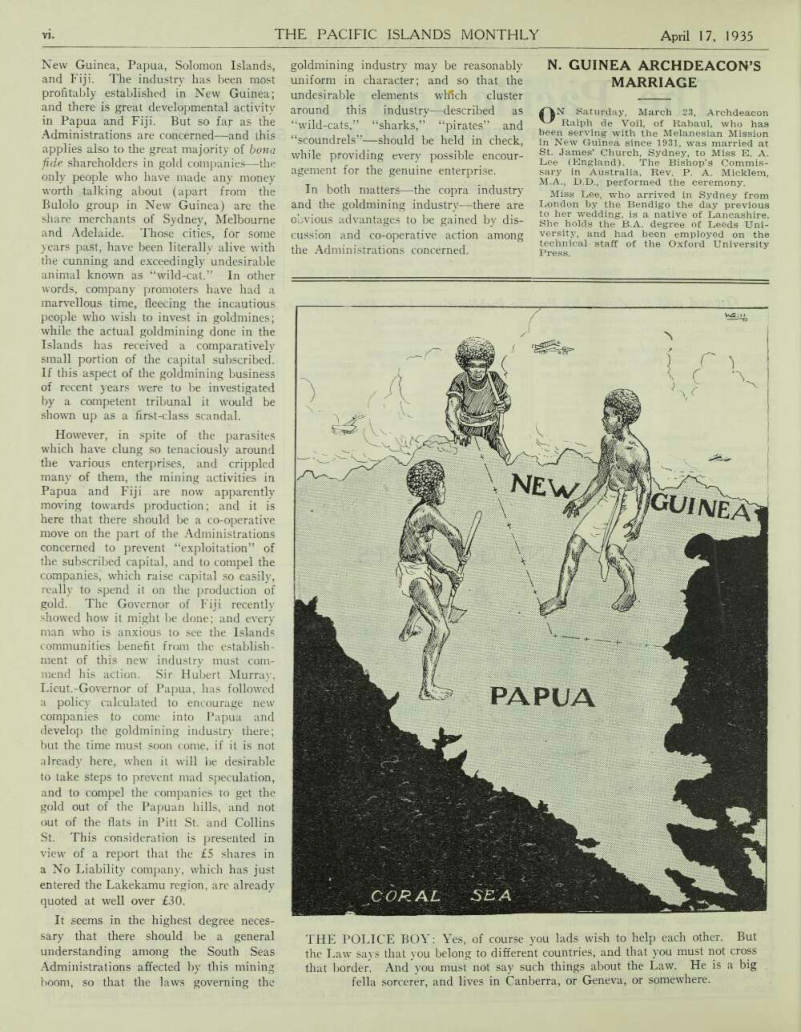
However, in spite of the parasites which have clung so tenaciously around the various enterprises, and crippled many of them, the mining activities in Papua and Fiji are now apparently moving towards production; and it is here that there should be a co-operative move on the part of the Administrations concerned to prevent “exploitation” of the subscribed capital, and to compel the companies, which raise capital so easily, really to spend it on the production of gold. The Governor of Fiji recently showed how it might be done; and every man who is anxious to see the Islands communities benefit from the establish ment of this new industry must com mend his action. Sir Hubert Murray, Lieut.-Governor of Papua, has followed a policy calculated to encourage new companies to come into Papua and develop the goldmining industry there; but the time must soon come, if it is not already here, when it will be desirable to take steps to prevent mad speculation, and to compel the companies to get the gold out of the Papuan hills, and not out of the flats in Pitt St. and Collins St. This consideration is presented in view of a report that the £5 shares in a No Liability company, which has just entered the Lakekamu region, are already quoted at well over £30.
It seems in the highest degree neces sary that there should be a general understanding among the South Seas Administrations affected by this mining boom, so that the laws governing the
goldmining industry may be reasonably uniform in character; and so that the undesirable elements which cluster around this industry —described as “wild-cats,” “sharks,” “pirates” and “scoundrels”—should be held in check, while providing every possible encour agement for the genuine enterprise.
In both matters —the copra industry and the goldmining industry—there are obvious advantages to be gained by dis cussion and co-operative action among the Administrations concerned.