Papua’S Strange Story
pp. 48-50 · Read in the full issue
How and Why it Became British Fifty Years Ago
By Mollie Lett
IN the much greater stir of Melbourne’s Centenary celebrations, it is feared that the fiftieth anniversary of the es tablishment of British rule in Papua has been overlooked. Yet the history of Aus tralia’s connection with the Territory is full of interest.
There is evidence that Chinese, Mala yan, and Indian traders visited New Guinea from very early times. But the first sight of its coasts so far as Euro pean nations are concerned, was obtained in 1511, when Antonio d’Abreu, a Portu guese navigator, saw the north-western shores. He was followed by Don Jorge de Meneses for Portugal, and by Saave dra and Grijalva for Spain. And the first attempt at annexation was made by Ynigo de Retes in 1545, when he hoisted the Spanish flag on the north-west coast of the island. Spain failed to confirm
his action; and a number of other navi gators sailed along the northern shore, reported ecstatically on the richness and beauty of the country, and sailed away.
But the south coast remained undis covered until Luis Vaes de Torres, after a troublesome voyage from Peru, found the extreme south-east point of New Guinea in 1606, and coasted west and north, passing through the Torres Straits: and on to Manila. Torres claimed the island for Spain; but the knowledge of his discoveries was concealed by the Spanish Ministry on the grounds that men could not be spared from Spain to settle the country, and that the state of the exchequer would not permit the heavy expenditure necessary to “conquer”’ the great island.
Torres was the last of the Spanish mariners to visit New Guinea, and the- Dutch took over the Moluccas from Spain. For many years the forts and warships of the Dutch East India Com pany jealously guarded the approach to New Guinea from the north and west; but in 1700 Dampier, coming from the south and east, landed on the island and was grieved by the lack of hospitality shown by the natives who, as he reported indignantly, were so fiercely hostile that they had no scruples about retaliating when fired upon.
After his visit British navigators were engaged in examination of the great Aus tralian continent and the islands near it in the temperate zone; and the next visit was made by Captain Cook in 1770.
He, too, found the natives hostile, as did also Lieutenant Yule, who hoisted the flag at Cape Possession in 1846, while engaged on a survey of the coast.
His action was ignored, as was also that of Captain Moresby in 1874 when, after adding detail to the surveys of his predecessors on the coast, he claimed the eastern end of the island for Britain.
But at about this time a few white traders began to compete with the Chinese for the pearls and beche-de-mer for which the island was already famous.
In 1872 the London Missionary Society landed half-a-dozen Cook Islands teachers and their wives near what is now Port Moresby. They were well treated by the natives, though sickness took heavy toll of them, and two years later the survivors were joined by the first white missionary and his wife.
Moresby’s discoveries opened the eyes of Australian statesmen to the desirabil ity of New Guinea, and they began to urge upon Great Britain the need for an nexing that part of the island which was not occupied by the Dutch. Some de
sired it for strategic reasons; others, look ing very far ahead, saw in it a home for the overflow of Australia’s population; others again frankly expressed the desire to exploit the natural wealth of the island in the Australian interest. But whatever the main reason, a fillip was given to Australian ambition by the discovery of gold near Port Moresby in 1877.
In the resulting rush many men died of starvation, exposure, and malaria, and very little gold was won. But Australia continued to press for annexation and, Britain proving obdurate, the Premier of Queensland in 1883, commissioned H. M.
Chester, a police magistrate at Thursday Island, to proceed to New Guinea and take possession in the name of Great Britain.
Chester duly arrived at Port Moresby and was disconcerted by the disappear ance of the flag which he had brought for the purpose. However, careful and prolonged search disclosed it stuffed into an empty sugar bag, in use as a pillow by one of the native crew, and the cere mony was performed on April 4, 1883.
Britain repudiated Chester’s action but, in response to continued pressure, she commissioned Commodore Erskine to declare a Protectorate over the southern part of the unoccupied territory.
News of Chester’s action had reached Berlin, and Germany, whose agents and traders had been very active -in the Paci fic, and particularly on the north-east coast of New Guinea, claimed the north ern part by right of occupation. The Under-Secretary for the Colonies was sent to Berlin to discuss the matter with Bismarck, who had already despatched a fast steamer to New Guinea to take pos session of the northern coast. This was not known to Britain, and negotiations were begun, and were protracted by Bis marck in order that the German steamer might have time to complete her voyage.
The discussion, like so many in which Bismarck was concerned, ended incon clusively; and orders were sent to Erskine, who was waiting in Sydney, to proceed.
Deputy Commissioner Romilly was in structed to be present at the ceremony.
He proceeded to what is now Port Mores by and, misreading his instructions, hoisted the flag and declared the Protec torate before the arrival of the naval squadron. Erskine, when he arrived, carried on the tradition of repudiation by ignoring Romilly’s action, and him self hoisted the flag and again declared the Protectorate on November 6, 1884— exactly 50 years ago.
New Zealand and Fiji, conjointly with the Australian colonies, undertook to pro vide £15,000 a year for the finances of the Protectorate: but the arrangement proved unworkable. New Zealand, Fiji, Western Australia and South Australia dropped out; and at a conference, held in London in 1887, it was arranged that Britain should annex British New Guinea on the condition that the three colonies, Queensland, New South Wales and Vic toria, became responsible for its finance and management. On the 4th September, 1888, Dr. William MacGregor arrived on H.M.S. Opal, formally annexed the Ter ritory to Great Britain, and took office as Lieutenant-Governor.
Still, matters were not satisfactory.
The Australian colonies supplied the finance, but control was very largely in the hands of the British Colonial Office through a Lieutenant-Governor appointed from London. Discontent grew until Federation in 1901, and lasted until 1906, when, on the confirmation of the Papua Act, which was passed by the Common wealth Parliament in the previous year,
British New Guinea became an Aus tralian Territory.
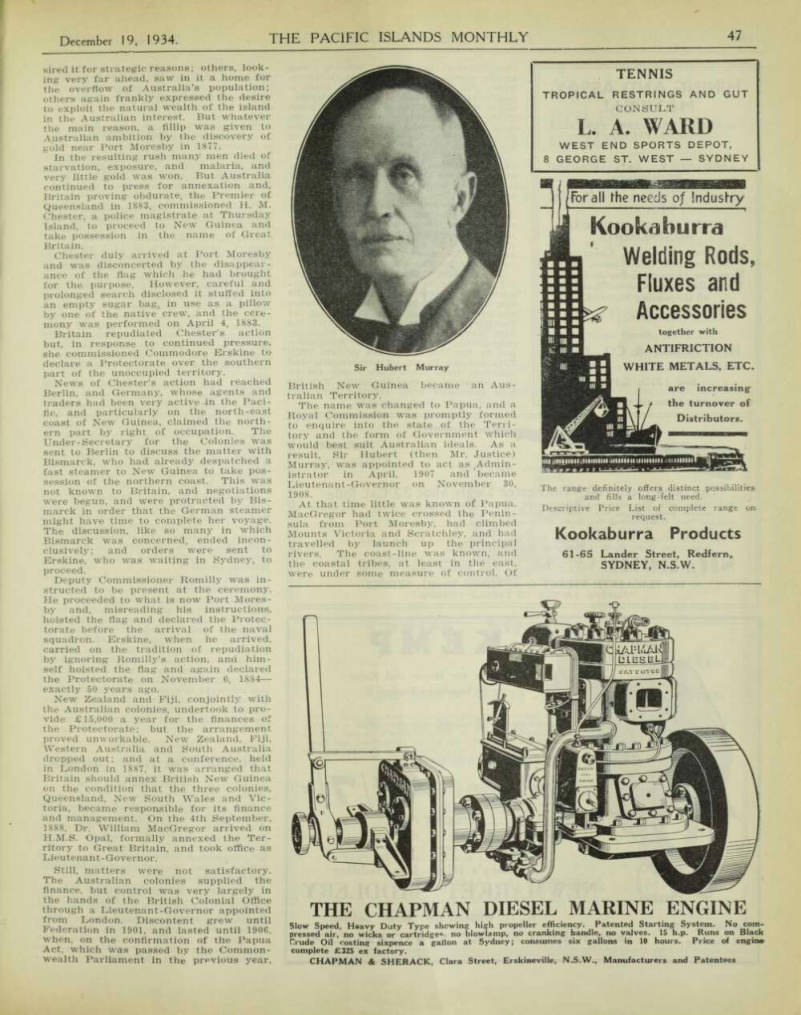
The name was changed to Papua, and a Royal Commission was promptly formed to enquire into the state of the Terri tory and the form of Government which would best suit Australian ideals. As a result, Sir Hubert (then Mr. Justice) Murray, was appointed to act as Admin istrator in April, 1907 and became Lieutenant-Governor on November 30, 1908.
At that time little was known of Papua.
MacGregor had twice crossed the Penin sula from Port Moresby, had climbed Mounts Victoria and Scratchley, and had travelled by launch up the principal rivers. The coast-line was known, and the coastal tribes, at least in the east, were under some measure of control. Of
Sir Hubert Murray
the interior practically nothing was known except on the Yodda Goldfield, where the influx of miners had made a magisterial station necessary. Magis trates had to a great extent a free hand in the management and patrolling of their divisions, and their patrols were governed more by the apparent needs of the moment than by any settled policy.
Agriculture was practically non-exis tent at that time, raiding and cainnibalism were practised by almost all of the many tribes, and white men travelled always with their lives in their hands.
The commercial history of Papua, since that time, has not been in any way re markable for its success, though the Ter ritory prospered well from 1910 to 1914, when the value of copra was rising, and Australia, Germany and Holland were competing for the shipping trade.
The outbreak of war in 1914 struck a heavy blow to enterprise and develop ment. Investment ceased, and the world’s shortage of shipping affected transport and communication. And hardly had the Territory found its feet again after the war, when it was faced witn economic ruin by the imposition of the Navigation Act by the Commonwealth in June 1921.
This Act cut Papua off permanently and definitely from the world’s trade; for by the operation of the Navigation Act she was prevented from trading with any other country than Australia.
After repeated applications for the re moval of the Act, Papua was relieved from its operation in September, 1925; but not before its evil influence had re sulted in damage which seems likely to be permanent.
The year 1925-26 was a memorable one in the history of Papua in that the value of exports and imports exceeded the mif lion. This improvement did not result from the removal of the Navigation Act, but was due to increased exports of rub ber, copra and copper, and to a big ad vance in the price of rubber.
From 1926 to 1928 reasonable hopes were entertained for the prosperity of the Territory, even though the New Guinea Copper Mines, the biggest concern in the country, closed down in 1926 owing to adverse working conditions and the ex haustion of capital before full production was attained. But when, in 1928-29, the market prices of copra and rubber, the only products of the Territory, dropped, and continued to drop dismally, the long established settlers realised that they could not hope for any reward for their consistent, hard, and honest efforts in the face of misfortunes so promiscuous and continuous, and so completely beyond their own control or that of their Govern ment.
Since 1928, with low prices for her products, and with a falling revenue still further depressed by a drastic reduction in the Commonwealth Grant, Papua has been struggling grimly. The rubber planting industry has been saved by a generous bounty from the Common wealth; but copra, the only other con siderable product of Papua, can only be rescued from complete collapse by a very early rise in the market price.
There are some signs, to-day, that in terest is not entirely lacking in the fur ther development of Papua; and the prospect of investment in those products subject to bounties and preferential tariff gives rise to the hope that the not very distant future may see a measure of com mercial recovery.
Native Administration shows very much happier results.
The achievements and reputation of Sir Hubert Murray are too well-known to need comment here. From the state of savagery and bloodshed in which the Territory was wrapped up till 1907 she has now reached a condition of almost complete pacification. Progress has been steady and continuous; and the last two areas will be brought under control dur ing the next few months by a searching patrol of the unknown district between the Kikori and Strickland rivers, and by the establishment of a police camp in the heart of the turbulent Goilala valley.