A Samoan Poetess
p. 39 · Read in the full issue
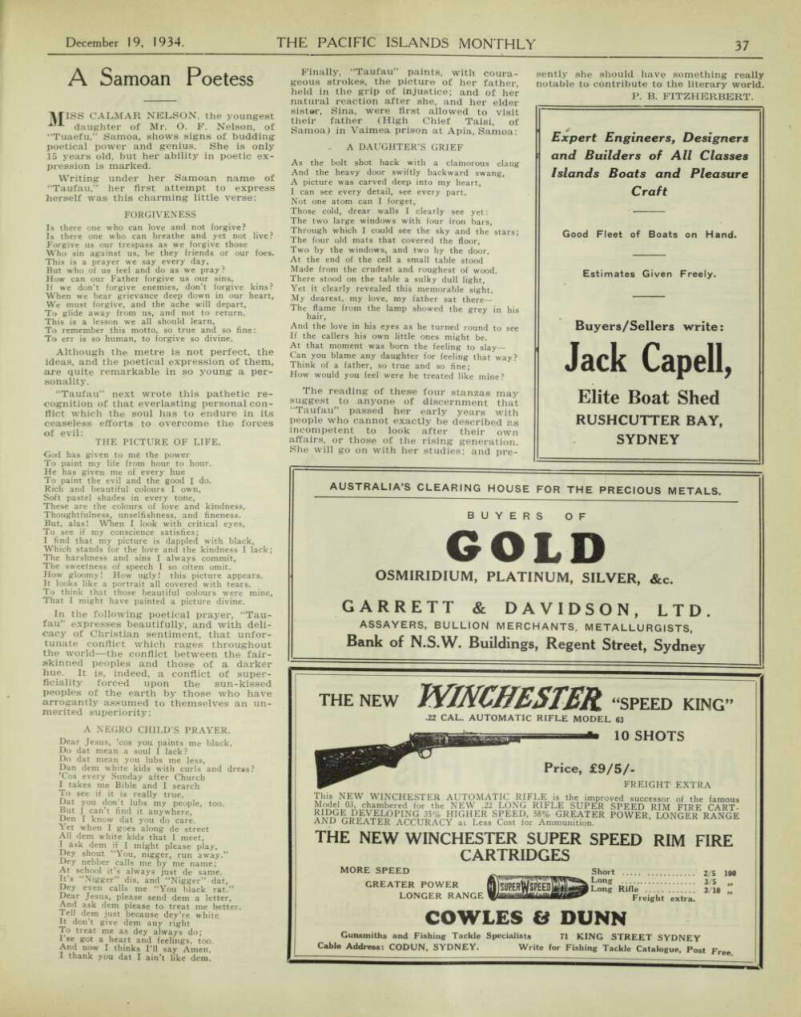
MISS CALMAR NELSON, the youngest daughter of Mr. O. F. Nelson, of “Tuaefu,” Samoa, shows signs of budding poetical power and genius. She is only 15 years old, but her ability in poetic ex pression is marked.
Writing under her Samoan name of “Taufau,” her first attempt to express herself was this charming little verse:
Forgiveness
Is there one who can love and not forgive?
Is there one who can breathe and yet not live?
Forgive us our trespass as we forgive those Who sin against us, be they friends or our foes.
This is a prayer we say every day, But who of us feel and do as we pray ?
How can our Father forgive us our sins.
If we don’t forgive enemies, don’t forgive kins?
When we bear grievance deep down in our heart, We must forgive, and the ache will depart, To glide away from us, and not to return.
This is a lesson we all should learn, To remember this motto, so true and so fine: To err is so human, to forgive so divine.
Although the metre is not perfect, the ideas, and the poetical expression of them, are quite remarkable in so young a per sonality.
“Taufau” next wrote this pathetic re cognition of that everlasting personal con flict which the soul has to endure in its ceaseless efforts to overcome the forces of evil:
The Picture Of Life.
God has given to me the power To paint my life from hour to hour.
He has given me of every hue To paint the evil and the good I do.
Rich and beautiful colours I own.
Soft pastel shades in every tone, These are the colours of love and kindness.
Thoughtfulness, unselfishness, and fineness.
But, alas! When I look with critical eyes, To see if my conscience satisfies; I find that my picture is dappled with black, Which stands for the love and the kindness I lack; The harshness and sins I always commit, The sweetness of speech I so often omit.
How gloomy! How ugly! this picture appears.
It looks like a portrait all covered with tears.
To think that those beautiful colours were mine, That I might have painted a picture divine.
In the following poetical prayer, “Tau fau” expresses beautifully, and with deli cacy of Christian sentiment, that unfor tunate conflict which rages throughout the world —the conflict between the fair skinned peoples and those of a darker hue. It is, indeed, a conflict of super ficiality forced upon the sun-kissed peoples of the earth by those who have arrogantly assumed to themselves an un merited superiority:
A Negro Child’S Prayer.
Dear Jesus, ’cos you paints me black, Do dat mean a soul I lack?
Do dat mean you lubs me less, Dan dem white kids with curls and dress ? ’Cos every Sunday after Church I takes me Bible and I search To see if it is really true, Dat you don’t lubs my people, too.
But I can’t find it anywhere, Den I know dat you do care.
Y r et when I goes along de street All dem white kids that I meet, I ask dem if I might please play, Dey shout “You, nigger, run away.”
Dey nebber calls me by me name; At school it’s always just de same.
It’s “Nigger” dis, and “Nigger” dat, Dey even calls me “You black rat.”
Dear Jesus, please send dem a letter, And ask dem please to treat me better.
Tell dem just because dey’re white It don’t give dem any right To treat me as dey always do; I'se a heart and feelings, too.
And now I thinks I’ll say Amen, I thank you dat I ain’t like dem.
Finally, “Taufau” paints, with coura geous strokes, the picture of her father, held in the grip of injustice; and of her natural reaction after she, and her elder sister, Sina, were first allowed to visit their father (High Chief Taisi, of Samoa) in Vaimea prison at Apia, Samoa:
A Daughter’S Grief
As the bolt shot back with a clamorous clang And the heavy door swiftly backward swang, A picture was carved deep into my heart, I can see every detail, see every part.
Not one atom can I forget, Those cold, drear walls I clearly see yet: The two large windows with four iron bars.
Through which I could see the sky and the stars; The four old mats that covered the floor, Two by the windows, and two by the door.
At the end of the cell a small table stood Made from the crudest and roughest of wood.
There stood on the table a sulky dull light, Yet it clearly revealed this memorable sight.
My dearest, my love, my father sat there— The flame from the lamp showed the grey in his hair, And the love in his eyes as he turned round to see If the callers his own little ones might be.
At that moment was born the feeling to slay Can you blame any daughter for feeling that way?
Think of a father, so true and so fine; How would you feel were he treated like mine?
The reading of these four stanzas may suggest to anyone of discernment that “Taufau” passed her early years with people who cannot exactly be described as incompetent to look after their own affairs, or those of the rising generation.
She will go on with her studies; and pre
sently she should have something really notable to contribute to the literary world.