Oil Piped From Iraq To Haifa
pp. 26-28 · Read in the full issue
Titanic Enterprise Transforming a Region of Forgotten Civilisation
Another enormous oil-supply is about to be made available to the world, and another slice of the earth’s surface is to be opened up to “progress.”
The pipe-lines of the Iraq Petroleum Company, brought 700 miles across the desert from the centre of Iraq to the shores of the Eastern Mediterranean, are practically completed. The first oil from Iraq arrived at Haifa in November, having been conveyed for hundreds of miles by pipe-line from Kirkuk, in the north of Iraq—one of the most remark able engineering feats in history. The quantity of oil that has been tapped at Kirkuk, in Iraq, between Bagdad and Mosul, and which will be brought out by the pipe-line, appears to be almost
beyond computation.
Fires, burning on the surface of the ground in this basin, have been known from time immemorial. And, from time immemorial, those fires were regarded
as supernatural. Alexander’s soldiers, the Persians, the Babylonians, the
Assyrians, stood there in awe. The Kurds and the Turks and the Arabs, wandering across these ancient, barren steppes, knew of the mysterious fires— knew that they were there sometimes and that, at other times, they had disappeared.
So the queer place was known, through countless centuries, as the home of mirages. It was called Baba Gurgur,
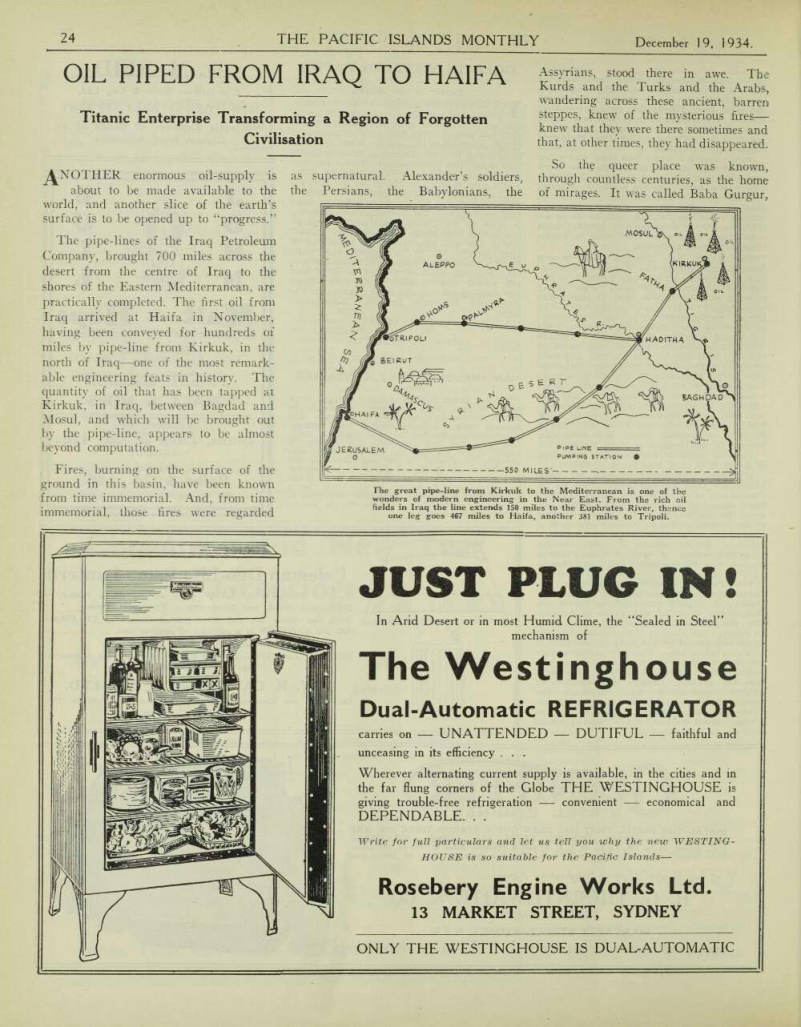
The great pipe-line from Kirkuk to the Mediterranean is one of the wonders of modern engineering in the Near East. From the rich oil fields in Iraq the line extends 150 miles to the Euphrates River, thence one leg goes 467 miles to Haifa, another 381 miles to Tripoli.
and people came long distances to con sult the oracle. They applied light to a stone. If it burst into flame, the pil grim’s wish would be granted; if not, the pilgrim went away disappointed. But he might try the same stone again.
Sometimes the stone took fire—some times it did not.
Then came the age of science and machinery. Men searched the surface of the globe for oil. Unimaginative Europeans heard of the mysterious fires of Baba Gurgur, and, in one minute, diagnosed the presence of gas. In five minutes, on the spot, they demonstrated how the sun-heated surface rocks, under certain conditions, could periodically set alight to the gas.
Hard on the heels of engineers and geologists came drills and derricks. Be
fore the first drill at Baba Gurgur was down 140 feet, it found a gusher—a phenomenal occurrence. Apparatus to seal it up had to be rushed in by aero plane. It is calculated that in the inter vening week, the company lost one mil lion pounds worth of oil, spread all over the surrounding country. Since then, up to the middle of 1933, they have proved 30 wells, from 2000 to 6000 feet deep.
They have been sealed up, awaiting the completion of the pipe-line.
A great new industry is taking birth.
In a very few years, this desert land will have been transformed. Already, thousands of nomad Arabs and desert dwellers, rovers and raiders for countless generations, have deserted their ancient camp-fires to become labourers at the wells and on the pipe-line. Mr. Nairn, formerly an Australian soldier, who passed through Sydney recently, is now the managing director of a great
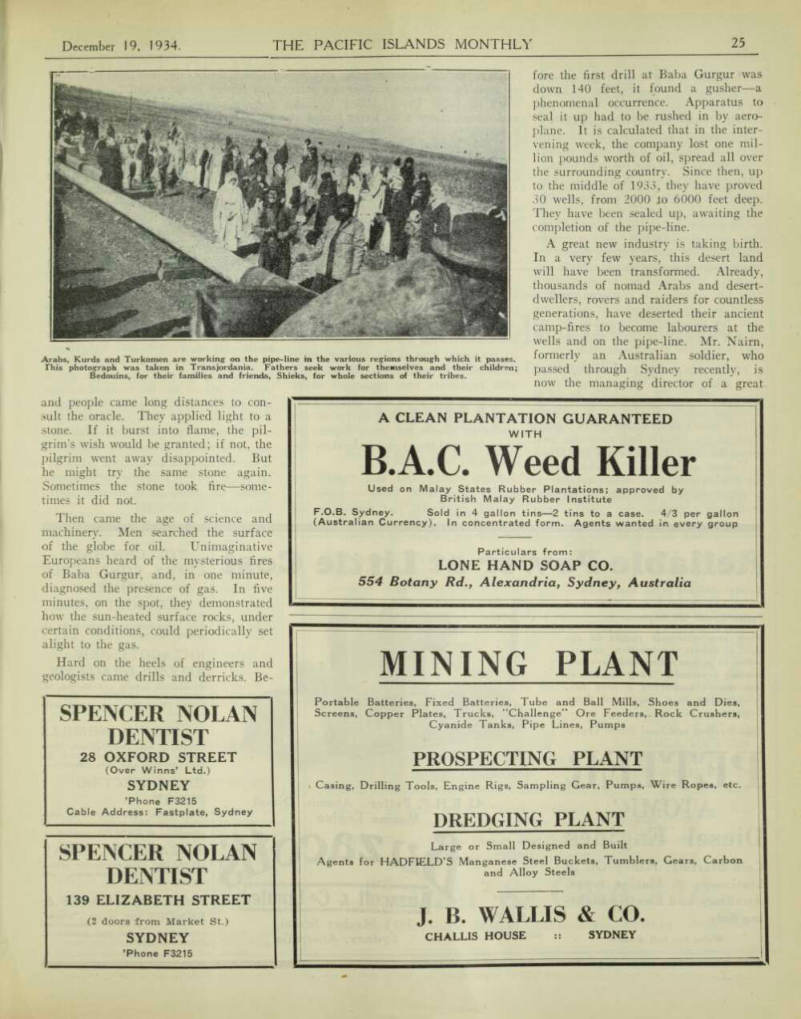
Arabs, Kurds and Turkomen are working on the pipe-line in the various regions through which it passes.
This photograph was taken in Transjordania. Fathers seek work for themselves and their children; Bedouins, for their families and friends, Shieks, for whole sections of their tribes.
line of motor-vehicles, carrying passen gers and freight, which run with railway train regularity between Haifa and Damascus, in Palestine, and Bagdad.
The inter-Continental lines of aero planes fly daily over the same country
—Bagdad is a regular stopping place.
In a few years, travellers between Aus tralia and Europe will leave the steamer at Port Said and will wander comfort ably over the legendary lands of Pales tine and Mesopotamia —over a region that to-day is mostly barren desert but which to-morrow may be wheatfields and orchards. The endless orange-gardens near Los Angeles, in Western America, would not have been possible had it not been for the wealth introduced by the oil-derricks, which are scattered so thickly over the same countryside.
The new pipe-line from Kirkuk runs in a south-westerly direction to Fatha, crossing the Tigris gorge, and thence to Haditha on the Euphrates, a distance of 150 miles, where it bifurcates. From Haditha the French fork runs due west across the desert, past Palmyra and Homs to Tripoli on the sea (425 miles); while the British fork (525 miles) extends in a south-westerly direction to Rutbad, continuing between the Syrian and
Najd-Hijaz desert boundaries, crossing the Iraq-Trans-Jordan frontier to a point south of Jabal Druze, called Mafrak, and thence, crossing the River Jordan at Samakh, to Ftaifa. The whole system will have eleven pumping stations, one at Fatha, one at Haditha, four on the French and five on the British line.
The steel pipes, weighing a ton each, are carried by six-wheel lorries across what is mostly a rocky waterless waste, up hills and down wadis; and after drop ping them along the line at every ten yards, the lorries return to the base camp. The journey between the last pipe and the camp lengthens as the work proceeds.
After the pipes are thus strung, the Arab laborers dig a trench to bury them.
By no means easy is the digging, for it has to be done at times through solid rock with explosives and pneumatic drills.
Even more difficult is the welding, which requires a shifting electrical plant and cranes to handle the heavy pipes; and when they are thus welded together, they are buried in the trench.
After having laid and welded and buried about thirty miles of pipes, the parties, engineers, and mechanics and
laborers, strike camp and move to another spot farther in the desert.
This titanic enterprise was begun simultaneously from four bases, from Kirkuk and Fatha in Iraq, from Mafrak in Trans-Jordan, and from Tripoli in Syria, thus working from east to west and from west to east; and when it is in full swing, there will be 20,000 labourers on the different lines. The whole system will require 120,000 tons of pipe and will cost about £10,000,000.
A gigantic enterprise, a unique enter prise, a romantic enterprise! For it is bound to transform the economic and social life of the people whose country it penetrates. The pipe-line traverses the land that was the cradle of history, of religion, and of romance. From the battlefields of Assyrian and Babylonian, of Persian and Greek, under the two historic rivers, across the barren waste, over the graves and the ruins of nations and empires, of civilisations and creeds, through the lava drift of extinct vol canoes, across the desert of Mahomet, the wilderness of Moses, the haunts of Jesus, the hand of man, allied with capi tal and science, is bringing the bounteous stream, the living oil of modern life to many parts of the world.