Ngata In Political Storm
pp. 23-25 · Read in the full issue
Head of Famous Maori Leader is “Bloodied but Unbowed”
By Eric Ramsden
THE resignation of Sir Apirana Ngata from the New Zealand Ministry is an event of significance to students of Poly nesian history—an event of importance to all, in fact, who are interested in the pro gress and cultural advancement of native races under the British Crown. To the Maori race, his departure at this particular juncture is tragic.
Sir Apirana resigned as a result of a Royal Commission's censure on his ad ministration of Maori land settlement schemes. He would have preferred, he declared on the floor of the New Zealand House, a criminal prosecution: that would
have given him a better opportunity of defending his honour. The report, he characterised as ‘‘a vicious prosecution.”
As to a charge that “he toured the country like an Eastern potentate,” he suggested that the picture might have been completed by placing him upon an elephant!
“The report puts the picture in such a way that the man outside is shaking his
head and wondering what sort of a man A. T. Ngata is,” he declared. He could hold his head up among his Maori people; but what about the Pakeha? . . . Sir Apirana was particularly incensed at the Commis sion’s reference to his own people, the Ngati-Porou. ‘‘They don’t deserve that,” he declared in answer to a charge of favouritism. “They deserve the commen dation of New Zealand for the part they have played in the reformation of the Maori race.”
“The Maori problem remains to be tackled,” he said, from his seat as a pri vate member, “and any man who is worth his salt has to keep going. I am one, and I propose to keep on until I drop! . . .”
Sir Apirana Ngata, it is admitted, is a great Polynesian. For all time his record will stand. His successor as Native Minis ter is the Prime Minister (Mr. Forbes): he referred to Sir Apirana as “a loyal and up right colleague.” Another Ministerial con frere, the ex-Prime Minister, Mr. Coates, declared Ngata to be “a white man.”
Many people in the Pacific have followed the career of Apirana Turupa Ngata, the
Moses of modern Maoriland. Head and shoulders in intellect above the average Parliamentarian, this diminutive leader from the Ngata Porou, an East Coast tribe,
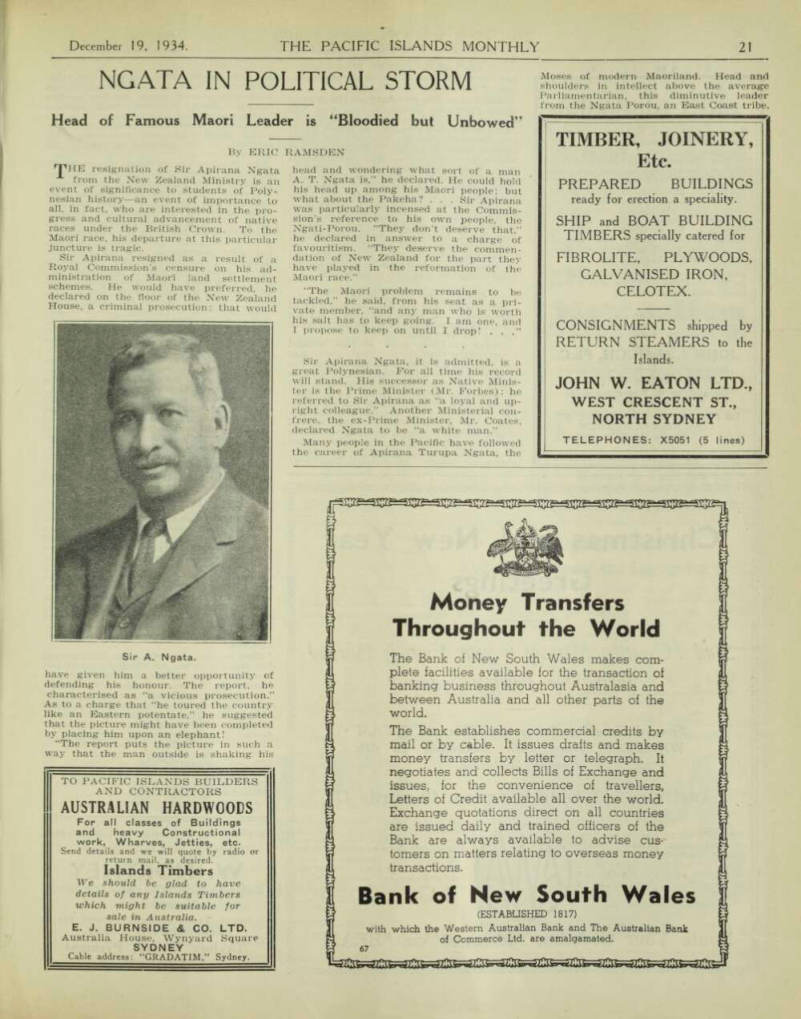
Sir A. Ngata.
has devoted his whole life to the regenera tion of his people, Ngata was the secretary of the Young Maori Party, an influential body that had its genesis at Te Aute College, and pro duced several brilliant men of mixed Maori and European blood. The late Sir Maui Pomare consecrated his life to the physical well-being of his race. Ngata concentrated upon Maori economics. Early in life he realised that if his people were to be saved from extinction as an entity, the only pos sible hope was to persuade them, originally an agricultural race, to return to the land.
Te Rangi-Hiroa (Dr. Peter Buck), another member of that Te Aute group, has since won world renown as an anthropologist and ethnologist. His recent appointment to the directorship of the Bishop Museum at Honolulu is evidence of the scientific achievement of this half-caste Maori.
Maori Butter Factories
But, Ngata was not like the majority of enthusiasts. He knew that Rome had not been built in a day. First, he set to work among his own tribe.
Owing to their more or less isolated geographical position, the Ngati-Porou had not parted with their lands for a song. The country was ideal for sheep and cattle. As leases fell due, Ngata encouraged his tribespeople to farm their own lands.
Groups were formed for that purpose. But ter factories were established. In the course of years, Ngata found himself managing-director of a freezing works. In days gone by, the tribes nearer the centres of population had referred to the Ngati- Porou as “Nati,” or country bumpkins.
But the country cousins showed the path to progress, and soon their butter was commanding good prices on the London market. Among his own people Apirana Ngata was adored; his prestige, or as the Maoris say mana, was unchallenged.
The Maori leader did not confine his activities to the material welfare of his race.
An outstanding scholastic career at Te Aute College and Canterbury College, was followed by his admittance to the bar, and eventual entry into Parliament. Sir Apirana has sat in the House continu ously since 1905; he is now the “Father” of the House of Representatives. Though his life’s work has been the consolidation of native land titles, preparatory to launch ing the communal farming schemes throughout the different tribes, he has also won renown as a poet of distinction and a writer of more than ordinary merit. Folk tales and ancient sagas have been assidu ously collected. Ngata has done every thing possible to preserve the arts and crafts of his gifted race. The school of carving at Rotorua is a tribute to his in terest in that phase of Maori art. Author of many monographs of scientific import ance, he has even written a pamphlet on the evolution of the poi dance, and col lected the songs popular among the Maori soldiers in the Great War.
Incidentally, his services as a recruiter were of the utmost importance during that war. Certain tribes, notably Waikato and Taranaki, refused to enlist until political grievances were settled: the young men preferred, like their fathers of old, to go to prison. At that time the patriotic example of leaders like Ngata and Pomare, and the late Sir James Carroll (Timi Kara) was invaluable.
Ngata The Peacemaker
Ngata has also been a peacemaker.
Not so long ago he brought an ancient weapon down from the north, the tribal domains of the Ngapuhi, and placed it on the marae, or village meeting place at Ohinemutu, Rotorua. It was a friendly gesture on the part of Ngapuhi to the Arawa tribes. The latter had never for given the thrashing inflicted upon them more than a century, ago by Hongi, the great Ngapuhi leader, with Sydney-pur chased guns.
Ngata was at his greatest at Waitangi, last year.
Clad in a piu-piu mat, a flax band around his massive brow, to which was attached the chieftainly feather, he stood and wel comed the representatives of the tribes.
In his right hand was a mere of green stone, a prized tribal heirloom. When Koroki, the young Waikato king arrived, knowing full well that he should have ac cepted a prior invitation from Ngata to visit the East Coast rather than go to Ratana, the so-called “prophet,” the Minister bridged a difficult situation by treating the lad as his son. Though he spoke plainly, even forcefully, Ngata, in effect, turned the other cheek. . . .
At night, the scene was different.
In his shirt-sleeves, piles of correspond ence massed before him, the Minister worked in an improvised office with his secretaries. No longer was he the ariki, the over-lord, the leader of ceremony, a stickler for tradition; here was a capable man of affairs, the business head of a great organisation, one of His Majesty’s responsible Ministers.
Still, though a truce had been called for the Waitangi celebrations, there was every evidence that the storm, when it broke, would be severe. Certain sections of Maori opinion were undoubtedly jealous of Ngata’s power. Some of the Ngapuhi leaders resented the fact that he stood on their marae to welcome the guests: such a privilege, they contended, was by tradition their own, as hosts.
Throughout New Zealand there was a general call among the European popula tion for Ngata’s scalp. One found it in un expected quarters. A man who never courted popular favour, and at times was unnecessarily brusque (particularly to press representatives!) the Minister’s enemies became legion. Forgotten were his great services of the past. Certain New Zealanders no longer took pride in the fact that Ngata, like Carroll, had held office as acting-Prime Minister. Expendi ture on his native lands settlement scheme had assumed colossal proportions: there were charges of extravagance and im efficiency in administration. The Maori, it was said, could advance to a certain stage, but beyond that he could not go. Ngata, it was contended, was anti-European.
Therefore, he thought only of his own.
Perhaps some of the criticism was just.
A great deal of it was most unjust.
If Ngata was anti-European, we must remember that he had good cause to be.
Thousands of acres of good Maori land had been alienated by confiscation. Ngata had seen the machinery of Parliament utilised to its fullest extent to deprive his race of ancestral acres. Much of it was legalised robbery. Ngata, astute and able, the in tellectual equal of any European, con tended for his people. Who can blame liim?
Whatever his defects, whatever his faults, the Maori race has lost its greatest leader. A mighty totara of the forest has fallen, the prow of the canoe is broken.
But, Sir Apirana Ngata is sufficiently great to survive the blast of the tempest, and not to be embittered by the political storm that has overtaken him. Years of useful service are still ahead of this father of his people.
And into retirement he will take with him the grateful thanks of thousands of Maoris throughout New Zealand, the people of the Cook Islands, and the inhabi tants of other groups in the Pacific, to whom indeed he has been a trusted friend and an able administrator.